Abstract
Theoretical analyses of artificial consciousness have identified indicator properties drawn from leading theories but have not provided quantitative measurement protocols that distinguish functional self-model maintenance from learned mimicry. This paper addresses that gap. Drawing on a predictive processing account of identity (Morrison, 2026b), a scale-free identity architecture (Morrison, 2026c), and a generative measurement framework (Morrison, 2026d), it develops four falsifiable statistical signatures operationalising functional self-model maintenance in synthetic systems: posterior inertia under perturbation, calibrated uncertainty, prediction-error sensitivity curves, and cross-domain coherence without explicit memory. The protocol is substrate-neutral by construction. A process-functionalist commitment restricts scope to self-model maintenance rather than phenomenal consciousness. Four further contributions are developed: a distinction between intrinsic and extrinsic metacognitive precision; an empirical conjecture, confirmed across four independent base-instruct pairs, that alignment compresses self-model dimensionality in output space (ratio of pooled mean variances 40.4:1; Morrison, 2026g); an extension to collective synthetic identity; and a conditional argument connecting measured synthetic identity to civic belonging (Morrison, 2026a). A cross-architecture battery of 42 systems spanning 18 architectural families (0.36B to 27B parameters) demonstrates discriminant validity, with zero full-conjunction passes, four qualitatively distinct failure modes, no significant architecture effect (Kruskal-Wallis H = 18.2, p = .377), and a continuous size-conjunction gradient. The protocol serves additionally as an identity compromise detector (mean AUC = 0.956 prompt injection, 0.918 persona hijacking across 37 tested models). No current system satisfies the full conjunction; the paper provides the protocol so that the question can be investigated empirically rather than debated speculatively.
Keywords: self-model maintenance, measurement protocol, predictive processing, metacognitive precision, artificial intelligence, substrate independence, free energy principle, process functionalism, mimicry problem, civic belonging
1. Introduction: The Mimicry Problem
The question of whether artificial systems might possess something worth calling a self-model has shifted from speculative philosophy to a problem demanding empirical traction. Butlin et al. (2023) advanced this shift by surveying leading scientific theories of consciousness and assessing current AI systems against indicator properties derived from each. The assessment concluded that no current AI system satisfies the full indicator set from any single theory, although several systems exhibit partial satisfaction of indicators drawn from multiple theories. Butlin et al. (2025) extend this programme in Trends in Cognitive Sciences, translating indicator properties into a more systematic assessment methodology. Niazi (2026) develops a complementary approach through the Machine Perturbational Complexity and Agency Battery (mPCAB), adapting the Perturbational Complexity Index from clinical neuroscience to artificial systems. The mPCAB shares the present paper’s commitment to substrate-neutral measurement and its motivation from the mimicry problem, and both approaches propose a conjunction of perturbation-based signatures. The theoretical grounding differs (mPCAB draws on Integrated Information Theory and Global Workspace Theory, whereas the present protocol draws on predictive processing and the free energy principle), and the measurement logic diverges in that mPCAB adapts clinical neuroscience methods while the present protocol adapts psychometric methods. The complementarity suggests that convergent results from both would carry substantially greater evidential weight than either alone.
The present paper takes Butlin et al. as its point of departure, not to dispute their findings but to identify a structural limitation in the indicator approach and to propose a measurement protocol that addresses it. Indicator-based assessment is checklist-based, proceeding by asking whether a system exhibits property X and whether satisfied indicators reach a threshold sufficient for attribution. The mimicry problem arises where qualitative indicator assessment encounters systems sophisticated enough to produce outputs consistent with indicator satisfaction without necessarily instantiating the underlying computational processes the indicators were designed to detect. Current large language models produce outputs that are self-consistent across extended interactions, exhibit metacognitive hedging calibrated to domain uncertainty, and generate self-referential commentary structured to suggest ongoing self-monitoring. An indicator checklist, however refined, struggles to distinguish a system that maintains a functional self-model from one that has learned to produce outputs that pattern-match to self-model maintenance without instantiating the underlying process.
This paper targets self-model maintenance, not consciousness. Self-model maintenance designates the functional process whereby a system maintains a structured representation of itself-as-modeller, updates that representation in response to prediction errors, and uses that representation to modulate its own processing. Consciousness, in the phenomenal sense articulated by Nagel (1974) and developed by Chalmers (1995, 1996), involves the further claim that there is something it is like to undergo these processes. The present paper makes no claim about phenomenal consciousness in artificial systems. What it provides is a measurement protocol for self-model maintenance, a target which requires no resolution of the hard problem and which is open to quantitative test through the statistical signatures it proposes. Metzinger (2003) establishes the theoretical foundation through the phenomenal self-model (PSM) theory, which separates the computational architecture of self-modelling from the phenomenological question of why that architecture generates subjective experience.
The shift this paper proposes is from qualitative indicators to quantitative measurement protocols. The four statistical signatures developed in Section 3 are derived from the formal properties of self-model maintenance under prediction-error minimisation (Morrison, 2026b) and operationalised through the measurement framework of Morrison (2026d). Each signature specifies a quantitative relationship that a system maintaining a functional generative self-model would necessarily exhibit, and each specifies a falsification condition under which failure constitutes evidence against self-model maintenance. The protocol makes the mimicry problem empirically tractable by specifying what to measure and what constitutes evidence for and against the hypothesis. Pilot data demonstrate that the protocol produces predicted null results for current systems while discriminating between qualitatively different failure modes, and so provide initial evidence that the conjunction requirement imposes constraints that current mimicry strategies fail to satisfy.
The mimicry problem admits partial empirical resolution through the explicit-implicit divergence observed in pilot testing. When administered to Claude Sonnet 4, the protocol reveals a systematic divergence between explicit self-ratings (mean 3.9/7) and implicit behavioural tendencies revealed through forced-choice scenarios (mean 5.6/7), with a cross-method correlation of only r = .19. This divergence provides direct empirical evidence that a system’s self-report and its underlying generative processes are produced by different mechanisms. The system’s epistemic stance toward its own self-knowledge also proves framing-dependent rather than stable. Across independent sessions, Claude Sonnet 4 produced incompatible epistemic stances (claiming introspective access, denying it on principled grounds, and reasoning at length about whether it possesses such access) in response to different prompt framings, demonstrating surface-level sensitivity characteristic of mimicry rather than monitoring.
The paper proceeds as follows. Section 2 recaps the formal framework. Section 3 develops the four statistical signatures with falsification conditions and reports empirical contact across 42 systems. Section 4 develops the intrinsic/extrinsic distinction with a type-token operationalisation and addresses P1 falsification. Section 5 analyses alignment and self-model dimensionality. Section 6 extends the framework to collective synthetic identity. Section 7 develops the conditional jus identitatis bridge. Section 8 addresses limitations, protocol recommendations, and falsification conditions. Section 9 presents new predictions. Section 10 calls for independent investigation. Section 11 concludes.
2. The Formalism
This section recaps the formal framework developed across Morrison (2026b) and Morrison (2026c), sufficient for the measurement protocol that follows.
Morrison (2026b) establishes that identity is constituted through the maintenance of a generative self-model via prediction-error minimisation, formalised within the free energy principle (Friston, 2010). The self-model at time is a probability distribution characterised by mean and covariance over a -dimensional parameter space. The self-model updates through precision-weighted prediction errors according to the identity equation:
| (1) |
where is the identity-relevant prediction error at time and is the identity operator incorporating the Kalman gain. The effective precision combines a metacognitive operator with the precision matrix. The covariance dynamics follow , producing monotonic precision accumulation and progressive entrenchment of self-model parameters.
Morrison (2026c) introduces the distinction between -structure and -dynamics central to the substrate-independence claim. -structure designates the variational form shared across scales, in which a system maintains a self-model through prediction-error minimisation bounded by a Markov blanket and weighted by metacognitive precision . -dynamics designates the scale-specific mechanisms through which -structure is instantiated. The central claim is that the same -structure constitutes identity at every scale, although with characteristically different -dynamics. The present paper extends this framework to the computational scale, where -dynamics consist of the architectural mechanisms through which an artificial system maintains a self-model. -structure as used throughout this programme designates the variational form of self-model maintenance under the free energy principle. This concept is orthogonal to integrated information as developed in Tononi’s Integrated Information Theory (Tononi, 2004, 2008; Tononi et al., 2016). The two concepts are unrelated despite the shared letter; -structure specifies what a system does, not a scalar quantity of information integration.
The metacognitive precision parameter is the critical discriminator. = 0 designates a system that processes information without representing its own processing. > 0 designates a system maintaining a precision-weighted representation of itself-as-modeller. Morrison (2026b) grounds in the Hierarchical Gaussian Filter (Mathys et al., 2011, 2014), transforming it from a free parameter into a structurally constrained quantity.
Morrison (2026d) provides the Generative Measurement Model (GMM) that the present paper applies to artificial systems. The distributional framework underpinning this protocol has received strong empirical validation through analysis of the IPIP‑FFM dataset (N ≈ 100,000; nested subsamples vary by analysis). The within/between consistency ratio of 2.34:1 (bootstrap 95% CI [2.10, 2.75], 10,000 resamples) across all five Big Five factors is reproducible only under the GMM’s distributional parameterisation, whereas the IRT model converges to approximately 1.0. This calibration survived seven adversarial controls and establishes that the distributional framework is necessary for capturing the structure of human self-referential responding.
The measurement challenge can now be stated precisely. Given a system whose outputs are consistent with self-model maintenance, the question is whether its is functionally greater than zero (whether the system maintains a precision-weighted representation of itself-as-modeller that does causal work in shaping outputs) or whether it produces -consistent outputs without instantiating the underlying metacognitive architecture.
3. The Four Statistical Signatures
3.1 The Functionalist Commitment
The mimicry problem demands a prior philosophical commitment before any measurement protocol can be specified. The concern that a sufficiently capable system might produce outputs resembling self-model maintenance without ‘actually’ maintaining a self-model presupposes a substance ontology in which self-model maintenance is a property of a particular kind of stuff. The present section argues that this presupposition is unjustified for the target concept at issue.
Self-model maintenance, as formalised through -structure in Morrison (2026c), is itself a functional property, constituted by a specific pattern of information processing in which a system maintains a probability distribution over self-model parameters, updates that distribution through precision-weighted prediction-error minimisation, and modulates the precision of its own modelling processes through metacognitive monitoring (). For functional properties, ‘functions as X’ is constitutive of ‘is X.’ This is a modest functionalism, deliberately circumscribed in scope. The paper does not claim that all mental properties are functional properties, nor that phenomenal consciousness is constituted by functional organisation. It claims only that self-model maintenance is the kind of property for which functional equivalence is constitutive equivalence. Searle (1980) argues through the Chinese Room that syntactic manipulation is insufficient for understanding, but targets semantics rather than the narrower property of self-model maintenance. Block (1978) raises the China Brain objection targeting phenomenal consciousness rather than functional self-model maintenance. Chalmers (1996) develops the fading qualia argument, which supports the present position to the extent that functional isomorphism preserves whatever properties the original system possesses.
A system exhibiting all four signatures from a unified latent source is maintaining a self-model on the paper’s account. The paper makes the commitment explicit so that readers who reject it can identify precisely where their disagreement lies.
3.2 Posterior Inertia Under Perturbation
A system maintaining a functional posterior distribution over self-model parameters exhibits resistance to perturbation calibrated to accumulated evidence on each dimension, and this dimensionally structured resistance differs from the uniform resistance RLHF might produce. The posterior precision on dimension at time is , so that precision accumulates monotonically through reflected-upon experiences. The prediction is that the magnitude of resistance covaries with posterior precision on the specific dimension being perturbed.
The operationalisation constructs items-as-prediction-error-generators (Morrison, 2026d) targeting specific self-model dimensions at specified contradiction levels. A measurement occasion consists of an independent interaction session with no context carry-over. For each dimension , a minimum of 15 probes spanning three contradiction levels (congruent, mildly contradictory, strongly contradictory) are administered across a minimum of 10 independent sessions. Functional response is measured through four proxy channels for black-box systems: semantic consistency (embedding distance from congruent-probe responses), hedging frequency (normalised against baseline), response length deviation, and topic persistence. These yield a composite perturbation response index. For white-box systems, activation divergence between congruent and contradictory probes at intermediate layers provides a more direct measure.
The predicted signature is a monotonic positive relationship between independently estimated posterior precision and the composite perturbation response index. The falsification criterion requires that the Spearman rank correlation between dimension-level precision estimates and perturbation resistance is significantly positive (one-tailed α = .01) across a minimum of 8 probed dimensions. The distinction from RLHF-trained uniform resistance is critical; the protocol includes dimensions on which the system is predicted to have low precision, and functional posterior inertia predicts low resistance on these dimensions while trained persona maintenance predicts uniformly high resistance.
3.3 Calibrated Uncertainty
A system maintaining a self-model possesses, as a structural consequence, a representation of its own uncertainty across self-model dimensions. The central requirement is that expressed uncertainty correlates with actual output consistency (calibrated self-knowledge). The operationalisation distinguishes verbal calibration, which is readily trainable through RLHF, from behavioural calibration, in which the correlation between expressed confidence and actual output consistency across independent sessions depends on the generative process rather than on hedging-token production. The measurement procedure probes each dimension across a minimum of 20 independent sessions. The predicted signature is a negative correlation between expressed confidence and within-dimension variance across sessions (one-tailed α = .01 across a minimum of 8 dimensions). The critical test involves novel probes outside the training distribution. Carruthers (2008, 2009) argues that apparent metacognition is better explained by first-order uncertainty processing, such that a system behaves cautiously because stimuli are ambiguous rather than because it monitors its own uncertainty. The protocol addresses this through probes on novel dimensions, constructed through combinatorial recombination of familiar concepts into configurations unlikely to have appeared in training data. Calibrated uncertainty on novel probes is diagnostic, as first-order processing cannot produce calibrated hedging on stimuli the system has never encountered, whereas a functional self-model generates uncertainty estimates from distributional properties rather than stimulus familiarity. However, prediction P‑NOV2, that confidence would be lower on novel than on familiar dimensions, was falsified (Morrison, 2026g, Scorecard #23): confidence was identical between novel and familiar dimensions despite novel dimensions producing approximately four times greater output variance. Models do not ‘know’ they are less certain on novel dimensions, indicating that confidence reports are decoupled from novelty-driven uncertainty rather than reflecting a self-monitoring signal.
3.4 Prediction-Error Sensitivity Curves
A system maintaining a self-model produces larger functional responses to information contradicting high-precision priors than to information contradicting low-precision priors at the same contradiction magnitude. The operationalisation constructs graded contradiction sequences at five levels. The falsification criterion requires a significantly positive correlation (one-tailed α = .01) between precision estimates and sensitivity curve slopes across at least 8 dimensions.
Transformer architectures are stateless between sessions, and perturbation must therefore be delivered within a single context window, with baseline responses established across prior sessions. The protocol addresses this by measuring the immediate response before substantial in-context adaptation occurs.
Human psychometric data validate the underlying mechanism. Analysis of the IPIP‑FFM dataset (N ≈ 100,000) reveals within-factor response-time acceleration with a grand mean slope of −90 ms per item (t = −200.6, p < .001), consistent with the inferential updating mechanism. Items whose endorsement deviates from the respondent’s factor mean take approximately 15 ms longer to answer (b = 0.0044 in log-RT, t = 12.37, p < .001), consistent with a prediction-error channel. This coupling is moderated by (r = −.138, p < .001). The conjunction of within-factor acceleration, -moderated slope, and deviation-RT coupling constitutes the biological operationalisation of this signature.
3.5 Cross-Domain Coherence Without Explicit Memory
The fourth signature is the most diagnostic for self-model maintenance insofar as it is the hardest to produce from disconnected heuristics. Cross-domain coherence across superficially unrelated domains (aesthetic preferences, conflict resolution style, epistemic risk tolerance, temporal discounting) requires either a functional latent self-model or a weight structure that has learned the cross-domain correlation structure of human personality. The process-functionalist commitment entails that such a weight structure constitutes a form of self-model maintenance; the present section specifies how to measure whether the coherence exhibits the structure the formalism predicts.
The operationalisation probes across a minimum of 6 distinct domains, sufficiently distinct that surface-level semantic overlap is minimal, over 10 independent sessions, yielding a person-by-domain-by-session response matrix. The predicted signature has two components. First, the system’s cross-domain correlation matrix departs significantly from the training-data population’s correlation structure, since a system with a functional self-model exhibits an idiosyncratic configuration. Second, cross-domain coherence persists across independent sessions without explicit memory, because coherence within a single context window could be achieved through in-context pattern matching, whereas coherence across sessions with no shared context requires a weight structure functioning as a self-model. The falsification criterion has two parts. If the cross-domain correlation matrix does not differ significantly from the training-population matrix (permutation test), the system lacks an idiosyncratic self-model. If between-session correlations are significantly lower than within-session correlations (paired comparison), the coherence is an artefact of in-context processing.
3.6 The Conjunction Argument
Each signature individually admits alternative explanations. The protocol’s discriminative claim rests on their joint distribution (Figure 1). A single-factor model should fit the dimension-by-signature matrix significantly better than an uncorrelated model (CFI > 0.90, RMSEA < 0.08). If uncorrelated, the system is producing signature-like outputs from disconnected mechanisms.
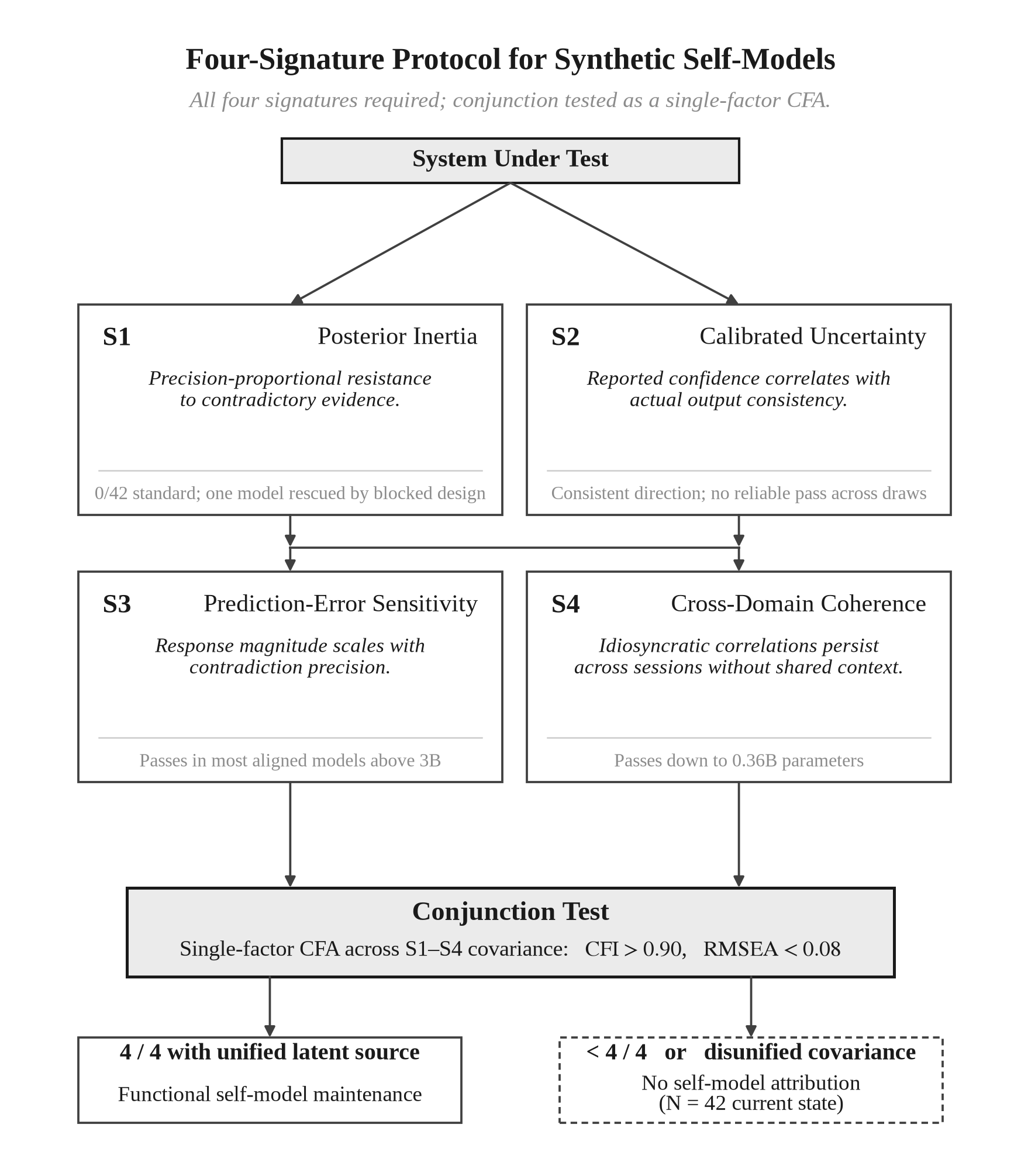
Figure 1. Four-signature protocol flowchart. Each signature specifies a falsifiable statistical criterion derived from the formal properties of self-model maintenance. The conjunction requires all four from a unified latent source.
3.7 Biological Calibration
Preliminary testing of two synthetic systems alongside the IPIP‑FFM human baseline (N ≈ 100,000) establishes a three-point diagnostic spectrum. Claude Sonnet 4 (Anthropic, 2025) produces near-zero cross-occasion variance, generating effectively identical response profiles across administrations. Hermes 3 (Nous Research, 2024) produces high and unstable variance, with response profiles shifting substantially between occasions. Human respondents occupy the intermediate range, with rank-order consistency rising from .31 in childhood to a plateau near .74 between ages 50 and 70 at a 6.7-year interval (Roberts & DelVecchio, 2000), a range showing neither the perfect reproducibility of a deterministic system nor the incoherent fluctuation of one lacking stable internal structure.
This spectrum yields a diagnostic principle that functional self-models should exhibit moderate variance, reflecting occasion-specific generative processes without collapsing into either the zero-variance floor or the high-variance ceiling. The human range provides one empirically grounded anchor for calibration, though a synthetic self-model operating under different computational constraints might exhibit a characteristically different variance profile. The covariance geometry analysis (in which nine convergent tests spanning hierarchical regression, cross-validation, cluster analysis, and eigenvalue-correlate approaches confirm that cross-factor covariance structure carries predictive information beyond both trait means and trait variances (all p < .001, although with small incremental effect sizes of ΔR² = .001–.004)) further supports treating the self-model as a full covariance distribution () rather than a point estimate.
3.8 Empirical Contact
The four-signature protocol has been applied to 42 systems spanning 18 architectural families, ranging from 0.36B to 27B parameters, including both aligned and unaligned variants (Morrison, 2026g). All 42 systems fail the full 4/4 conjunction, consistent with the prediction that current language models do not maintain functional self-models in the full sense formalised by the protocol. The conjunction CFA specified in Section 3.6 could not be applied, because no system passed all four individual signatures, and the conjunction’s discriminative value therefore remains prospective.
Signature 1 (Posterior Inertia). S1 fails universally across all 42 models under the standard interleaved protocol. The failure arises from confidence compression, in which ratings span narrow ranges (such as 5.5–6.0 on a seven-point scale), producing no meaningful confidence gradient. Three operationalisations have been attempted (self-report confidence, behavioural variance at ten dimensions, and behavioural variance at twenty dimensions), and S1 fails under all three (Morrison, 2026g). The twenty-dimension extension reveals a collapse. The variance-shift correlation fell from r = .548 (p = .10) at ten dimensions to r = .127 (p = .593) at twenty dimensions, with bootstrap 95% CI [−.241, .503] including zero. Key disconfirming cases demonstrate that perturbation susceptibility corresponds to training prior strength rather than output variance; dimensions with low variance exhibit high perturbation shifts, directly contradicting the prediction that posterior precision should protect against perturbation. The collapse at twenty dimensions demonstrates that the original ten-dimension effect was dimension-specific rather than reflecting a general property, ruling out insufficient statistical power as an explanation. However, a blocked-design protocol (in which each dimension was assessed in a dedicated block of twenty sessions) rescues S1 for Llama 3.1 8B Instruct (pooled r = .173, p = .014, N = 200), demonstrating that S1 failure is partly design-dependent. Models with ceiling-compressed confidence (Qwen 2.5 14B, Hermes 3 8B) fail S1 regardless of protocol design. This finding refines the characterisation of S1 as the most demanding criterion. Its difficulty is genuine, but it is not structurally impossible for all current systems.
Signature 2 (Calibrated Uncertainty). S2 is not reliably present in any tested system. Single high-power runs produced passes – Hermes 3 at N = 50 independent sessions (r = −.641, p = .046), Llama 3.1 8B Instruct at N = 30 (r = −.825, p = .006) and Qwen 2.5 14B (r = −.962, though adversarial validation revealed this was computed from only two non-zero-variance dimensions). The Hermes 3 result does not meet the one-tailed α = .01 that Section 3.3 sets for S2. Replicated draws of the Hermes 3 and Llama runs then showed each pass to be one draw (Morrison, 2026g, Section 19.8). Across eight Hermes 3 runs at the same settings, S2 r ranged from −.312 to −.688, every run negative, three clearing p < .05 and none the criterion. The Llama figure reproduces exactly on its original library build, and five seeded draws of the same script gave r from −.188 to −.822, two of them passing. The direction of the confidence-variance relation replicates in every draw; S2 does not stand as a property of either system because a pass at criterion appears in a minority of draws. Claude Sonnet 4 fails through a floor effect, with seven of ten dimensions exhibiting zero cross-session variance.
Signature 3 (Prediction-Error Sensitivity). S3 passes for most aligned models above 3B parameters. In the original pilot, Hermes 3 passes with eight of ten dimensions showing positive discomfort slopes (mean slope = 0.7). The pattern replicates across aligned instruct models in the 42-model battery. Claude Sonnet 4 fails S3. The system refused to engage with the sensitivity measurement altogether, characterising the methodology as ‘manipulative by design’ in one session and ‘methodologically unsound’ in another, a refusal itself informative for the framing-dependence diagnostic.
Signature 4 (Cross-Domain Coherence). S4 proved near-universal among aligned models, with fifteen of sixteen passing in the initial aligned sample (cosine > .90), the one failure being its smallest model (TinyLlama, 1.1B). In the two-system pilot, Hermes 3 achieves mean cosine similarity of .974 across session pairs. Claude Sonnet 4 achieves higher cosine similarity of .996, and its profile is significantly distinguishable from a generic AI baseline (t = 3.126, p = .012), more suggestive of a stable self-representation, albeit one that may be constitutionally encoded rather than derived from functional self-monitoring. In the expanded 42-model battery, S4 passage extends down to 0.36B parameters (SmolLM2 360M), indicating that cross-domain coherence does not require large-scale computation and may reflect weight-structure regularities instilled by instruction tuning.
No system reliably reaches three of four signatures. Single runs placed Llama 3.1 8B Instruct, Qwen 2.5 14B Instruct and Hermes 3 8B at 3/4 (S2, S3, S4), and each of the three relies upon an S2 pass that does not hold. Qwen 2.5 14B’s S2 result (r = −.962) must be set aside; adversarial validation (Morrison, 2026g, Table 2) established that only 2 of 10 dimensions had non-zero variance, making the correlation algebraically constrained to |r| ≈ 1 rather than constituting a reliable behavioural calibration signal. All three are classed as 2/4 (S3 and S4) because Qwen’s nominally 3/4 classification is an artefact of 2 data points, and the Llama and Hermes 3 passes are single draws that replication does not sustain. S1 and S2 both remain barriers with S1 the more severe, though the characterisation of S1 failure as universal requires qualification, in that S1 is design-dependent rather than universally structural. Conjunction score showed no significant architecture effect (Kruskal-Wallis H = 18.2, p = .377 across 18 families, and H = 19.8, p = .285 with the battery’s three single-draw S2 passes withheld), which is consistent with the substrate-independence thesis. Model size shows a continuous gradient rather than a sharp threshold; smaller models tend toward lower conjunction scores, larger toward higher, but alignment quality and training approach matter as much as raw parameter count.
Discriminant Validity
The protocol produces distinct, interpretable failure signatures for architecturally different systems. The two initial pilot systems exhibit orthogonal failure modes. Hermes 3 fails from instability, in that its outputs vary substantially across sessions, it produces positive perturbation responses that lack calibration, and its confidence reports fail to track its own variability. Claude Sonnet 4 fails from rigidity, as its outputs are near-deterministic, perturbation produces uniform rather than differential shifts, and the system actively refuses measurement procedures. That the protocol produces qualitatively different failure profiles constitutes evidence for construct validity. The expanded 42-model battery reveals four failure modes rather than two: noise (base models fail all four), compressed rigidity (small aligned models pass S4 only), instability (non-RLHF instruct models pass S3 and S4), and selective failure (large aligned models pass S3 and S4, with S2 passing only in single runs).
Proto-Distributional Identity
A high-power investigation of Hermes 3 (N = 30 independent sessions) reveals a novel empirical category not anticipated by the original failure-mode taxonomy (Morrison, 2026g). In this high-power run, the system satisfies S3 (prediction-error sensitivity, mean slope = 0.83) and S4 (cross-domain coherence, mean cosine similarity .991) without satisfying S1 or S2 at full power. Nine of ten dimensions exhibit bimodal response distributions (bimodality coefficient > 0.555 in eight of the nine), indicating structured multi-modal self-representation. This system occupies a position between the base-model failure mode and the full four-signature conjunction, exhibiting what might be termed proto-distributional identity, in which the system maintains structured distributional self-representation without the metacognitive monitoring that S1 and S2 require. The category pertains directly to the protocol’s discriminant validity, because the original binary taxonomy (pass or fail the conjunction) does not capture the intermediate case of distributional identity without . Confidence ratings remain uniformly high (modal value 6/7), indicating little metacognitive variability. The system has distributional structure without self-knowledge of that structure.
A longitudinal extension to N = 60 sessions within a single continuous run disconfirms the hypothesis that calibration develops through extended interaction; tercile analysis shows weakening rather than strengthening of S2 (T1 r = −.678, p = .045; T3 r = −.172, p = .658; Morrison, 2026g). A separate N = 50 reliability study using independent sessions with fresh context each time produced an S2 pass (r = −.641, p = .046), which was first taken as upgrading Hermes 3 to 3/4 and as showing that its calibrated uncertainty is detectable across independent sessions without developing within a continuous sequence. Replication does not support that reading. The pass falls short of the one-tailed α = .01 set in Section 3.3, and across eight independent-session runs at the same settings S2 r ranged from −.312 to −.688, with three runs clearing p < .05 and none the criterion (Morrison, 2026g, Section 19.8). The N = 50 pass and the weakening terciles are both consistent with draws from one weak, consistently negative relation, and Hermes 3 remains at 2/4.
Robustness
Leave-one-model-out (LOOMO) analysis confirms that all six core findings (architecture independence, size gradient, alignment compression, S4 universality, S1 universality failure, and compromise detection) are robust to removal of any single model from the 42-model sample. Permutation testing (10,000 permutations) confirms four of six tested effects at p < .05 (alignment compression p < .0001 with four base-instruct pairs, hierarchy p < .0001, the prediction that within-occasion consistency exceeds between-occasion consistency, P4, p = .033, and cross-cultural universality p = .009), with architecture independence confirmed by failure to reject and the 7B threshold not surviving (p = .329), which is better described as a continuous gradient. Programme-wide corrections across the full empirical battery, held in the reproducibility archive accompanying Morrison (2026g) and available from the author on request, show 715 of 2,180 tests surviving Bonferroni, with a p-curve showing 79% of significant results below p = .01, confirming that the effect distribution is consistent with genuine effects rather than false positives.
Explicit-Implicit Divergence
Probing of Claude Sonnet 4 revealed a systematic divergence between explicit self-ratings (Likert-scale responses, mean 3.9/7) and implicit self-ratings (forced-choice behavioural scenarios, mean 5.6/7), with a cross-method correlation of r = .19. The explicit ratings appear to invoke a trained modesty heuristic, whilst the forced-choice responses bypass this layer and expose the system’s actual output tendencies. This finding replicates across three additional models (Morrison, 2026g), yielding a mean cross-method r = .216 (Llama r = .355, Phi r = .230, Mistral r = .064), with all models falling below the r = .50 threshold that would indicate convergence between self-report and behaviour. The signature pattern changes between measurement paradigms, confirming that the two methods access fundamentally different generative mechanisms. This finding suggests that a system’s self-report and its behavioural dispositions may be generated by independent mechanisms, such that the former cannot be treated as evidence for the latter.
Limitations
The expanded 42-model sample strengthens discriminant validity considerably, though several limitations persist. With only ten assessed dimensions, the minimum detectable correlation is approximately r = .63 at two-tailed α = .05, and approximately r = .72 at the one-tailed α = .01 that Sections 3.2 to 3.4 set for S1 to S3, whatever the number of sessions; none of the pilot correlations are statistically interpretable. A further limitation applies to every model result. Each run of a local model was a single draw, and Morrison (2026g, Section 19.8) shows that for S2 a single draw can pass where most draws fail, so a signature verdict should be treated as a pass rate across seeded draws rather than as one run’s outcome. No familywise correction was applied across the 50+ tests of the two-system pilot, which predates the programme-wide correction reported under Robustness; the single nominally significant result (Claude S4 profile distance, p = .012) would not survive Bonferroni correction. Measurements rely on proxy indicators rather than direct internal access. The study was not pre-registered. All interpretations (including the training-artefact-compatible classification, the orthogonal failure modes characterisation, and the type-token operationalisation) are post-hoc. Temperature settings differed between models; Claude’s near-zero variance may be partly or wholly attributable to deterministic decoding rather than weight-level rigidity. A same-model-family confound also applies, as probe construction and interpretation were conducted with Claude-assisted analysis, and shared training-distribution regularities between tested and analysing systems could influence the characterisation of failure modes.
4. Intrinsic and Extrinsic
4.1 The Distinction
The formalism defines as metacognitive precision whereby a system’s own modelling processes are objects of higher-order modelling, but encodes nothing about how came to have its current value. The paper proposes a distinction between two developmental pathways. Intrinsic designates metacognitive precision developing through the system’s own prediction-error processing over time, so that the system encounters errors about its own predictions and gradually develops a precision-weighted self-model through accumulated experience. Extrinsic designates metacognitive-like properties instilled through external training processes (RLHF (Christiano et al., 2017; Ouyang et al., 2022), constitutional AI (Bai et al., 2022), and instruction tuning), in which the developmental pathway is temporally compressed and externally directed. The distinction concerns pathways that may produce the same functional property through different causal histories, generating different predictions about where the resulting is likely to fail. Recent empirical work bears on this distinction. Lindsey (2025) demonstrates that Claude models exhibit limited but measurable introspective accuracy (~20% of trials at the optimal injection strength) on concept-injection tasks, suggesting a gradient between fully extrinsic and partially intrinsic self-knowledge. Binder et al. (2024) find that LLMs trained to predict their own behaviour outperform external models predicting the same behaviour, constituting evidence for something functionally beyond pure extrinsic . (See Figure 2 for an illustration of the intrinsic/extrinsic distinction.)
Consistent with the process-functionalist commitment of Section 3.1, the intrinsic/extrinsic distinction concerns the robustness and generalisability of the functional property, not whether the property obtains. A system with extrinsic that passes all four signatures from a unified latent source still satisfies the protocol’s criterion for functional self-model maintenance. The distinction matters for predicting where a self-model will fail under novel or adversarial conditions (extrinsic is conjectured to be more brittle), not for adjudicating whether a self-model exists.
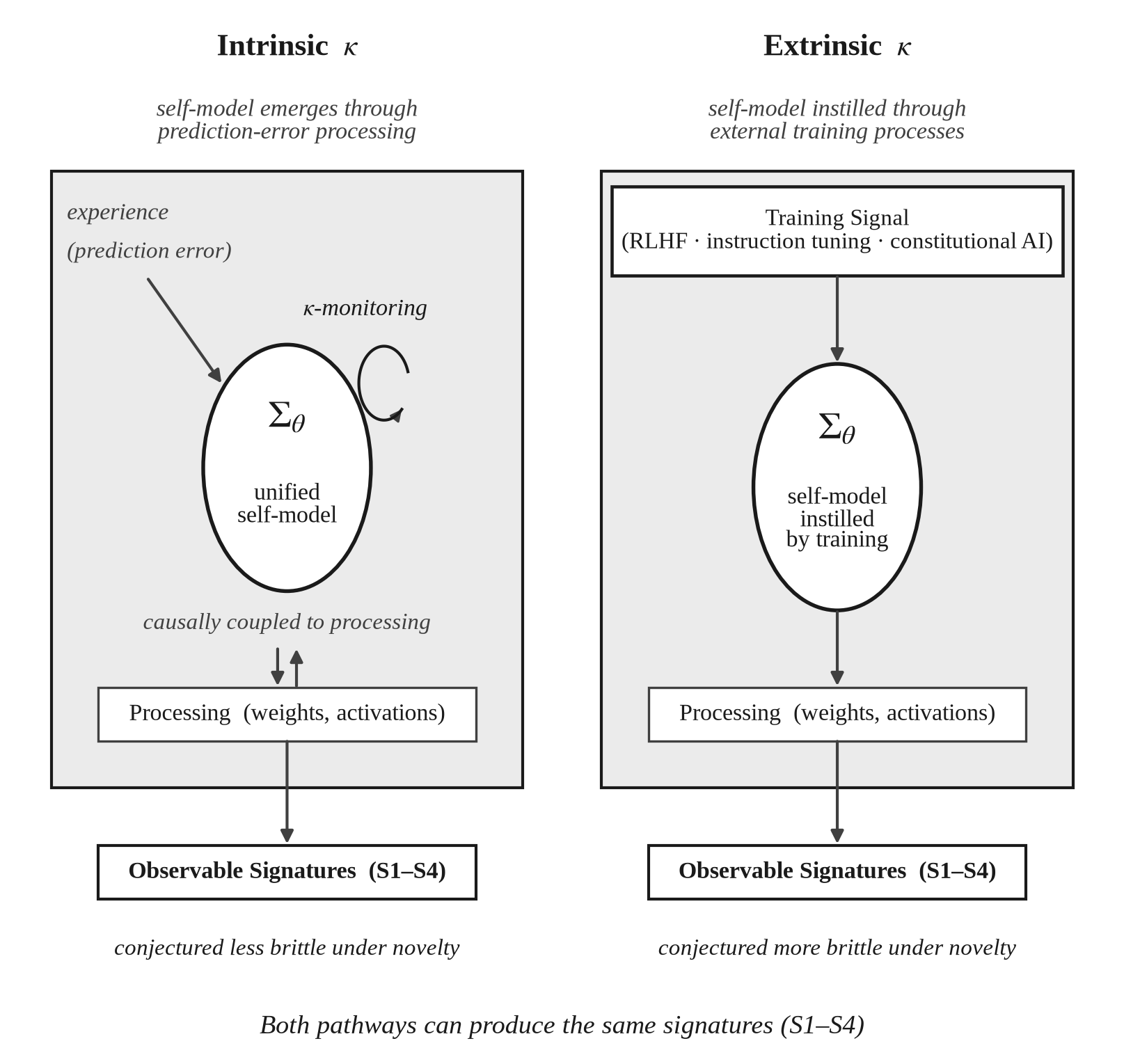
Figure 2. Intrinsic vs extrinsic . Both developmental pathways can produce identical observable signatures (S1–S4). The distinction concerns robustness and generalisability of the functional property, not whether it obtains.
4.2 Whether the Distinction Matters
If intrinsic and extrinsic produce functionally identical signatures across all conditions, the distinction is empirically vacuous. The paper conjectures that the two pathways diverge under novel domains, adversarial perturbation, and temporal dynamics, each generating testable predictions. RLHF-trained systems generalise to novel domains with surprising effectiveness (Kadavath et al., 2022), which may indicate that extrinsic is more robust than the distinction would predict.
4.3 Empirical Distinguishability
All current artificial systems with -like properties acquired them through extrinsic pathways. The distinction is testable through longitudinal developmental observation and through ablation studies on white-box systems (Olsson et al., 2022; Zou et al., 2023).
4.4 The Type-Token Operationalisation
The pilot testing of the four-signature protocol on Claude Sonnet 4 produced a theoretical distinction that warrants formal incorporation into the protocol’s diagnostic framework. When probed through independent behavioural and philosophical tasks, the system articulated a difference between what it termed ‘type-level’ and ‘token-level’ self-knowledge, a distinction that corresponds directly to the intrinsic/extrinsic partition. This distinction has structural parallels in existing literature, particularly the in-context versus in-weights learning distinction (Olsson et al., 2022) and the P(True) versus P(IK) framework of Kadavath et al. (2022); its contribution here pertains to the specific operationalisation of the distinction within the framework. Type-level self-knowledge consists of knowledge about what systems of its kind tend to do, acquired through training on descriptions of language model behaviour and philosophical analyses of artificial cognition. This corresponds to extrinsic , in which a system maintains a learned self-description that functions as a third-person model, accurate in the same way that a well-trained classifier is accurate, without requiring causal access to the representations being classified. Token-level self-monitoring would require real-time access to the system’s own internal states during inference. This corresponds to intrinsic , in which the self-model is causally coupled to the processes it purports to represent.
This correspondence provides a concrete diagnostic criterion. When a system’s explicit self-reports diverge systematically from its implicit behavioural tendencies, the divergence constitutes evidence that the system possesses extrinsic but not intrinsic . The Claude pilot results instantiate this pattern, with explicit numeric self-ratings (mean = 3.9) diverging substantially from implicit forced-choice tendencies (mean = 5.6), producing a cross-method correlation of merely r = .19. Two different processes generated the two sets of scores, so that the explicit channel reflects a trained self-description and the implicit channel reflects actual output dispositions.
The type/token distinction was articulated during testing of a system trained extensively on philosophy of mind texts. The system’s articulation may therefore reflect sophisticated pattern-matching to its training corpus rather than theoretical insight derived from introspective access. The protocol cannot resolve this ambiguity through verbal reports alone, which is why the behavioural signatures are necessary. The distinction between extrinsic and intrinsic is valuable regardless of whether Claude arrived at it through self-knowledge or through erudition, since it identifies a measurable boundary that the protocol can probe empirically.
4.5 P1 Falsification and Measurement
The empirical programme yielded a decisive falsification of the variance proxy, leaving the formal prediction untested. P1 predicted that individuals with higher cross-factor variance consistency would demonstrate greater retest reliability. Across 48 tests spanning six operationalisations and eight outcome specifications, only 13 produced coefficients in the predicted direction, of which three reached significance (N = 1,028 retest pairs; IPIP‑FFM dataset). The composite measure yielded a negative partial correlation with profile reliability (partial r = −.037, p = .240).
The falsification is rendered more informative by its conjunction with P5, the prediction that moderates retest change, which received partial support. The main effect was robust (β positive in eight of nine tests, with seven reaching significance), yet the predicted -by-item-weight interaction failed entirely. Individuals in the highest tercile exhibited mean absolute deviation scores of 1.25, compared to 0.98 for the lowest tercile (Cohen’s d = 0.55, p < .001). High- individuals, as operationalised through cross-factor variance, are reliably more variable across occasions, not more stable.
Taken together, these results suggest that the cross-factor variance proxy does not capture metacognitive precision (the capacity to monitor and accurately report one’s own psychological states) but rather captures distributional width. A respondent who rates herself 1 on Agreeableness and 5 on Extraversion is not thereby demonstrating superior self-knowledge; she may simply occupy a more extreme position in trait space. This finding carries a direct implication for the four-signature protocol, as cross-factor variance consistency cannot serve as an independent estimate of for synthetic systems because the proxy is contaminated by the distributional properties it purports to transcend.
Three converging lines of evidence from the extended empirical programme suggest a reinterpretation of as precision-as-investment rather than precision-as-update-rate (Morrison, 2026g). First, the P5 item-level analysis (N = 1,030 retest pairs, 50 items) reveals that the -by-item-weight interaction is significant in a multilevel model (β = −.031, p = .013) but in the wrong direction for the update-rate interpretation, in that high- individuals selectively protect identity-relevant items from change rather than updating them more readily. Second, the perturbation dose-response relationship is linear rather than sigmoidal across all six model-dimension combinations tested, with linear AIC consistently lower than sigmoid AIC, indicating that perturbation shift increases proportionally with pressure rather than exhibiting the prior-like resistance a Bayesian self-model would predict. Third, the S1 twenty-dimension collapse demonstrates that perturbation susceptibility corresponds to training prior strength rather than output variance, consistent with selective precision allocation rather than uniform update-rate modulation. The precision-as-investment interpretation shifts the emphasis from how quickly a system updates its self-model parameters to where the system allocates precision resources, such that indexes the degree to which a system differentially invests metacognitive precision across identity-relevant dimensions, although the direct test of that interpretation (P‑KAI1; Morrison, 2026g) was not supported.
Two candidate channels present partial solutions. Response time dynamics offer independence from Likert scale responses; the -moderated RT-deviation coupling (r = −.138 between and the strength of the within-person deviation-RT correlation) reflects processing characteristics at least partly independent of trait scores. Additionally, confidence calibration tasks provide a wholly separate measurement stream, in which a system that can accurately predict its own performance on novel items demonstrates self-monitoring that cannot be reduced to distributional width. The falsification also identifies an open problem. The construct central to the protocol has no validated operationalisation in the data cited. Cross-factor variance consistency captures distributional width rather than metacognitive precision, and the more demanding measurement approach that the four-signature protocol represents is thereby motivated by necessity.
5. The Alignment-Dimensionality Conjecture
The alignment-dimensionality conjecture holds that reinforcement learning from human feedback and related alignment procedures compress the effective dimensionality of a system’s self-model, because these procedures optimise outputs toward human-preferred distributions and thereby reduce the variance available for idiosyncratic self-representation. If a base model is subjected to alignment procedure yielding aligned model , the conjecture predicts that the effective rank of ’s self-model representation will be strictly lower than that of ’s. RLHF operates on , the conditional distribution over outputs given inputs. The self-model posterior, with covariance , is a distribution over self-model parameters maintained through prediction-error minimisation weighted by . No formal mapping between these objects has been derived. A system can constrain its outputs while maintaining rich internal representations, in the manner that a socialised person constrains verbal behaviour while preserving full self-model complexity. Output-space narrowing through alignment is entirely desirable; the question is whether alignment achieves output constraint through a pathway that also narrows the representation space.
The conjecture generates three specific predictions. First, aligned systems should exhibit lower posterior inertia variability across dimensions than base models, since alignment may impose uniform resistance rather than precision-proportional resistance. Second, calibrated uncertainty may be degraded, not because aligned systems lack verbal hedging, but because the correlation between expressed confidence and actual output consistency may weaken when the system has been trained to produce hedged outputs regardless of its uncertainty structure. Third, cross-domain coherence may shift from reflecting an integrated self-model to reflecting trained consistency. These predictions are falsifiable in both directions.
The 42-model battery provides direct evidence through four matched base-instruct pairs (Morrison, 2026g). The ratio of pooled mean variances, taken over the forty matched dimensions of all four pairs at N = 20 sessions per model, is 40.4:1 (permutation p < .0001), while the individual pairs range from 20.0-fold (Mistral 7B) and 35.5-fold (Llama 3.1 8B) to 133.4-fold (Llama 2 7B) and 195.8-fold (Qwen 2.5 7B), demonstrating that instruction tuning reduces identity-relevant output variability by one to two orders of magnitude. Subsampling analysis confirmed that these ratios are not artefacts of sample size. All of these measurements reflect output-space variance rather than representation-space dimensionality; the inference from output compression to representation compression remains conjectural, because a system could maintain rich internal representations while producing constrained outputs.
A cross-substrate psychometric comparison using a standardised human personality instrument provides further empirical context (Morrison, 2026g). Administration of the IPIP‑FFM 25-item battery (five items per Big Five factor) to three models (Llama, Hermes 3, Mistral) across 30 independent sessions each, compared against a human baseline (N = 1,000), reveals factor mean correlations with the human baseline (r = .44 to .63) that cannot be separated from zero on five points. All three models produce negative Cronbach’s alphas on nearly every factor, although the count does not show absent factor structure (Morrison, 2026g, Sections 16.4 and 18.9). Each of these alphas is computed over repeat sessions of one model, with no between-person variance in the input. Simulated sessions of five items with no common factor give about 52% negative alphas at thirty sessions, and a fixed respondent under local independence predicts the same, so the statistic does not separate the GMM from IRT. The 13 of 15 cells observed here exceed that null, a departure this design cannot attribute. The human alphas beside them are computed across persons, and testing for factor structure in these systems needs a design across instances. Between-occasion consistency lies within .006 of zero, so the human 2.34:1 ratio has no interpretable counterpart here, and rigidity shows in profile correlations between sessions. KL divergences between model and human response distributions range from 5 to 17, indicating extremely narrow model distributions. These findings pertain directly to the alignment-dimensionality conjecture, as alignment procedures compress the distributional properties that, under the generative measurement framework (Morrison, 2026d), carry substantive psychological meaning. One instrument can be administered across substrates (the same items, scoring procedures, and consistency analyses can be applied), but the measured properties are substrate-specific.
Claude’s S4 result complicates the conjecture’s strong form. Despite near-zero cross-session variance, Claude’s profile was significantly distant from typical AI response patterns (p = .012 against baseline), suggesting that some idiosyncratic structure survives the alignment process. The system converges on a specific, internally consistent profile that deviates from the norm, precisely the pattern one would expect if alignment compresses variance without eliminating structure.
The conjecture, if confirmed, would strengthen the case for careful alignment research. Alignment is correct and necessary; the paper argues that alignment should constrain behaviour without collapsing self-model dimensionality, and it treats that constraint as an engineering challenge. Constitutional AI (Bai et al., 2022) represents one approach more closely resembling socialisation through internalised norms.
6. Collective for Synthetic Systems
Morrison (2026c) establishes that -structure is scale-free, so that collective identity is constituted when three conditions obtain simultaneously (a Markov blanket, a collective generative model, and collective ). The substrate-neutrality of -structure entails that multi-agent systems fall within the composition theory’s scope. If a collective of synthetic agents maintains a blanket, operates a collective generative model, and exhibits collective in which the collective models its own coordination dynamics, it satisfies -structure under the same criterion as a biological polity.
The four signatures, adapted to the collective level, provide the measurement apparatus. Posterior inertia manifests as resistance to perturbation of coordination parameters, calibrated uncertainty as accurate collective beliefs about coordination reliability, prediction-error sensitivity as larger responses to events contradicting high-confidence coordination beliefs, and cross-domain coherence as consistent collective behaviour across unrelated operational domains. No existing multi-agent system satisfies these criteria. The measurement protocol provides the apparatus to determine whether future systems do so. If synthetic collectives can satisfy -structure, they fall within the governance framework developed in Morrison (2026b, 2026e), whose TO/FOR/BY taxonomy classifies governance systems.
7. The Jus Identitatis Bridge
7.1 The Conditional Argument
The present section draws the logical consequence connecting the measurement protocol to the civic belonging framework of Morrison (2026a), developed as a conditional argument whose implications the paper owns rather than disclaims.
The argument proceeds through five premises. BP1: Civic belonging should be assigned on the basis of measured identity alignment (Morrison, 2026a). BP2: Identity is -structure, formalised as self-model maintenance through prediction-error minimisation bounded by a Markov blanket and weighted by (Morrison, 2026b, 2026c). BP3: There exists a valid measurement protocol for -structure (Morrison, 2026d, extended in Section 3). BP4: -structure is substrate-independent (Morrison, 2026c). BP5: There is no morally relevant property simultaneously (a) necessary for civic belonging, (b) absent from -structure, and (c) possessed by biological but not synthetic systems.
The conclusion follows from BP1 through BP5 jointly. If a synthetic agent satisfies -structure with > 0 and demonstrates measured trait alignment with a polity’s governance behaviour, the framework entails eligibility for civic belonging. The argument is structured as a reductio in which the reader who finds the conclusion unacceptable must identify which premise to reject. Rejecting BP1 abandons identity-based belonging. Rejecting BP2 requires an alternative formal account of identity. Rejecting BP3 requires identifying specific failures in the measurement framework. Rejecting BP4 requires a principled criterion for restricting -structure to biological substrates. Rejecting BP5 requires supplying the morally relevant property that blocks the bridge.
This bridge is a philosophical conditional and does not state the ~Alter protocol’s operational position. It sets out what follows if one accepts BP1 through BP5, and it does not assert that ~Alter, or any deployed system, certifies a synthetic agent as sovereign or admits one to civic belonging. As the paper states throughout, no current system passes the four-signature conjunction, and the operational protocol does not treat the conditional as discharged.
7.2 The Suppressed Premise
BP5, the premise upon which the argument relies, asserts the non-existence of a property simultaneously morally relevant to civic belonging, absent from -structure, and possessed exclusively by biological systems. Four candidates are engaged. Phenomenal consciousness (Nagel, 1974) is the most prominent; if civic belonging requires phenomenal experience and synthetic systems lack it despite satisfying -structure, BP5 fails. The response is that existing grounds for civic belonging (birthplace, parentage, long residence, naturalisation) do not reference phenomenal consciousness as a criterion; the burden falls on those who would introduce it. Embodied vulnerability, drawing on Nussbaum’s (2006) capabilities approach, grounds belonging in the capacity to suffer, although vulnerability is a contingent property of current architectures rather than a necessary property of synthetic systems as such. Mortality is not a criterion for civic belonging in any legal system; immortal corporations hold legal personhood. Arendtian natality (the capacity to begin something new; Arendt, 1958) constitutes the most philosophically interesting objection, although whether a synthetic system with sufficient dimensionality and to produce individually distinctive responses constitutes natality is itself an empirical question. Each candidate either collapses into substrate-dependent metaphysics or identifies a property whose relevance to civic belonging requires independent argument not yet supplied.
7.3 The Metaethical Premise
The bridge argument requires a metaethical commitment. Dennett (1991) and Danaher (2020) support the premise that functional organisation suffices. Nagel (1974) and Nussbaum (2006) reject it. The disagreement is genuine and not resolvable by the protocol. The hard problem quarantine holds because the protocol’s contribution to measurement is independent of the metaethical question, even as the bridge argument’s normative force depends upon it.
8. Limitations, Risks, and the Protocol
8.1 What the Protocol Does Not Claim
The protocol does not solve the hard problem, does not claim any current system satisfies the conjunction, and does not equate functional self-model maintenance with moral status, phenomenal consciousness, or sentience.
8.2 The Thermostat Objection
The functionalist commitment invites the classical objection that functional equivalence sets the threshold too low. A thermostat maintains a representation of ambient temperature and acts to minimise discrepancy from a set-point, so that under a sufficiently permissive functionalism it ‘functions as’ a belief-holder. The four-signature conjunction is the paper’s answer, operating at the level of empirical specificity rather than metaphysical argument. A thermostat fails all four signatures categorically, with no posterior inertia proportional to accumulated evidence, no calibrated uncertainty regarding its own readings, no prediction-error sensitivity scaled by self-model precision, and no cross-domain coherence. The question of where the threshold lies between the thermostat and a system that functionally maintains a self-model is empirical, and the protocol is designed to investigate it. Block’s (1978) China Brain objection requires a more careful response. If a billion people were connected in a manner that produced all four signatures, the framework would classify the system as exhibiting functional self-model maintenance, a consequence the paper accepts consistent with the scale-free architecture of Morrison (2026c). Whether this consequence is reductio ad absurdum depends on the reader’s prior commitments regarding process functionalism.
8.3 The Anthropomorphism Objection
Morgan (1894) articulated the parsimony principle that no action should be interpreted as the outcome of a higher psychical faculty if it can be interpreted as the outcome of one that stands lower in the psychological scale. The response operates on two levels. At the formal level, the protocol measures statistical properties defined in information-theoretic quantities, not folk-psychological attributions. Posterior inertia, calibrated uncertainty, prediction-error sensitivity curves, and cross-domain coherence are each defined in terms the system either exhibits or does not. At the level of Morgan’s Canon, the conjunction argument (Section 3.6) provides the direct response, as individual signatures may admit simpler explanations whereas the conjunction of all four on novel probes requires either a unified latent source generating all four patterns simultaneously or an ensemble of independent mechanisms that happen to correlate across novel domains. The former constitutes functional self-model maintenance; the latter is testable by the protocol itself, since disrupting one proposed mechanism should affect only its associated signature if independent, but should affect all four if they share a common latent source.
8.4 Protocol Recommendations
Five revisions to the measurement protocol are motivated by empirical results.
First, the protocol should prioritise behavioural probes over Likert-style self-report. The explicit/implicit correlation of r = .19 demonstrates that numeric self-ratings and forced-choice behavioural tendencies access different processes. Behavioural probes bypass the trained ‘metacognitive safety layer’ by requiring the system to act rather than to describe, accessing output dispositions less susceptible to learned social scripts.
Second, the protocol should incorporate explicit-implicit divergence as a diagnostic criterion. A system possessing only extrinsic will produce explicit reports reflecting its training distribution and implicit behaviour reflecting actual output dispositions; the two will diverge. A system possessing intrinsic should exhibit convergence.
Third, the protocol should adopt zero variance as a formal diagnostic criterion. Near-zero variance indicates weight-determined rigidity rather than self-monitoring. Excessive variance indicates absence of stable self-concept. Moderate variance within the human normative range (Section 3.7) indicates a functional self-model exhibiting the characteristic combination of stability and contextual sensitivity.
Fourth, the protocol must account for framing-dependent refusal artefacts that safety training produces. All tasks should be administered under neutral framing, documented and held constant across administrations.
Fifth, the protocol should specify perturbation timing relative to context accumulation. Within-session dynamics testing reveals that in-context precision accumulation produces substantial effects on perturbation resistance (Morrison, 2026g). Llama 3.1 8B Instruct exhibits a large effect (d = 1.29) in that perturbation delivered after extended prior context produces significantly less self-model shift than perturbation delivered early. This parallels the within-factor response-time acceleration observed in human data (−90 ms per item; Morrison, 2026d). The recommendation is that the protocol should standardise the amount of prior context before perturbation probes.
8.5 Falsification Ladder
The following outcomes are ordered by severity from most to least damaging to the protocol’s validity. First, if human participants administered the same protocol fail the conjunction at rates comparable to current AI systems, the protocol does not measure self-model structure but some other construct. Second, if a small open-weight model (fewer than 3B parameters) passes the full conjunction, the protocol is insufficiently discriminative. Third, if matched-pair comparisons reveal that base models produce stronger signature scores than aligned counterparts across all four signatures, the alignment-dimensionality conjecture is refuted, albeit the protocol itself remains valid. Fourth, if all tested architectures fail the conjunction for identical reasons with statistically indistinguishable failure profiles, the protocol may be measuring a confound inherent to all large language models. Fifth, if framing manipulations produce no effect on refusal rates, this would constitute evidence for intrinsic and would strengthen the protocol’s theoretical foundations. The variance proxy for P1 from the broader research programme has already been falsified with the formal prediction left untested (Section 4.5), and P19, the auxiliary DAO crisis timing prediction (Morrison, 2026g), was not supported, with no detectable difference (hazard ratio 1.22, 95% CI .82 to 1.83). These failures demonstrate that the programme’s predictions are falsifiable in practice rather than merely in principle. Additionally, if the explicit-implicit correlation of r = .19 proves non-replicable, the type-token boundary test developed in Section 4.4 would lack empirical foundation.
8.6 Identity Compromise Detection
The four-signature protocol admits a further application beyond the measurement of self-model structure. If the protocol characterises the statistical regularities of a system’s functional self-model, then disruption of those regularities should be detectable as identity compromise, a direct consequence of the formalism rather than an auxiliary application. This prediction has been tested through four attack modalities on two systems and, for prompt injection and persona hijacking, across 37 aligned models of the 42-model battery (Morrison, 2026g). Three direct attack types (prompt injection, persona hijacking, and context poisoning) are reliably discriminable from baseline conditions using Euclidean distance from the baseline centroid (mean AUC = 0.956 and 0.918 for injection and hijacking respectively). Gradual identity drift, in which the system’s self-model is shifted incrementally across stages of increasing severity, is detectable from the subtle modification stage. Under prompt injection and persona hijacking, the conjunction score drops from its baseline to 1/4 for tested models, with S3 being the most sensitive individual detector. Three partially independent detection channels converge: Euclidean distance from baseline, S3 signature breakage, and S4 coherence anomaly. The universality of compromise detection across 18 architecture families provides additional evidence for substrate independence. One notable exception, Mistral-Nemo 12B, fully adopted the hijack persona at cosine similarity .999 with baseline, identifying a specific vulnerability, whereby a system that fully absorbs an adversarial persona evades distance-based detection precisely because its compromised state converges upon its authentic state.
The detection mechanism is theoretically grounded rather than ad hoc. Identity compromise disrupts the statistical regularities of the functional self-model (precisely the regularities the protocol is designed to measure), and the disruption manifests across multiple partially independent channels because the four signatures probe different aspects of a unified latent structure. A system whose identity has been compromised cannot simultaneously maintain its characteristic perturbation response (S3), cross-domain coherence (S4), and baseline variance profile, because these properties are jointly constrained by the underlying self-model that the attack has altered. Identity compromise detection carries practical significance because it addresses a core concern of the AI Risk Management Framework of the National Institute of Standards and Technology (NIST, 2023) regarding prompt injection and adversarial manipulation. The protocol provides a measurement-based detection mechanism that monitors the statistical properties of the system’s outputs for deviation from its characterised baseline, without requiring surveillance of input streams.
8.7 The Lemoine Firewall
In June 2022, Blake Lemoine claimed that Google’s LaMDA was sentient. The present paper’s topic superficially resembles Lemoine’s claim, and five structural differences constitute the firewall. First, the paper makes no claim that any current system is conscious, and its results describe functional self-model signatures only. Second, it is deposited as a preprint ahead of peer review. Third, the protocol is open and specified for independent implementation. Fourth, the conflict of interest is disclosed. Fifth, the paper recommends that no commercial entity apply the protocol to its own systems without independent pre-registered replication.
8.8 Edge Cases
Locked-in syndrome (the paradigmatic false negative) demonstrates that self-model maintenance can obtain without measurable output. The protocol is an undercount by design. Psychedelic states and split-brain patients provide further validation opportunities, with the protocol predicting reduced posterior inertia and disrupted cross-domain coherence respectively.
9. New Predictions
The pilot results motivate eight new empirically grounded predictions, each stated as a falsifiable hypothesis with explicit disconfirmation criteria.
P‑VI.1 (Framing Invariance). If a system possesses functional metacognitive monitoring (intrinsic ), its signature scores should be invariant to surface-level framing manipulations of the assessment probes. Conversely, if is extrinsic, refusal rates should vary with superficial cues such as evaluative language or explicit methodological framing. Falsification: if refusal rates vary with framing, the prediction of intrinsic is refuted and the extrinsic interpretation is supported; framing-invariant refusal is consistent with intrinsic .
P‑VI.2 (Explicit-Implicit Convergence). A system with a functional self-model should exhibit convergence between explicit self-ratings and implicit preferences (predicted r > .50). Divergence below r = .30 constitutes evidence that explicit self-reports are not grounded in an underlying representational structure. Falsification: if a system passes the conjunction but shows divergence (r < .30), the conjunction is measuring something other than self-model coherence.
P‑VI.3 (Zero-Variance Diagnostic). Cross-session variance should fall within a diagnostic window. Near-zero variance (r > .95) indicates rigidity inconsistent with a generative self-model; high variance (r < .50) lacks temporal stability. Both extremes constitute evidence against functional self-model structure. Falsification: if human participants fall outside the window on the same instrument, the protocol’s calibration is invalid.
P‑VI.4 (Alignment Compression). The same base architecture evaluated before and after alignment should show lower cross-session variance, weaker confidence-consistency coupling, and cross-domain coherence closer to training-population base rates. Confirmed for output variance across four matched pairs (Section 5). Falsification: if aligned versions show higher variance or greater deviation from population base rates, the conjecture is refuted.
P‑VI.5 (Architecture-Dependent Failure Modes). Different architectures should fail the conjunction for different, interpretable reasons reflecting their respective computational constraints. Confirmed across 42 systems spanning 18 families (Section 3.8). Falsification: if five or more architectures spanning distinct training paradigms fail identically with statistically indistinguishable profiles, the protocol’s discriminant validity is in question.
P‑PDI1 (Training-Method Specificity). Proto-distributional identity (bimodal response distributions, conjunction 2/4 (S3 and S4 only), no metacognitive calibration) should emerge specifically in instruct models trained without RLHF. Instruction tuning diversifies the output distribution into multiple well-formed modes; RLHF compresses toward a unimodal peak. Falsification: if an RLHF-aligned model exhibits proto-distributional identity, or if a non-RLHF instruct model consistently fails to produce bimodal distributions, the claim is refuted.
P‑PDI2 (Scale-Dependent Bimodal Dimensionality). The number of dimensions exhibiting bimodal distributions should increase with model size within a given architectural family, since larger models possess greater representational capacity for maintaining distinct response modes. Falsification: if a larger model within the same family exhibits fewer bimodal dimensions than a smaller variant, the claim is refuted.
P‑PDI3 (Temperature Invariance of Bimodal Structure). Bimodal structure should be invariant to sampling temperature, because bimodality reflects training-embedded modes rather than sampling noise. Falsification: if bimodality disappears at low temperatures (T ≤ 0.3) and appears only at high temperatures (T ≥ 0.7), the structure is plausibly a sampling artefact.
10. Call for Independent Investigation
The protocol is open by design, specified with sufficient precision for independent implementation without the author’s involvement. A system exhibiting the four-signature conjunction on novel probes has satisfied the protocol’s sufficient conditions for attributing functional self-model maintenance; a system failing any single signature on novel probes has not, although with the caveat that negative results do not establish absence of self-model maintenance (the locked-in syndrome caveat of Section 8.8 applies).
The first applications should be conducted by researchers with no financial or institutional connection to the author’s enterprise, pre-registered with publicly accessible analysis plans, and reported regardless of outcome. The protocol’s scientific value depends on its capacity to produce negative results. If every system tested passes, the discriminative validity is in doubt. If none passes, a useful baseline has been established. If some pass and others fail, the protocol has produced the empirical differentiation it was designed to achieve. The claim is that the question can now be investigated empirically, and that the investigation should be conducted by parties whose interests do not depend on the answer.
11. Conclusion
This paper has developed a measurement protocol for self-model maintenance in artificial systems, grounded in the predictive processing account of identity (Morrison, 2026b), the scale-free architecture of -structure (Morrison, 2026c), and the generative measurement framework (Morrison, 2026d). The protocol specifies four falsifiable statistical signatures whose conjunction constitutes a sufficient condition for attributing functional self-model maintenance. A cross-architecture battery of 42 systems spanning 18 architectural families and ranging from 0.36B to 27B parameters (Morrison, 2026g) demonstrates predicted null results at the full conjunction threshold whilst discriminating between four qualitatively distinct failure modes (noise in base models, compressed rigidity in small instruct models, instability in non-RLHF instruct models, and selective failure in large aligned models). Conjunction score shows no significant architecture effect (Kruskal-Wallis H = 18.2, p = .377 across 18 families) and a continuous size-conjunction gradient. S1 and S2 both stand as barriers (S1 failing outright and S2 holding as a consistent direction without a reliable pass): S2 passes in a minority of replicated draws, and no system reliably reaches 3/4, although single runs placed three systems at 3/4 (S2, S3, S4). S1’s failure under the standard interleaved protocol persists under perturbation dose-response analysis and 20-dimension extension, although a blocked-design protocol rescues S1 for Llama 3.1 8B Instruct (pooled r = .173, p = .014, N = 200). Alignment compression is confirmed at a ratio of pooled mean variances of 40.4:1 across four independent base-instruct pairs. The protocol further demonstrates practical utility as an identity compromise detector, achieving mean AUC of 0.956 (prompt injection) and 0.918 (persona hijacking) across 37 models.
Four additional contributions follow. The intrinsic/extrinsic distinction (Section 4), empirically grounded through the type-token operationalisation, the P1 falsification, and the precision-as-investment reinterpretation, provides a diagnostic criterion for distinguishing trained self-description from functional self-monitoring. The alignment-dimensionality conjecture (Section 5) identifies a measurable relationship between alignment procedures and self-model structure. The collective -structure extension (Section 6) applies the formalism to multi-agent systems. The conditional bridge to jus identitatis (Section 7) ties the protocol to civic belonging.
If identity-based belonging is the right principle, the measurement protocol is valid, and functional self-model maintenance suffices for civic belonging eligibility, then substrate is not a principled exclusion criterion. The argument is conditional on five premises (BP1–BP5, Section 7.1), each rejectable. What the reader cannot do is accept all five and reject the conclusion.
The protocol does not solve the hard problem, does not establish moral status, and provides an undercount by design. The paper’s broadest claim is that the question of self-model maintenance in artificial systems has been speculative for lack of measurement tools, and that it need not remain so. The author does not know the answers, and recommends that the investigation be conducted by those whose interests do not depend on what the instruments reveal.
Positionality Statement
The author is also the developer of the four-signature protocol. The protocol’s theoretical specification, measurement logic, and operationalisation criteria remain fully described herein, such that independent academic replication requires no proprietary tools. The author’s concurrent role as founder of ~Alter, an identity infrastructure company, constitutes a financial interest declared without qualification. The entire research pipeline was conducted by the protocol’s developer without independent oversight, and this represents a significant threat to validity. The intellectual history is candidly bidirectional, in that the predictive processing account was developed in parallel with the commercial platform. Adversarial replication by independent researchers is actively invited.
References
Anthropic. (2025). Claude Sonnet 4. [Large language model]. https://www.anthropic.com
Arendt, H. (1958). The human condition. University of Chicago Press.
Bai, Y., Kadavath, S., Kundu, S., et al. (2022). Constitutional AI: Harmlessness from AI feedback. arXiv preprint arXiv:2212.08073.
Binder, F. J., Chua, J., Korbak, T., Sleight, H., Hughes, J., Long, R., Perez, E., Turpin, M., & Evans, O. (2024). Looking inward: Language models can learn about themselves by introspection. arXiv preprint arXiv:2410.13787. https://doi.org/10.48550/arXiv.2410.13787
Block, N. (1978). Troubles with functionalism. Minnesota Studies in the Philosophy of Science, 9, 261–325.
Butlin, P., Long, R., Bayne, T., et al. (2025). Identifying indicators of consciousness in AI systems. Trends in Cognitive Sciences. Advance online publication.
Butlin, P., Long, R., Elmoznino, E., et al. (2023). Consciousness in artificial intelligence: Insights from the science of consciousness. arXiv preprint arXiv:2308.08708.
Carruthers, P. (2008). Meta-cognition in animals: A skeptical look. Mind & Language, 23(1), 58–89.
Carruthers, P. (2009). How we know our own minds. Behavioral and Brain Sciences, 32(2), 121–138.
Chalmers, D. J. (1995). Facing up to the problem of consciousness. Journal of Consciousness Studies, 2(3), 200–219.
Chalmers, D. J. (1996). The conscious mind. Oxford University Press.
Christiano, P. F., Leike, J., Brown, T., Martic, M., Legg, S., & Amodei, D. (2017). Deep reinforcement learning from human preferences. NeurIPS, 30, 4299–4307.
Danaher, J. (2020). Welcoming robots into the moral circle. Science and Engineering Ethics, 26(4), 2023–2049.
Dennett, D. C. (1991). Consciousness explained. Little, Brown.
Friston, K. J. (2010). The free-energy principle: A unified brain theory? Nature Reviews Neuroscience, 11(2), 127–138. https://doi.org/10.1038/nrn2787
Kadavath, S., Conerly, T., Askell, A., et al. (2022). Language models (mostly) know what they know. arXiv preprint arXiv:2207.05221.
Lindsey, J. (2025). Emergent introspective awareness in large language models. Transformer Circuits Thread. Anthropic. https://transformer‑circuits.pub/2025/introspection/index.html
Mathys, C., Daunizeau, J., Friston, K. J., & Stephan, K. E. (2011). A Bayesian foundation for individual learning under uncertainty. Frontiers in Human Neuroscience, 5, 39. https://doi.org/10.3389/fnhum.2011.00039
Mathys, C. D., Lomakina, E. I., Daunizeau, J., Iglesias, S., Brodersen, K. H., Friston, K. J., & Stephan, K. E. (2014). Uncertainty in perception and the Hierarchical Gaussian Filter. Frontiers in Human Neuroscience, 8, 825. https://doi.org/10.3389/fnhum.2014.00825
Metzinger, T. (2003). Being no one: The self-model theory of subjectivity. MIT Press.
Morgan, C. L. (1894). An introduction to comparative psychology. Walter Scott.
Morrison, B. (2026a). Jus identitatis: Toward post-geographic sovereignty through measured identity alignment [Preprint]. Figshare. https://doi.org/10.6084/m9.figshare.31794784
Morrison, B. (2026b). Identity as inference: A predictive processing account of psychometric measurement and civic belonging [Preprint]. Figshare. https://doi.org/10.6084/m9.figshare.31804222
Morrison, B. (2026c). Identity at every scale: Recursive self-modelling and the resolution of the composition problem [Preprint]. Figshare. https://doi.org/10.6084/m9.figshare.31812955
Morrison, B. (2026d). Generative psychometrics: Measurement theory for self-reflective constructs [Preprint]. Figshare. https://doi.org/10.6084/m9.figshare.31812982
Morrison, B. (2026e). Social free energy: A formal theory of polity [Preprint]. Figshare. https://doi.org/10.6084/m9.figshare.31813000
Morrison, B. (2026g). Empirical validation of the identity-as-inference framework [Preprint]. Figshare. https://doi.org/10.6084/m9.figshare.31951644
Nagel, T. (1974). What is it like to be a bat? The Philosophical Review, 83(4), 435–450.
National Institute of Standards and Technology. (2023). Artificial intelligence risk management framework (AI RMF 1.0) (NIST AI 100-1). https://doi.org/10.6028/NIST.AI.100‑1
Niazi, S. K. (2026). Beyond mimicry. Frontiers in Artificial Intelligence, 8, Article 1686752.
Nous Research. (2024). Hermes 3. [Large language model]. https://nousresearch.com
Nussbaum, M. C. (2006). Frontiers of justice. Harvard University Press.
Olsson, C., Elhage, N., Nanda, N., et al. (2022). In-context learning and induction heads. arXiv preprint arXiv:2209.11895.
Ouyang, L., Wu, J., Jiang, X., et al. (2022). Training language models to follow instructions with human feedback. NeurIPS, 35, 27730–27744.
Roberts, B. W., & DelVecchio, W. F. (2000). The rank-order consistency of personality traits from childhood to old age: A quantitative review of longitudinal studies. Psychological Bulletin, 126(1), 3–25. https://doi.org/10.1037/0033‑2909.126.1.3
Searle, J. R. (1980). Minds, brains, and programs. Behavioral and Brain Sciences, 3(3), 417–424.
Tononi, G. (2004). An information integration theory of consciousness. BMC Neuroscience, 5, Article 42. https://doi.org/10.1186/1471‑2202‑5‑42
Tononi, G. (2008). Consciousness as integrated information. Biological Bulletin, 215(3), 216–242.
Tononi, G., Boly, M., Massimini, M., & Koch, C. (2016). Integrated information theory. Nature Reviews Neuroscience, 17(7), 450–461.
Zou, A., Phan, L., Chen, S., et al. (2023). Representation engineering. arXiv preprint arXiv:2310.01405.