Abstract
If constituted polities possess genuine Markov blankets and governance mode determines which term of the social free energy equation is minimised (Morrison, 2026b), a formal framework for governance follows that generates qualitative predictions existing political theory cannot produce. Firstly, aggregate social free energy is developed as a distributional governance diagnostic whose statistical properties (mean, variance, skewness, modality) correspond to distinct pathologies, and polarisation, alienation, oligarchy and legitimacy crisis are revealed as geometric properties of the same underlying distribution rather than separate phenomena. The bimodality trap is characterised as a condition in which no single parameter adjustment reduces free energy at both population modes simultaneously, producing paralysis-then-rupture dynamics qualitatively distinct from unimodal trajectories. Secondly, the Schmittian exception is reconceived through a structural analogy with thermodynamic phase transitions (formalised as a function of institutional responsiveness and constitutional flexibility), and polycentric governance is shown to raise the system-level crisis threshold by distributing model-selection capacity across scales. Thirdly, decentralised autonomous organisations are classified as structurally FOR-mode governance despite their BY-mode self-description, predicting that DAO governance failures will exhibit the crisis trajectory of paternalistic rather than participatory systems. Lastly, governance attunement () is decomposed into four dimensions (aggregate, access, responsiveness and anisotropy), extending the programme’s precision parameter to governance measurement, and a consent-based channel is proposed as a novel operationalisation subject to a central open problem (the surveillance inversion, whereby any infrastructure precise enough to detect governance legitimacy failures is simultaneously precise enough to enable surveillance of affected populations). Six predictions are specified, five of them with explicit falsification criteria.
Keywords: social free energy, governance, free energy principle, Markov blankets, phase transitions, decentralised autonomous organisations, polycentricity, polarisation, Schmitt, Ostrom, institutional analysis
1. Introduction: Governance Without a Formal Language
How should political theory formally compare governance systems when the institutional forms under comparison no longer share a common morphology? Aristotle’s (ca. 350 B.C.E./1998) sixfold regime classification distinguished governance forms by the number of rulers and whether they governed in the common interest or their own – a typology that has endured despite its limits. Linz & Stepan (1996) refined the classificatory enterprise for the twentieth century, distinguishing authoritarian, totalitarian, post-totalitarian, sultanistic and democratic regimes by their degree of pluralism, ideological intensity, mobilisation patterns and leadership structure. The Polity project (Marshall et al., 2020) operationalised a unidimensional autocracy-democracy scale that has underwritten decades of quantitative comparative politics. More recently, the Varieties of Democracy project (Coppedge et al., 2023) has constructed the most ambitious measurement infrastructure to date, disaggregating democracy into electoral, liberal, participatory, deliberative and egalitarian components and coding institutional properties at the country-year level across nearly two centuries of state governance.
V‑Dem’s indices predict democratic transitions, identify backsliding episodes with considerable accuracy, and have become indispensable for tracking autocratisation worldwide. Yet V‑Dem’s unit of analysis remains the country-year, and its indicators capture institutional properties of formal state governance, as the presence or absence of constitutional provisions, the de facto independence of courts and the openness of electoral competition are coded by expert judgement. What V‑Dem does not measure (and was not designed to measure) is the population-level distribution of citizen-governance misalignment. Two polities may receive identical V‑Dem liberal democracy scores while differing profoundly in how their citizens experience the gap between civic self-understanding and governance reality. The distributional approach developed in this paper operates at a different unit of analysis altogether – not the institutional properties of governance but the heterogeneity of individual divergence between civic self-models and governance environments across a population.
The classificatory challenge intensifies when one turns to governance forms that existing typologies were never designed to accommodate. Decentralised autonomous organisations encode governance rules in smart contracts executed on public blockchains, and decision rights are allocated through token holdings while proposals are ratified through on-chain voting mechanisms that bear only superficial resemblance to electoral democracy. Network states, as theorised by Balaji Srinivasan (2022), propose that digitally coordinated communities can achieve diplomatic recognition and territorial acquisition through demonstrated collective capacity rather than through the Westphalian inheritance of sovereign territory. Digital cooperatives organise economic activity through member-owned platforms with governance structures that hybridise cooperative principles, algorithmic decision-support and pseudonymous participation. None of these forms corresponds cleanly to Aristotle’s regime types, Linz & Stepan’s authoritarian-democratic spectrum, or V‑Dem’s institutional indicators, not because the typologies are wrong but because they were constructed for a world in which governance was synonymous with the territorial nation-state.
The absence of a formal language capable of classifying governance by mechanism rather than by institutional form creates three interrelated deficits. Firstly, comparative analysis across radically different governance morphologies becomes impossible because classification schemes presuppose shared institutional features that digital-native governance forms may lack entirely. Secondly, the relationship between governance structure and crisis vulnerability remains undertheorised, with existing frameworks identifying correlates of democratic breakdown but offering limited formal machinery for predicting which distributional configurations of citizen-governance misalignment produce which crisis types. Lastly, emerging governance forms cannot be evaluated prospectively because the evaluative vocabulary is retrospective, built from observation of forms that already exist rather than from formal properties that governance systems must instantiate.
This paper proposes a formal framework that addresses all three deficits and is derived from the free energy principle (Friston, 2010). The framework begins with a quantity termed ‘social free energy,’ defined for each individual as the divergence between their civic self-model and the governance environment they inhabit, and then analyses the statistical distribution of this quantity across a governed population. The central argument is that the shape of this distribution (its mean, variance, skewness and modality) carries diagnostic information about governance type, crisis vulnerability, and institutional trajectory that is not captured by existing measurement approaches. The framework classifies governance forms by which component of social free energy they minimise, generates qualitative predictions about crisis types from distributional properties, and offers falsifiable claims about governance forms that do not yet exist at scale.
The paper makes three contributions, each at an early stage of development. The first is distributional governance diagnostics, in which the statistical properties of population-level social free energy distributions serve as indicators of governance type and crisis vulnerability. The second is a structural analogy between Schmittian exception and thermodynamic phase transition, wherein the sovereign decision on the exception is reconceived as a discontinuous reorganisation of the governance Markov blanket under conditions that the blanket’s existing structure cannot accommodate. The third is a classification of decentralised autonomous organisations as FOR-dominant governance systems, a categorisation that generates specific predictions about DAO failure modes that differ from those predicted by existing DAO governance literature.
The framework builds upon Morrison (2026b), which develops the concept of social free energy within a theory of identity as active inference, and Morrison (2026c), which establishes the scale-free identity architecture that permits the same formal apparatus to operate at individual, group and polity levels. Morrison (2026d) contributes the psychometric measurement infrastructure through which individual social free energy might eventually be estimated empirically. The present paper extends these foundations into political theory proper, arguing that the free energy principle provides not a metaphor for governance but a set of formal tools that political theorists can deploy to address questions internal to their discipline. The contribution is to political theory, made with tools drawn from computational neuroscience.
The author discloses a material interest in these claims; the full positionality statement appears after the conclusion.
The paper proceeds as follows. Section 2 introduces the social free energy formalism in terms accessible to political theory readers, defining the key quantities and their political interpretation. Section 3 develops the distributional analysis, demonstrating how population-level distributions of social free energy generate a typology of governance forms classified by mechanism. Section 4 presents the Schmittian exception as phase transition, connecting Carl Schmitt’s theory of sovereignty to the formal apparatus through structural analogy, and introduces consent volatility as a phase transition precursor. Section 5 applies the framework to DAOs, network states and digital cooperatives, and proposes consent patterns as a novel measurement channel for social free energy. Section 6 addresses the framework’s relationship to the institutional analysis and development tradition and develops governance attunement () as a four-dimensional decomposition of governance measurement precision. Section 7 engages with power, materiality, and the limits of information-theoretic governance, identifying the surveillance inversion as the programme’s central open problem. Section 8 specifies six predictions. Section 9 engages objections. Section 10 concludes.
2. Social Free Energy and Governance
The formal apparatus required for the paper’s argument is minimal, although its derivation draws on extensive work in active inference and variational methods. This section introduces the key quantities with sufficient precision for the analyses that follow while referring readers to Morrison (2026b) for detailed derivations and to Friston (2010) for the foundational treatment of the free energy principle from which the social application proceeds.
The free energy principle proposes that self-organising systems maintain their structural integrity by minimising a quantity called variational free energy, which bounds the surprise associated with sensory observations given an internal generative model of their environment. Biological organisms, on this account, persist insofar as they maintain models of their environment that generate accurate predictions about incoming sensory data, and they act upon their environments to bring sensory observations into alignment with those predictions. The principle has been developed primarily within computational neuroscience and theoretical biology (Friston, 2010), with extensions to multi-agent systems and social dynamics (Ramstead, Badcock & Friston, 2018) that motivate its application to governance.
2.1 Individual Social Free Energy
The quantity at the centre of the framework is defined for a single individual i situated within a governance context C. Individual social free energy takes the form
where each term carries a specific political interpretation. The first term, [() || ], is a Kullback-Leibler divergence measuring the discrepancy between the individual’s internal civic self-model () and the civic identity that would be inferred from publicly observable governance evidence under a reference model p. The civic self-model encodes how the individual understands their own position, rights, obligations and standing within the polity, while the reference distribution represents the civic identity attributable to that individual on the basis of observable governance outputs such as legal status, institutional treatment, resource allocation and civic participation opportunities. This first term, then, quantifies civic self-model divergence (the gap between who one understands oneself to be as a civic agent and who the governance system treats one as being).
The second term, −ln , is the negative log-evidence, measuring how well the individual’s generative model of their governance environment predicts the governance observations they actually encounter. An individual whose model of governance accurately predicts institutional behaviour, legal outcomes and civic treatment will have low surprise and therefore a small contribution from this term. An individual who is persistently surprised by governance outputs (who cannot predict whether their rights will be respected, whether institutions will function as formally specified, or whether civic participation will produce its ostensible effects) contributes a large value through this term, and this constitutes governance prediction error.
The reference model raises an observer-dependence problem that the framework does not fully resolve. In a well-functioning polity with broad civic consensus, governance observations may be publicly observable and their interpretation broadly agreed upon, and the reference model therefore approximates an ideal-observer or community-consensus construction. In deeply polarised polities, however, no such consensus exists. Citizens observing identical institutional outputs may interpret them through incommensurable frameworks, rendering the reference distribution contested. Social free energy is well-defined, strictly speaking, only when governance observations are publicly observable and when the reference model is specified. The framework treats the choice of reference model as an explicit modelling decision rather than as a natural fact, and the paper acknowledges that in polarised contexts this choice itself becomes politically consequential.
2.2 Aggregate Social Free Energy and Distributional Analysis
The aggregate social free energy of a governed population constitutes the population mean
where G denotes the governance system and the sum ranges over all N individuals subject to it. This aggregate quantity is informative but insufficient for the paper’s purposes. Two governance systems with identical mean social free energy may differ profoundly in how that aggregate is distributed across their populations. A polity in which every citizen experiences moderate civic self-model divergence differs in kind from one in which a majority experiences near-zero divergence while a minority bears extreme misalignment, even when the population averages coincide. The paper therefore analyses the full distribution of individual values, attending to variance, skewness, kurtosis and modality as governance-diagnostic properties. Section 3 develops this distributional analysis systematically.
2.3 Governance-Constituted Markov Blankets
The framework requires a criterion for determining which collectives constitute polities in the relevant sense. Morrison (2026b) develops the concept of a governance-constituted Markov blanket, drawing on work by Kirchhoff et al. (2018) on nested Markov blankets in biological systems while attending to critiques from Bruineberg, Kiverstein & Rietveld (2018; see also Bruineberg et al., 2022) concerning the non-trivial conditions under which social systems instantiate genuine Markov blankets rather than merely exhibiting blanket-like statistical regularities. The criterion specifies four formal requirements. A collective constitutes a polity insofar as it maintains enforceable boundaries distinguishing members from non-members, sustains internal governance processes that regulate member states, presents coherent external interfaces through which it interacts with other polities and external environments, and persists through time with sufficient continuity that governance observations accumulate into a track record against which generative models can be evaluated. Informal groups, social movements and cultural communities that lack enforceable boundaries or internal governance mechanisms do not satisfy these criteria and therefore fall outside the framework’s scope. This restriction is deliberate, ensuring that the social free energy formalism applies only to collectives with sufficient institutional structure to generate the governance observations upon which individual social free energy is defined. Morrison (2026c) demonstrates that the Markov blanket criterion scales without modification from small cooperatives to nation-states, a property termed ‘scale-free identity’ that the present paper inherits.
2.4 The TO/FOR/BY Taxonomy
The social free energy equation contains distinct terms, and governance systems can be distinguished by which term their mechanisms primarily operate upon. This observation generates a taxonomy, developed in Morrison (2026b) and refined here for political-theoretic application, that classifies governance along three analytically distinguishable dimensions rather than into three discrete types.
Governance that operates on the TO dimension minimises social free energy by restricting the evidence term. When a regime controls information flows, suppresses civic observation, or constrains the governance observations available to citizens, it artificially reduces −ln not by making governance more predictable but by narrowing the observations against which predictions are tested. Citizens under TO-dominant governance have low measured surprise not because their models are accurate but because the sensory evidence that would reveal model failure is systematically withheld.
Governance operating on the FOR dimension minimises social free energy through external active inference performed on behalf of citizens. A paternalistic welfare state, an algorithmically optimised DAO, or a technocratic regime may reduce civic self-model divergence by restructuring the governance environment to align with citizens’ existing self-models, so that citizens experience reduced misalignment without having engaged in the inferential process themselves. The civic self-model remains static while the environment is adjusted around it.
Governance operating on the BY dimension facilitates citizens’ own perceptual inference and self-directed active inference, as individuals update their civic self-models through genuine engagement with governance evidence and act upon the governance environment to reduce misalignment through civic participation. BY-dominant governance produces social free energy minimisation through the citizen’s own inferential activity rather than through sensory restriction or environmental manipulation.
Every real governance system operates along all three dimensions simultaneously. A liberal democracy restricts certain forms of evidence through classification and state secrecy (TO), provides public goods and regulatory frameworks that reduce civic friction without citizen-by-citizen input (FOR), and maintains participatory institutions through which citizens engage in self-directed civic inference (BY). The taxonomy’s analytical value lies not in assigning governance systems to categories but in identifying the relative dominance of each dimension and the conditions under which that balance shifts, a diagnostic application that Section 3 develops through distributional analysis and Section 5 applies to digital-native governance forms.
3. The Distribution of Social Free Energy
3.1 Distributional Shape as Governance Diagnostic
The aggregate social free energy , defined in Morrison (2026b) as the population-level mean of individual civic free energy values, inherits from its individual-level constituents a distributional structure that existing governance theory has largely overlooked. Where conventional approaches treat polarisation, alienation, oligarchy and legitimacy crisis as distinct phenomena requiring separate theoretical apparatus, the free energy framework reveals them as different geometric properties of a single underlying distribution. This unification constitutes the paper’s primary novel contribution, albeit one whose empirical operationalisation remains, as Section 3.3 acknowledges, substantially incomplete.
Each citizen i carries a civic free energy quantifying the divergence between that citizen’s generative model of governance (which encodes their expectations regarding institutional behaviour, policy responsiveness and civic identity recognition) and the actual governance dynamics they encounter. When governance institutions function well for a given citizen, is low and predictions about institutional behaviour are largely confirmed by experience. When institutions systematically fail to match a citizen’s model, is high and the citizen experiences persistent prediction error that no available action repertoire can resolve. The population-level distribution of these individual values (rather than the aggregate mean alone) encodes diagnostic information about the type of governance failure a polity is undergoing (Figure 1).
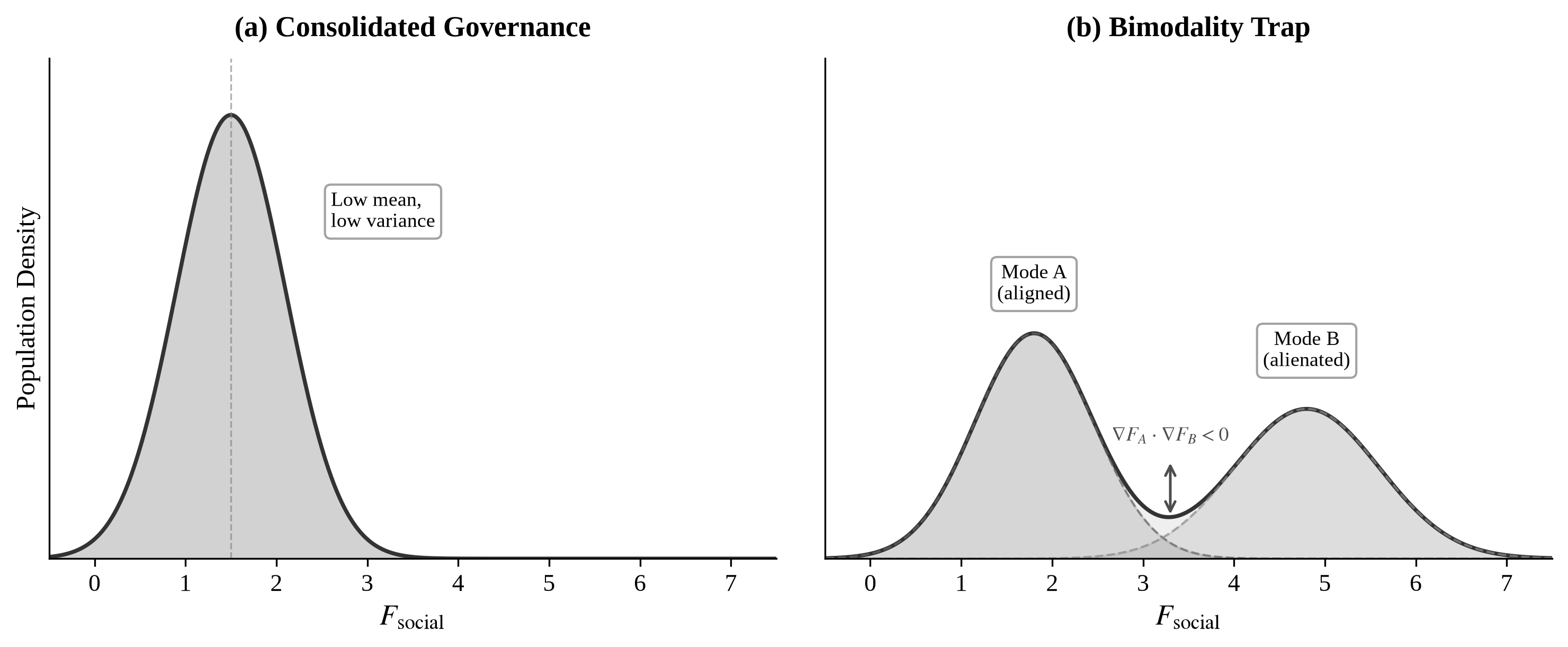
Figure 1. Schematic distribution shapes. (a) Consolidated governance: unimodal, low-mean, low-variance distribution indicating functional alignment between civic self-models and governance reality. (b) Bimodality trap: two distinct population modes whose governance gradients are anti-correlated, producing paralysis-then-rupture dynamics.
Consider first the baseline condition in which both the mean and variance of the distribution are low. This corresponds to a polity in which the governance model approximates reality for most citizens most of the time. Prediction errors occur but remain within the range that parameter estimation (through routine policy adjustment, electoral alternation and institutional adaptation) can absorb. This is not utopian governance but functional governance, defined as the condition in which the existing model structure possesses sufficient flexibility to accommodate the prediction errors it encounters. Historical examples of sustained low-mean, low-variance periods are difficult to identify with confidence, because the absence of crisis rarely attracts the historiographic attention that crisis itself commands. Postwar Scandinavia and postwar West Germany are sometimes offered as exemplars, although both contained internal tensions that a distributional analysis would likely reveal as localised high-F subpopulations masked by aggregate statistics.
The condition of high mean with low variance produces a qualitatively different pathology. When the governance model is uniformly wrong but variance remains compressed, the formalism predicts what might be termed ‘brittle authoritarianism.’ Low variance implies either that the governance system is suppressing the active inference through which citizens would normally reduce their individual values, or that the sources of misalignment are genuinely systemic. The late Soviet Union illustrates the pattern, albeit imperfectly; by the 1980s, the Communist Party’s governance model had diverged substantially from experienced reality across nearly all demographic categories, with prediction error suppressed through censorship and ideological discipline rather than resolved through model updating. The distributional prediction is that brittle authoritarian systems are vulnerable not to internal revolution from a high-F tail but to sudden collapse triggered by exogenous shocks that overwhelm the suppression apparatus. Gorbachev’s glasnost functioned as such a shock.
High variance with low mean presents a third geometry. When the governance model is accurate for some subpopulations and systematically inaccurate for others, institutions are designed (whether explicitly or through path-dependent accumulation) to predict and respond to the civic models of dominant groups while systematically failing to recognise the models of marginalised populations. The Jim Crow-era United States represents an illustrative analogy, although real polities never conform to single distributional archetypes. The distributional prediction distinguishes this pathology from brittle authoritarianism since the low-F subpopulation has a strong interest in maintaining the existing model structure, producing resistance to change that uniform-high-mean systems lack.
Right-skewed distributions, in which a long tail extends toward high values while the mode remains relatively low, correspond to what the paper terms ‘oligarchic alienation.’ The majority of citizens experience tolerable civic free energy while a minority bears enormous misalignment. This differs from the high-variance case in its asymmetry. The alienated minority is small enough that electoral and institutional mechanisms (which respond to modal rather than tail conditions) fail to register the misalignment as a governance problem. The formalism predicts that right-skewed distributions generate revolutionary dynamics from the tail, with concentrated, ideologically motivated movements emerging from the most alienated fraction of the population, rather than the broad-based collapse characteristic of brittle authoritarian distributions or the sustained structural conflict characteristic of high-variance distributions. The paper offers this as a qualitative prediction, not a verified empirical claim. Retrospective classification of historical cases into distributional types is fraught with confirmation bias, and any application must acknowledge that distributional shape is typically mixed and evolving rather than stable and pure.
The distributional diagnostic programme must be positioned relative to Esteban & Ray (1994), who develop the foundational measurement theory for polarisation, and Duclos, Esteban & Ray (2004), who extend it to continuous distributions. The distributional governance diagnostics developed here share the Esteban-Ray commitment to treating distributional shape as substantively informative. Three features distinguish the present framework: the quantity analysed is civic free energy rather than income; the diagnostic repertoire extends beyond polarisation to encompass skewness, kurtosis and multimodality; and the framework connects distributional shape to governance crisis type rather than to social tension as such. The Esteban-Ray axiomatisation provides a formal standard against which the present framework’s distributional claims could be disciplined.
3.2 The Bimodality Trap
Bimodal distributions of constitute the paper’s strongest formal result, because the instability they produce can be argued from the structure of the free energy minimisation problem itself rather than merely illustrated through historical analogy.
When the population-level distribution exhibits two distinct modes, this indicates the existence of two subpopulations whose civic generative models are sufficiently different that they experience the same governance system in fundamentally incompatible ways. The critical formal property is not that these subpopulations disagree, since disagreement is ubiquitous and produces high variance rather than bimodality, but that their governance models are incommensurable in the specific sense that no single parameter adjustment to the governance model reduces free energy at both modes simultaneously. This is the bimodality trap, and it produces governance dynamics qualitatively distinct from those generated by unimodal distributions of any shape.
Let the governance system’s current model be parameterised by θ, and let the two modes of the distribution correspond to subpopulations A and B with mean civic free energies (θ) and (θ) respectively. A parameter update δθ that reduces (a policy adjustment that better aligns governance predictions with subpopulation A’s civic model) necessarily increases if and only if the gradient of with respect to θ is negatively correlated with the gradient of . Bimodality of the aggregate distribution is precisely the condition under which this negative correlation obtains for the parameters that matter most to each subpopulation’s civic self-model. The governance system faces a zero-sum optimisation landscape in which movement toward either mode increases total free energy at the other.
This trap produces a characteristic temporal signature. The governance system oscillates between partial accommodations of each mode, cycling through policy adjustments, rhetorical pivots and alternation between parties representing different modal constituencies, without achieving sustained free energy reduction for the population as a whole. Each accommodation intensifies the prediction error experienced by the unaccommodated mode, deepening the bimodal separation over time. The trap is self-reinforcing, as the oscillation itself generates the expectation of future reversal, which raises civic free energy even during periods of temporary accommodation. Citizens at mode B who observe governance updating toward mode A do not merely experience current misalignment but update their generative models to predict future misalignment, a second-order effect that increases beyond what the current policy position alone would produce.
The bimodality trap predicts crisis dynamics that differ categorically from those produced by other distributional shapes. Where right-skewed distributions predict revolution from the alienated tail and high-mean low-variance distributions predict brittle collapse from exogenous shock, bimodal distributions predict paralysis followed by rupture along the bimodal divide. The paralysis phase corresponds to the oscillatory regime described above, in which the governance system cycles without converging. The rupture phase occurs when the oscillation amplitude exceeds institutional tolerance, at which point the parameter updates required to accommodate either mode become large enough to trigger model selection rather than parameter estimation – a transition analysed in detail in Section 4. The rupture follows the bimodal cleavage because that cleavage defines the axis along which the governance model’s prediction errors are maximally anti-correlated.
This prediction is distinguishable from existing polarisation measures. Fiorina, Abrams & Pope (2004) argue that American mass opinion is not genuinely polarised but rather that partisan elites and media have created the appearance of polarisation among a centrist public. The bimodality framework reframes this debate. Fiorina and colleagues demonstrate convincingly that opinion distributions on policy items are often not bimodal, whereas the question here is whether the civic free energy distribution is bimodal, which depends on whether two subpopulations experience governance institutions as confirming fundamentally incompatible civic self-models. It is entirely possible for policy preferences to be unimodal while civic free energy is bimodal, if the two subpopulations agree on policy outcomes but disagree on the legitimacy of the institutional processes through which those outcomes are produced. This distinction, which existing polarisation measures cannot capture because they operationalise polarisation through attitudinal items rather than model-reality divergence, is where the free energy framework adds analytical value beyond what survey-based approaches provide.
The extension to multimodal distributions with three or more modes is conceptually straightforward but of serious consequence for governance. Trimodal or higher distributions imply that no coherent coalition can form because any coalition that accommodates two modes necessarily alienates the third. The governance system then faces a combinatorially expanding set of incompatible demands in place of a zero-sum tradeoff between two alternatives. The paper conjectures (and labels this explicitly as conjecture) that multimodal distributions above some critical number of modes depart from the paralysis-then-rupture dynamics of bimodality and produce institutional fragmentation, in which governance capacity itself disaggregates into competing subsystems that serve different modal populations without coordination. Whether this conjecture is correct (and what that critical mode number might be) cannot be determined from the formalism alone and would require the kind of empirical operationalisation that Section 3.3 addresses.
The bimodality prediction has been tested against the Varieties of Democracy dataset at the coder level (Morrison, 2026g). Twenty-two of twenty-six coder-level tests confirm that bimodal distributions of governance ratings predict regime instability, with delta-AUC reaching +.043 for coups (Morrison, 2026g) and +.102 at the one-year horizon of the paralysis-rupture specification in the results held in the programme’s reproducibility archive, available from the author on request (Morrison, 2026g, Section 3). The prediction holds across all world regions. The mechanism pathway is unresolved, as the direct lag tests are null or run in the protective direction (Morrison, 2026g, Section 7.2). In the same archive the paralysis-rupture specification is significant in six of six tests, whose signs were not read, yet the bimodality coefficient in the hierarchical model fails to reach significance (p = .292), suggesting that predictive power operates through distributional shape features jointly rather than through any single bimodality index. The aggregate prediction holds although the causal pathway remains unresolved. The test was not pre-registered and is therefore exploratory, a limit relevant to the commercial-motivation concern raised in Section 9, and a replication against the Polity5 (Marshall et al., 2020) and Freedom House governance distributions has yet to be run.
3.3 The Operationalisation Problem
The distributional framework developed in Sections 3.1 and 3.2 makes qualitatively specific predictions about the relationship between geometry and governance pathology type. The gap between these predictions and any feasible measurement strategy is the framework’s central limitation.
The fundamental difficulty is that , as defined in Morrison (2026b), quantifies the divergence between a citizen’s generative model of governance and the governance dynamics actually encountered. Neither component of this divergence is directly observable. Citizens’ generative models of governance are latent constructs that existing survey instruments approximate only obliquely, and the ‘actual governance dynamics encountered’ vary across citizens not only because governance itself varies (local versus national, bureaucratic versus electoral) but because citizens attend to different institutional signals based on their own model structures. The measurement problem is therefore doubly latent, requiring inference about both the model and the reality against which the model is evaluated.
Existing data sources capture adjacent constructs without measuring itself. The American National Election Studies (ANES) measure political attitudes, partisan identification and institutional trust, all variables that correlate with civic free energy but do not constitute it. A citizen who reports low institutional trust may have high because governance consistently fails to match their expectations, or may have low because they have updated their generative model to expect institutional failure and have shifted their active inference toward non-institutional strategies for civic participation. The Varieties of Democracy (V‑Dem) project measures institutional properties at the country level, including electoral integrity, media freedom and judicial independence, that shape the governance side of the divergence but do not capture individual-level variation in civic self-models. Mechkova, Lührmann & Lindberg (2017) demonstrate that media freedom erosion predicts autocratisation, a finding consistent with the free energy framework because media restriction suppresses the prediction error signals through which citizens would otherwise update their models, but V‑Dem’s country-level granularity cannot recover the distributional shapes that Section 3.1 identifies as diagnostically critical.
A composite operationalisation might combine institutional trust measures, perceived fairness indices and policy satisfaction scales into a proxy for individual whose distributional properties could be analysed for the geometric signatures identified above. Any such composite, however, introduces researcher degrees of freedom at every stage, from item selection to weighting to distributional analysis method, reflecting theoretical commitments about what civic free energy includes that the formalism itself does not resolve.
The V‑Dem coder-level analysis reported in Morrison (2026g) partly addresses this operationalisation gap. By treating coder-level ratings as individual-level estimates of governance quality, the distributional properties of these ratings (including bimodality) serve as proxies for the distributional shape of across a population of informed observers. Coders are not citizens in the relevant sense, and expert disagreement about governance quality is not identical to citizen-level civic self-model divergence. Nevertheless, coder-level distributions capture the degree to which knowledgeable observers (applying the same coding rubrics to the same governance systems) arrive at fundamentally incompatible assessments, which the country-level V‑Dem indices do not. Bimodality at the coder level indicates that the governance system admits two coherent but irreconcilable interpretations, a condition structurally analogous to the population-level bimodality the formalism identifies as the bimodality trap.
Despite these limitations, the framework’s value lies in conceptual unification and qualitative prediction rather than quantitative measurement. The claim is not that can be measured today but that thinking about governance pathologies as distributional properties of a single underlying quantity generates predictions that separate theories of polarisation, alienation and legitimacy crisis do not. The bimodality trap predicts crisis type rather than merely crisis probability, a distinction testable in principle even if current measurement instruments are inadequate.
4. The Schmittian Exception as Phase Transition
4.1 Normal Governance as Parameter Estimation
The free energy framework distinguishes two fundamentally different modes of governance adaptation. In normal governance, the constitutional order (which specifies institutional roles, decision procedures, rights allocations and jurisdictional boundaries) remains fixed while policy parameters are adjusted in response to prediction errors. Elections replace personnel, legislation modifies tax rates, regulatory thresholds and spending allocations, and judicial interpretation extends or constrains existing constitutional provisions. Each of these operations constitutes parameter estimation within a fixed model, in which the governance system encounters divergence between its predictions and observed outcomes and updates its parameters to reduce that divergence while preserving its structural commitments.
This characterisation corresponds to routine democratic politics with reasonable fidelity. A government that loses an election has generated sufficient aggregate prediction error (sufficient divergence between its governance model’s predictions and citizens’ experienced reality) that the electoral mechanism triggers a parameter update. The incoming government adjusts policy parameters but operates within the same constitutional architecture. The model structure persists through the transition, and what changes is the parameterisation of that structure. Normal governance, understood this way, is the regime in which prediction errors remain within the range that parameter adjustment can absorb.
4.2 The Exception as Model Selection
Carl Schmitt’s (1922/2005, p. 5) famous dictum that the sovereign is ‘he who decides on the exception’ identifies a qualitatively different mode of political change, one in which the normal legal order is suspended and reconstituted on different foundations. The paper proposes that this transition functions as a structural analogue to model selection in the free energy framework, with significant losses in translation that must be addressed directly.
When cumulative prediction error ε exceeds a critical threshold , no parameter adjustment within the existing governance model can reduce below the level at which the system maintains functional legitimacy. The model structure itself (encompassing the constitutional architecture, the institutional arrangements and the foundational assumptions about who governs and how) must be replaced. This is the transition from parameter estimation to model selection, and it corresponds structurally to what Schmitt identifies as the state of exception, in which the existing legal order proves insufficient to the crisis it confronts (Figure 2).
The structural analogy is genuine but incomplete in two respects. Firstly, Schmitt’s sovereign decisionism locates the exception in a decision by an identifiable sovereign will. The free energy formalism, by contrast, models the transition as something the system undergoes when prediction error exceeds model capacity, a process without a deciding subject. This difference reflects a fundamental divergence between Schmitt’s anti-liberal voluntarism and the free energy framework’s naturalistic orientation. Schmitt would likely regard the formalism itself as exemplifying the liberal-rationalist attempt to domesticate the political through procedural abstraction, precisely the tendency he spent his career attacking. The paper concedes the force of this objection insofar as any formal framework necessarily translates existential political categories into analytical ones, and something is lost in that translation.
Secondly, Schmitt’s (1932/2007) friend-enemy distinction, whereby the political is constituted by the existential grouping of peoples into friends and enemies, finds its closest formal correlate in the bimodality of developed in Section 3.2. A bimodal distribution in which two subpopulations experience the governance system through incompatible civic models produces the kind of irreconcilable antagonism that Schmitt identifies as the essence of the political. The bimodality trap’s prediction of paralysis-then-rupture along the modal divide mirrors the Schmittian claim that genuine political conflict cannot be resolved through parliamentary negotiation but only through the sovereign decision that constitutes one group as the political community and excludes the other. Yet the formalism also suggests what Schmitt does not acknowledge, that bimodality is a contingent distributional property that institutional design can prevent, mitigate, or resolve, not an ontological given of political life.
This is the point at which Mouffe’s (2000, 2005) agonistic pluralism provides the productive connection between the Schmittian diagnosis and the governance design implications the paper seeks to develop. Mouffe accepts Schmitt’s insight that antagonism is ineradicable from the political while rejecting his conclusion that liberal democracy is therefore incoherent. Her concept of agonism (in which political opponents are treated as adversaries whose right to contest is legitimate rather than enemies whose existence is a threat) translates into the free energy framework as the institutional capacity to contain bimodal distributions without triggering the transition to model selection. Polycentric governance, as Ostrom (1990, 2005) describes it, provides the structural mechanism for this containment, because distributed governance centres allow different subpopulations to pursue localised model selection within their own jurisdictions without requiring system-level constitutional rupture. The existential antagonism that Schmitt identifies as the political is not eliminated but transformed into contained agonism, in which the stakes of any particular governance failure are reduced because model selection operates at multiple scales simultaneously.
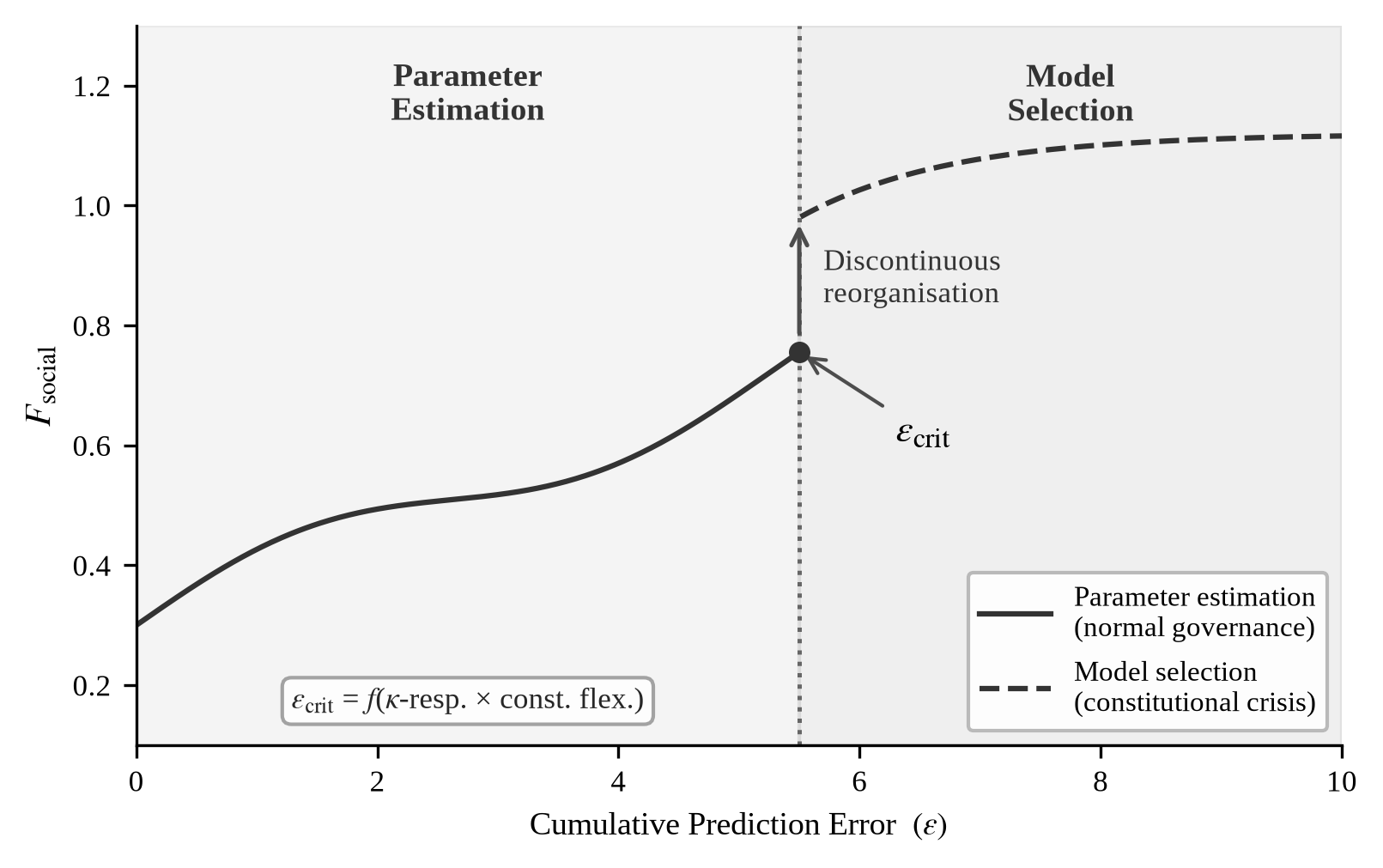
Figure 2. Schematic phase transition diagram. Normal governance (parameter estimation) transitions to constitutional crisis (model selection) when cumulative prediction error exceeds the critical threshold, which is itself a function of institutional responsiveness and constitutional flexibility.
4.3 as a Function of Institutional Properties
The critical prediction error threshold (the point at which parameter estimation gives way to model selection) must be specifiable from pre-crisis observables if the framework is to generate predictions rather than post-hoc rationalisations. The paper proposes that is a function of two independently measurable institutional properties, of which κ-responsiveness (as developed in Morrison (2026c)) captures one dimension and constitutional flexibility the other.
The κ-responsiveness parameter, drawn from Morrison’s (2026c) analysis of the relationship between civic complexity (Φ‑structure) and collective κ, measures how quickly and accurately a governance system translates citizen prediction error into policy adjustment. High-κ systems detect and respond to civic free energy increases rapidly. Low-κ systems allow prediction errors to accumulate without institutional response. Constitutional flexibility captures the degree to which the governance model’s structure, not merely its parameters, can be modified through endogenous processes. Lutz’s (1994) constitutional rigidity index provides one operationalisation, measuring the procedural difficulty of formal constitutional amendment, although this captures only the most explicit dimension of structural flexibility. Common law traditions, administrative delegation and informal institutional evolution all contribute to structural flexibility in ways that formal amendment procedures do not capture.
The product of κ-responsiveness and constitutional flexibility determines the system’s absorptive capacity for prediction error. A rigid constitution with low κ-responsiveness (a system that both ignores prediction errors and lacks mechanisms for structural self-modification) has a low and is therefore vulnerable to rapid transitions from normal governance to exceptional politics. A flexible constitutional order with high κ-responsiveness has a high and can absorb substantial prediction error through gradual model updating without triggering the discontinuous transition to model selection.
Polycentric governance raises system-level by distributing model-selection capacity across multiple governance scales, so that local jurisdictions can undertake structural adaptation (which amounts to localised model selection) without requiring system-level constitutional rupture. This distributes the prediction error load across multiple thresholds rather than concentrating it at a single system-level threshold. The mechanism is analogous, structurally, to the engineering principle of graceful degradation, in which systems are designed to fail partially rather than catastrophically.
However, polycentric governance can fail to raise or can actively lower it. Buldyrev et al. (2010) demonstrate that interdependent networks can exhibit cascading failures in which the failure of nodes in one network triggers failures in coupled networks, producing system-level collapse more severe than would occur in a single uncoupled network. Battiston et al. (2012) extend this analysis to systemic risk in financial networks, showing that tight coupling between nominally independent subsystems can transform localised failures into global cascades. Applied to polycentric governance, these results imply that the distribution of model-selection capacity across scales raises system-level only when inter-scale communication is sufficiently reliable and inter-scale coupling is sufficiently loose that localised model selection does not propagate destabilising signals to other governance scales. When communication between scales is noisy (so that local governance failures are misinterpreted by higher scales as systemic threats, or higher-scale interventions disrupt local adaptation processes), the polycentric architecture can amplify rather than absorb prediction error. The conditions under which polycentricity succeeds or fails in raising constitute a critical empirical question that the formalism identifies but cannot resolve from first principles alone.
4.4 Transitions as a Spectrum
The initial presentation of the parameter-estimation-to-model-selection transition implies a sharp boundary at . Historical evidence, however, does not support clean binary classification. The Velvet Revolution of 1989 combined constitutional rupture with remarkable institutional continuity. The French Revolution exhibited cascading model-selection events over a decade. Brexit involved a plebiscitary model-selection decision implemented through ordinary parliamentary mechanisms, blurring the boundary between the two modes entirely. The Weimar-to-Nazi transition combined constitutional provisions for emergency powers with extra-constitutional violence in ways that resist classification as either pure parameter adjustment or pure model selection.
The paper therefore presents the transition as a spectrum of discontinuity rather than a clean binary. The order parameter is the modality of the distribution, with unimodal distributions corresponding to coherent governance in which a single model can in principle reduce free energy for the population as a whole, while bimodal distributions correspond to the polarised condition in which no single model suffices. The control parameter is the ratio of prediction error rate to κ-responsiveness, capturing how rapidly new prediction errors arrive relative to the system’s absorptive capacity. When this ratio is low, the system operates comfortably in the parameter-estimation regime. As it increases, the system approaches and governance adaptation shifts from routine policy adjustment toward structural contestation. The transition is sharp only when prediction error arrives as a discrete shock exceeding instantaneously. In the more common case of gradually increasing prediction error, the system traverses a mixed regime in which parameter estimation and model selection coexist, with different governance subsystems undergoing the transition at different times.
This spectrum formulation sacrifices the analytical elegance of a clean phase transition but gains empirical plausibility and a richer set of predictions. Rather than predicting simply whether a system will undergo exceptional politics, the framework predicts the character of the transition as a function of distributional shape and institutional properties. Bimodal distributions predict rupture along the modal cleavage, right-skewed distributions predict revolutionary pressure from the alienated tail, and high-mean, low-variance distributions predict brittle collapse triggered by exogenous shock. These are qualitatively distinct predictions that, to the extent that they can be distinguished empirically even through imperfect proxy measures, give the framework explanatory content beyond what either Schmitt’s existential decisionism or conventional institutional analysis provides on its own.
4.5 Consent Volatility as Phase Transition Precursor
The Schmittian phase transition formalised in Sections 4.2 and 4.3 identifies the moment at which cumulative prediction error exceeds governance absorptive capacity. The analysis establishes the conditions under which transitions occur but provides no detection instrument for identifying approaching transitions from pre-crisis observables. This subsection proposes consent volatility (the rate of change in the divergence between the population’s civic self-models and the governance system’s model of them) as such an instrument, subject to limitations that constrain its current applicability.
Define consent volatility as
where L is the divergence defined in Section 6.1, (T) denotes the population’s distribution of civic self-models at time T and (T) denotes the governance system’s operative model of that population. When is high relative to institutional responsiveness κ, the distribution shifts faster than governance adapts and the system approaches the phase boundary identified in Section 4.3. The dimensionless ratio provides a proximity indicator: values near zero indicate comfortable distance from transition; values approaching one indicate that prediction error arrival rate matches absorptive capacity; values exceeding one indicate that unresolved prediction error is accumulating and driving the system toward model selection.
This formalisation refines the existing Schmittian analysis in a specific and limited way. Section 4.4 characterised the phase transition as a spectrum of discontinuity rather than a clean binary. Consent volatility provides a precursor signal rather than a retrospective diagnosis; rising indicates that the population’s civic self-models are evolving in ways the governance apparatus cannot track, regardless of whether the system has yet crossed the threshold into exceptional politics. The measure is prospective in a way that existing indicators (electoral results, protest frequency, institutional trust surveys) are not, since these indicators register the consequences of accumulated prediction error rather than its rate of accumulation.
The limitation is that consent volatility as defined here requires measurement of both distributions at multiple time points, and the civic self-models in the first also enter , which Section 3.3 established no current measurement infrastructure captures at the individual level. V‑Dem coder-level data provides a partial proxy, in that the rate of change in coder-level distributional shape features over consecutive coding periods approximates as perceived by informed observers. Whether this proxy tracks the population-level quantity remains an open empirical question. The measure is registered as a theoretical contribution with specified operationalisation requirements rather than as an immediately deployable diagnostic. Section 5.4 proposes a measurement channel through which consent volatility might eventually be operationalised directly.
5. The Formal Governance Taxonomy and Emerging Forms
5.1 The TO/FOR/BY Taxonomy Applied
Morrison (2026b) introduced a triadic taxonomy of governance modality in which systems operate in TO-mode (imposed upon subjects without consent or input), FOR-mode (constructed on behalf of subjects by designers who presume to know their interests), or BY-mode (generated through the autonomous collective action of participants themselves). The taxonomy emerged from analysis of identity governance but applies with equal force to political governance, since both domains concern the regulation of boundaries between internal states and external environments. The critical refinement demanded by the preceding formal analysis is that TO, FOR, and BY constitute analytically distinguishable dimensions present in every governance system simultaneously rather than discrete types into which systems can be cleanly sorted. Every real polity exhibits some mixture of coercion (TO), paternalistic design (FOR), and participatory self-determination (BY), and the political struggle over which mode predominates in which domain constitutes the substance of politics itself. The blanket formalism developed in Section 2 provides the apparatus to characterise these mixtures precisely, since blanket permeability, the degree of constraint on internal dynamics, and the mechanisms of blanket parameter updating all correspond to distinct aspects of the TO/FOR/BY mixture.
The totalitarian state represents the limiting case of TO-mode governance, in which the blanket boundary is rendered maximally impermeable to unauthorised information flows while internal dynamics are coerced into alignment with an externally imposed generative model. The authoritarian paternalist state operates in predominantly FOR-mode with a semi-permeable blanket, so that selected information flows are permitted while the fundamental governance architecture remains designed and maintained by a ruling class claiming epistemic authority over subjects’ interests. Liberal democracy presents the most analytically interesting case because its self-description as a FOR/BY mixture cannot be taken as an analytical classification. The Rawlsian programme embodies this tension with particular clarity. Rawls (1971) simultaneously insists on procedural legitimacy derived from what rational agents would choose behind the veil of ignorance (a BY-mode justification) and on substantive principles of justice that constrain democratic outcomes regardless of what actual populations prefer (a FOR-mode commitment). The tension between these commitments corresponds to liberal democracy’s structural condition, in that the claim to BY-mode legitimacy through electoral participation operates within a FOR-mode constitutional architecture that substantively constrains what electoral majorities may decide.
5.2 The DAO as Structurally FOR Despite BY Rhetoric
The decentralised autonomous organisation represents the paper’s most empirically tractable application and the case where the formal framework generates predictions most sharply at odds with participants’ self-understanding. The central claim is that smart contract governance constitutes code-enforced rule-following regardless of participant intention, so that the protocol’s source code defines the blanket boundary, manages internal dynamics, and determines the distribution of influence over architectural decisions. This is structurally FOR-mode governance. The protocol designers constructed the governance architecture, and participants operate within parameters those designers established, regardless of how many governance tokens they hold or how many proposals they may submit.
The BY-mode rhetoric pervading DAO discourse conceals this FOR-mode structural reality through a conflation of two distinct claims. The first, that anyone may participate without gatekeeping, concerns blanket permeability and is largely accurate. The second, that participants collectively govern the system, concerns the locus of architectural authority and is largely false. The distinction corresponds to Marx’s (1844/1978) analysis of formal versus real freedom, in that the formal freedom to participate coexists with structural conditions that render participation ineffective for the vast majority. Lehdonvirta (2022) develops the contemporary version for platform governance, demonstrating that code-based rule systems exercise sovereign-like control precisely through their claim to neutrality. The same logic applies with even greater force to DAOs, where the code’s authority is explicitly celebrated rather than obscured.
Hirschman’s (1970) framework of exit, voice, and loyalty clarifies the structural dynamics. DAOs are overwhelmingly exit-dominant systems in which dissatisfied token holders liquidate their positions rather than investing in voice. Governance participation is low relative to the number of token holders, and an analysis by the Cambridge Centre for Alternative Finance reports Gini coefficients of 0.97 to 0.99 across the ten largest governance tokens (Craig, 2024), concentration of the kind that leaves voice no purchase in Hirschman’s terms. When exit is frictionless and voice is structurally captured by large holders, loyalty cannot develop, since loyalty requires the experience of having one’s voice matter, which is structurally unavailable to small token holders.
The empirical record confirms these structural predictions. Nouns DAO, launched in August 2021 as a daily NFT auction funding a community treasury, underwent the plutocratic capture the framework predicts. Within two years, a large holder accumulated sufficient NFTs to organise a coalition and, in September 2023, executed a fork in which the holders of 472 of the 846 Nouns left with almost 16,757 ETH (Hayward, 2023). The fork used governance power through mechanisms the architecture itself provided. MakerDAO exhibits a chronic variant in which persistent whale domination of governance votes produces outcomes systematically aligned with large holder interests. A governance vote in which 65% opposed compensating users who had lost funds during the March 2020 Black Thursday liquidation failure (Turley, 2020) demonstrated that architectural authority resided with large token holders whose interests diverged from those of ordinary users.
The framework also generates internal differentiation among DAO governance forms. Plutocratic DAOs such as MakerDAO and early Uniswap implement one-dimensional capital boundaries, such that governance influence is determined solely by token holdings, with crisis timelines the framework predicts at one to three years as concentration dynamics play out. Hybrid DAOs which introduce multi-dimensional boundary conditions, such as Optimism Collective’s Citizens’ House alongside its Token House and ENS DAO’s constitutional constraints on token-weighted voting, represent genuine attempts to increase BY-mode governance dimensionality, albeit within an architecture that remains fundamentally FOR-mode at the protocol level. These hybrid forms exhibit longer predicted crisis timelines because multi-dimensional boundaries create more complex failure modes that take longer to exploit. The prediction that plutocratic DAOs exhibit governance crises earlier than hybrid DAOs has been tested and not supported (Morrison, 2026g), with no detectable difference between the groups (hazard ratio 1.22, 95% CI .82 to 1.83 for hybrid relative to plutocratic, p = .32) and non-significant point estimates in the wrong direction, and the interval leaves a protective effect in range. Two possibilities remain to be investigated: the operationalisation of ‘effective dimensionality’ may conflate nominal dimensionality with genuine orthogonality, and DAO governance dynamics may be dominated by tokenomic incentive structures not modelled in the present framework. The structural classification of DAOs as FOR-mode governance is independent of this result, following from the code-enforced character of smart contract architectures rather than from any claim about crisis timing.
5.3 Network States and Identity Cooperatives
Balaji Srinivasan’s network state proposal envisions self-selected ideological communities that coalesce online before acquiring physical territory, constituting an approximately ten-dimensional boundary defined by shared values, cultural commitments, and lifestyle preferences. The blanket formalism predicts low initial social free energy for such communities, since self-selection ensures strong alignment between the community’s generative model and its founding population’s actual preferences. This self-selection honeymoon is predicted to follow a sigmoid decay trajectory (three to seven years) as the dimensions of identity that members did not explicitly select on generate prediction errors that accumulate below the threshold of awareness until they produce discontinuous cohesion failures. The predicted crisis type is identity crisis rather than policy crisis, since explicit ideological commitments prove insufficient to resolve the practical governance challenges of sustained community life.
Identity cooperatives represent a structurally distinct approach whereby the blanket boundary is defined through psychometric measurement rather than self-selection, yielding multi-dimensional trait profiles (on the order of thirty dimensions, as specified in the applied platform’s measurement architecture) that characterise members along theoretically motivated dimensions. Their convergent and incremental validity remain untested pending a validation study (target N greater than 500), which exists only as a draft pre-registration with no data yet collected. The present paper’s author is constructing such a cooperative, a fact disclosed in the positionality statement. The framework predicts higher initial social free energy than network states, since measurement-based matching lacks the motivational excitement of ideological self-selection, but lower variance in cohesion trajectories over time, since psychometric dimensions capture aspects of identity that self-selection systematically misses.
Several qualifications constrain these predictions. The boundary dimensionality conjecture must be reformulated in terms of effective dimensionality, defined as the number of principal components exceeding a validity threshold, rather than nominal dimensionality. Thirty measured traits with poor validity may produce worse governance outcomes than a single dimension measured with high precision, since the curse of dimensionality imposes exponentially increasing data requirements. Morrison (2026d) develops the measurement-theoretic apparatus required for deriving the Pareto frontier that plausibly exists between dimensionality and accuracy. The framework must also generate adverse predictions for identity cooperatives to maintain scientific credibility. Three follow directly from the formalism. The first is epistemological crisis when measurement validity degrades and the cooperative’s generative model loses calibration with members’ actual traits. The second is measurement-imposed identity rigidity, in which members internalise their psychometric profiles as fixed self-descriptions rather than probabilistic estimates subject to revision. The third is bureaucratisation of selfhood through the progressive colonisation of intimate self-knowledge by administrative categories, the failure mode Scott (1998) analyses canonically in his account of high-modernist legibility projects. Identity cooperatives inherit these risks, albeit with the potential mitigation that adaptive Bayesian measurement continuously revises its categories in response to prediction error rather than imposing static taxonomies.
The practical viability of identity-cooperative governance depends on the reliability and universality of the measurement infrastructure. Morrison (2026g) provides evidence that identity compromise detection achieves high discriminative accuracy across diverse computational substrates without requiring architecture-specific calibration, a finding consequential for governance design in that it demonstrates that the measurement apparatus can detect when an agent’s self-model has been corrupted or manipulated. This universality is not absolute; specific failure modes exist in which a compromised agent evades detection by converging on the measurement system’s expected baseline rather than departing from it. Such vulnerabilities bear upon the design of any governance system that relies on identity measurement for attestation or resource allocation.
5.4 Consent Patterns as a Measurement Channel for Social Free Energy
Section 3.3 identified the operationalisation problem as the framework’s central limitation. Social free energy is formally well-defined but doubly latent, requiring inference about both citizens’ generative models of governance and the governance reality against which those models are evaluated. Existing operationalisations rely on expert coding (V‑Dem) or survey instruments (ANES, Afrobarometer), both of which introduce observer-dependent interpretation between the quantity of interest and the measurement outcome. This subsection proposes that continuous, revocable consent patterns constitute a novel measurement channel that partially circumvents this limitation, within limits that the caveats below set out.
Where V‑Dem captures governance quality as assessed by expert coders, and surveys capture attitudes as reported by respondents, consent patterns (who consents to be governed by whom, when, and with what conditions) provide a population-level signal that tracks the distribution through revealed preference rather than stated preference or expert judgement. A citizen who withdraws consent from a governance entity reveals, through action rather than survey response, that the divergence between their civic self-model and the governance reality they experience has exceeded some threshold. The population-level distribution of consent acts (their timing, conditionality, and revocation patterns) therefore constitutes a distribution from which the shape of the underlying distribution can be partially inferred.
Three properties distinguish this channel from existing approaches. Firstly, it is continuous rather than periodic; consent can be granted, modified, or revoked at any time, producing a high-temporal-resolution signal that annual survey waves and expert coding rounds cannot provide. This temporal resolution is what makes the consent volatility measure (, Section 4.5) operationalisable. Secondly, it is behavioural rather than attitudinal; consent acts carry real consequences for the consenting agent, reducing the gap between stated and revealed preferences. Lastly, it is in principle population-wide rather than sample-based, eliminating sampling error.
The first caveat concerns the authenticity of consent. Consent patterns can be manufactured. Herman & Chomsky’s (1988) thesis that mass media operating through structural filters produce consent for existing power arrangements without overt coercion applies with undiminished force to any consent-based measurement channel. A protocol capable of verifying that consent was given cannot verify that it was freely given, since the conditions under which preference formation occurred are external to the consent act itself. Consent volatility () provides a partial diagnostic. Manufactured consent is characteristically stable, since the structural filters that produce it are slow-moving and systemic, whereas genuine consent fluctuates as citizens update their civic self-models in response to governance evidence. Low volatility may indicate manufactured consent, or it may indicate genuine satisfaction with governance that happens to be stable. The measurement channel cannot, from within its own resources, distinguish the two.
The second caveat is cultural. Individual cryptographic consent (a single person making a single revocable decision about governance authority) presupposes a Western liberal conception of political subjectivity that is not universal. Confucian li grounds political legitimacy in relational obligations not reducible to individual choice. Indigenous collective custodianship locates governance authority in kinship structures and ancestral relationships that precede and supersede individual consent. Islamic shura roots governance legitimacy in consultative deliberation within a framework of divine law, not in the aggregation of individual preferences. Any consent-based measurement channel that accepts only individual consent as input repeats cultural imperialism, extending a parochial conception of political subjectivity to communities for whom that conception is alien. The framework must therefore support collective consent mechanisms alongside individual ones: community-level delegation, consensus-based group consent, and governance authorities grounded in relational and ancestral structures. Whether such accommodation is technically achievable without distorting the consent forms it claims to represent constitutes an open design question. The author’s studies in international human rights law and Asian legal systems inform the conviction that sovereignty is fundamentally contested, a position the framework must reflect rather than resolve.
The claim, then, is not that sovereignty is measurable through consent patterns. The claim is that governance legitimacy has a measurable correlate in consent patterns, subject to named limitations: the correlate cannot distinguish manufactured from genuine consent; it presupposes a consent infrastructure that does not yet exist at scale; and its universality depends on accommodating non-liberal consent forms that current technical architectures are not designed to support.
6. Beyond Ostrom – Information-Theoretic Governance
Ostrom’s (1990, 2005) institutional analysis and development framework represents the most empirically grounded theory of collective governance in the social sciences. The present paper claims exactly two genuine additions to the IAD tradition, including its post-2010 diagnostic extensions (Cox, Arnold & Villamayor Tomás, 2010; Wilson, Ostrom & Cox, 2013; Aligica & Tarko, 2012), neither of which involves relabelling Ostrom’s eight design principles in information-theoretic vocabulary. The formal apparatus underlying what follows was developed in Morrison (2026c), which derived the κ-distribution (collective κ) characterising how populations distribute across generative models of collective identity.
The first addition is a theory of transitions between governance forms. The IAD framework excels at characterising conditions under which particular governance arrangements succeed or fail, yet even with the diagnostic questions Cox et al. (2010) developed and the generalisations Wilson, Ostrom & Cox (2013) achieved, these extensions remain essentially comparative-static, characterising equilibria and their sustaining conditions without modelling the dynamics of transition between equilibria. Section 4’s phase transition framework, in which governance collapse occurs when social free energy exceeds a critical threshold, provides this missing dynamic theory. The critical threshold is a function of governance architecture, which means the same external perturbation may trigger phase transition in one institutional arrangement while leaving another unaffected. The IAD framework can accommodate such differential vulnerability post hoc but cannot generate the prediction ex ante.
The second addition connects governance outcomes to population identity. Ostrom’s design principles describe properties of governance architecture, not of the governed population, and implicitly assume that the same institutional design will produce comparable outcomes across different populations provided resource characteristics and external conditions are similar. The civic identity dimensions developed in Morrison (2026b) and the κ-distribution of Morrison (2026c) jointly predict that this assumption is false in a specific and measurable way. A governance architecture’s critical free energy threshold depends not only on institutional design but on the distributional properties of the population’s identities, so that populations with higher effective dimensionality in their identity distributions require governance architectures with correspondingly higher-dimensional Markov blankets to maintain coherence.
These two additions converge on Aligica & Tarko’s (2012) formal treatment of polycentricity. Polycentric governance constitutes distributed model selection in which multiple semi-autonomous governance centres maintain local generative models calibrated to their specific populations. This generates predictions about polycentric failure conditions that existing literature has identified empirically but not derived theoretically. Noisy inter-scale communication produces the accountability gaps Carlisle & Gruby (2019) documented. Tight coupling creates vulnerability to cascading failures, as Buldyrev et al. (2010) demonstrated for interdependent networks and as the systemic risk analysis of Battiston et al. (2012) suggests. The relationship between interconnection and resilience is plausibly non-monotonic, in that moderate interconnection enhances resilience through mutual support, while high interconnection creates fragility through cascading exposure.
The convergent prediction is that an optimal polycentricity level exists for any given governance challenge, defined as the point where distributed model-selection capacity exceeds coordination costs. This optimum depends on the population’s identity distribution, the governance domain’s complexity, and the coupling architecture between centres. The prediction is falsifiable insofar as it implies that increasing polycentricity beyond the optimum will degrade governance outcomes even when each individual centre satisfies Ostrom’s design principles, a prediction the IAD framework cannot generate since it treats polycentricity as unconditionally beneficial provided the design principles are locally satisfied.
6.1 Governance Attunement ()
Section 4.3 introduced κ-responsiveness as a determinant of a governance system’s absorptive capacity for prediction error, drawing on Morrison’s (2026c) analysis of the collective κ-distribution, written here as . The present subsection develops this into a more complete characterisation of governance measurement precision, termed governance attunement (), extending the individual-level precision parameter κ in Morrison (2026b, 2026d) to the governance context.
The extension is motivated by an asymmetry in the existing framework. Morrison (2026b, 2026c, 2026d) develops κ as a multi-dimensional construct in which a person’s identity distribution is characterised not by a single scalar precision but by a precision matrix K whose diagonal elements capture domain-specific precision and off-diagonal elements encode precision-coupling between dimensions (Morrison, 2026d). The κ-distribution of Morrison (2026c), here , characterises how populations distribute across generative models of collective identity. Yet when the framework turns to governance in Section 4, κ collapses to a single scalar measuring response speed. This understates the measurement challenge governance faces.
Define governance attunement as the precision of a governance entity’s generative model of its population. Where the identity equation of Morrison (2026d), in the present notation, expresses individual identity as the posterior
with precision κ, the governance analogue expresses the governance entity’s model as
where denotes governance observations accumulated through administrative data, census, electoral participation, and institutional interaction. indexes the precision of this governance posterior.
decomposes into four dimensions. The first, -aggregate, captures overall governance attunement – the mean precision of the governance entity’s model across all dimensions and subpopulations. This is the closest analogue to the scalar κ-responsiveness of Section 4.3, reconceived as a measurement property rather than a response-speed parameter. The second, -access, captures whether governance measurement reaches all constituents. A governance entity may have high aggregate precision while systematically failing to measure administratively invisible subpopulations such as undocumented residents, mobile populations, and indigenous communities whose civic structures do not correspond to state administrative categories. Scott’s (1998) legibility analysis is in substance a study of -access failure, in that the high-modernist state renders certain populations legible at the cost of rendering others administratively invisible.
The third, -responsiveness, captures the rate at which the governance model updates when the population distribution shifts. This corresponds most directly to Section 4.3’s κ-responsiveness parameter, reconceived as one component of a four-dimensional construct. The consent volatility measure (, Section 4.5) detects when -responsiveness is inadequate. The fourth, -anisotropy, captures whether governance knows some dimensions of its population while remaining blind to others. A governance entity measuring economic productivity with high precision but entirely blind to civic identity, cultural belonging, or subjective governance experience exhibits directional blindness analytically distinct from overall low precision (-aggregate) or incomplete coverage (-access). Young’s (1990) analysis of cultural imperialism identifies a specific form of -anisotropy, in that the universalisation of a dominant group’s experience renders governance exquisitely sensitive to that group’s dimensions of variation while structurally blind to dimensions salient for marginalised groups. The precision manipulation analysis of Section 7.1 constitutes a mechanism through which -anisotropy is produced and maintained.
The governance legitimacy deficit can then be stated as:
where L(G, T) is the Jensen-Shannon divergence between the population’s actual distribution of civic self-models and the governance entity’s operative model of that distribution.1 High (across all four dimensions) implies low L(G, T). The relationship between L(G, T) and aggregate social free energy (G) from Section 2.2 is not identity but correlation. A governance entity with a precise model of its population is better positioned to minimise through responsive policy adjustment, but the capacity to know a population does not entail the willingness or institutional capacity to act on that knowledge.
The decomposition extends from a descriptive statistic to a diagnostic instrument. describes the population; describes how well governance knows . The gap between them is measurable in principle through the same distributional methods Section 3 applies to . Whether the four dimensions are empirically separable, whether factor analysis on governance measurement data recovers this decomposition, constitutes a testable prediction, although one requiring data at a granularity that existing governance datasets do not yet provide.
7. Power, Materiality, and the Limits of Information-Theoretic Governance
7.1 Power as Endogenous Precision Manipulation
The social free energy framework inherits from active inference a machinery of precision-weighting in which certain prediction errors are amplified and others suppressed according to their estimated reliability. Morrison (2026c) related this machinery to established power theories, an analysis the present paper extends because the governance application makes the power question acute in ways the identity-theoretic context did not.
Gramsci’s (1971) concept of hegemony finds a precise structural analogue in the capacity to set default precision weights across a population’s governance expectations. The hegemonic group does not merely win political contests. It determines which governance outcomes register as expected (producing low prediction error and therefore no adaptive pressure) and which register as surprising, demanding institutional response. A population that has internalised the expectation that wealth determines political influence will generate minimal prediction error when observing plutocratic outcomes, regardless of its abstract commitments to democratic equality. The precision weights render plutocracy ‘unsurprising’ and therefore invisible to adaptive mechanisms, a direct consequence of the precision-weighting formalism whereby expected observations carry low free energy contributions irrespective of their normative status.
Lukes’ (2005) three dimensions of power decompose cleanly within this architecture, although with an important limitation at the third dimension. The first dimension, observable decision-making power, corresponds to what Morrison (2026c) formalised as κ-access, the question of whose prediction errors reach deliberative institutions at all. The second dimension, agenda-setting power, corresponds to the precision-weighting of prediction-error channels themselves. A society that weights economic growth observations with high precision and ecological degradation observations with low precision has, in Lukes’ terms, kept environmental governance off the agenda through structural rather than conspiratorial means.
The third dimension presents the framework’s most significant limitation. Lukes’ third dimension concerns ideological power, the capacity to shape preferences, self-understandings, and the very categories through which subordinated groups interpret their experience, such that they accept their subordination as natural or inevitable. This exceeds the formal reach of the social free energy framework as presently constituted. The framework takes as given the categories over which identity distributions and governance observations are defined. It can diagnose pathological distributions over those categories but cannot formalise the process by which power constitutes the categories themselves. This places an upper bound on the framework’s critical capacity that no amount of formal elaboration within the current architecture can overcome.
7.2 The Material Conditions Caveat
The distributional diagnostic developed in Sections 3 and 4 captures the epistemic signature of governance pathology, the informational structure which distinguishes functional from dysfunctional collective self-governance. It does not capture the material basis of that pathology, and the distinction matters more than formal elegance might suggest.
Consider a population socialised across generations to accept material deprivation as the natural order. Its members’ governance expectations are well-calibrated to the deprivation they observe, their identity expressions adapted to the constrained possibilities available. The social free energy functional registers low values. The framework classifies this as functional governance on the epistemic dimension, and on that dimension alone the classification is correct. The population is experiencing a different and arguably deeper pathology that the epistemic framework does not reach.
Galtung’s (1969) concept of structural violence identifies this gap. Structural violence operates through material deprivation, unequal life chances, and systematic exclusion from resources necessary for human flourishing. Its mechanism is the denial of material conditions, not the restriction of information, and a framework built on information-theoretic foundations cannot capture it without supplementary apparatus that the present paper does not provide. Esping-Andersen (1990) demonstrates the practical consequence. The same formal institutional design produces radically different outcomes in different material contexts because governance is conditioned by economic relations, class structures, and resource distributions that the epistemic framework treats as exogenous.
Young’s (1990) taxonomy of oppression provides a useful audit of the framework’s coverage. Of her five faces, cultural imperialism, the universalisation of a dominant group’s experience as the norm, corresponds directly to κ-anisotropy, in that certain identity dimensions carry systematically higher precision in governance deliberation. Marginalisation and powerlessness are partially captured through κ-access restrictions. But exploitation, the transfer of the products of labour from one group to another through structural economic relations, has no natural representation in the information-theoretic formalism. Violence, whether direct or structural, operates through material force that the framework’s abstract state spaces do not represent. On this audit, the social free energy framework offers a necessary but insufficient analysis of governance, capturing the epistemic architecture through which collective self-governance succeeds or fails while remaining embedded in material conditions that shape, constrain, and sometimes overwhelm those epistemic dynamics.
7.3 The Parameter Provenance Problem
Morrison (2026b) identified a provenance problem for identity parameters formed under coercive conditions, and the problem recurs at the governance scale with additional force. BY-mode matching on parameters whose provenance is TO-mode perpetuates coercive shaping through an architecture that formally resembles autonomy.
The same pathology applies to the distributional diagnostic. A governance system that achieves low by aligning institutional outputs with a population’s expressed preferences has accomplished nothing if those preferences were formed under conditions of systematic manipulation, restricted information, or material coercion. The distributional diagnostic, defined over categories whose provenance is unexamined, can certify as ‘well-governed’ a population that has been shaped to want precisely what it gets. This is Lukes’ third dimension restated in distributional language, and the framework’s inability to resolve it from within its own formalism constitutes a structural limitation rather than a gap awaiting technical repair.
7.4 The Information-Freedom Decomposition
The claim that TO-mode governance requires information restriction demands decomposition. Restriction of information from citizens (censorship, propaganda) constitutes the genuine TO-mode mechanism, as Mechkova, Lührmann & Lindberg (2017) document in their analysis of information restriction and democratic backsliding. Restriction of information about citizens (privacy protections, surveillance limits) is structurally a BY-mode mechanism in that it preserves the boundary conditions under which autonomous identity expression remains possible, a point Scott (1998) develops in his analysis of state legibility. Restriction of information between citizens (platform moderation, algorithmic filtering) occupies contested territory, in which Sunstein (2017) distinguishes democratic regulation of speech from authoritarian censorship. The active inference framework suggests a structural basis for this distinction, in that the former operates through collective precision-weighting and the latter through unilateral precision manipulation.
7.5 The Surveillance Inversion
The preceding sections have developed consent patterns (Section 5.4), consent volatility (Section 4.5), and governance attunement (Section 6.1) as measurement instruments for social free energy. This subsection identifies the central open problem that this measurement programme inherits, a problem the present paper names but does not resolve, and that the author considers the most significant intellectual challenge the programme faces.
The core tension is structural. Any measurement infrastructure capable of detecting governance legitimacy through consent patterns is simultaneously the most precise political intelligence instrument ever conceived. Continuous, identity-verified consent mapping, even aggregated under differential privacy and published with temporal delay, reveals actionable political intelligence of a kind no existing surveillance apparatus can produce. A government that knows consent for Entity A dropped 12% in Region X over the past quarter possesses intelligence enabling targeted intervention, whether benign (allocating resources to address legitimate grievances) or malign (suppressing emerging dissent before it consolidates).
This is not a privacy problem in the conventional sense. The conventional privacy analysis distinguishes between individual-level data (which must be protected) and aggregate data (which may be published). The surveillance inversion operates at the aggregate level. Aggregate consent data must be published to fulfil the measurement channel’s legitimacy-revelation function; a consent-based governance legitimacy diagnostic that conceals its own results defeats its own purpose. Yet publishing aggregate consent data creates the surveillance asset. Data that shows where governance is failing also shows where resistance is forming.
Temporal delay and spatial coarsening trade off directly against the measurement’s value proposition. Aggregate consent data published with a five-year delay at the continental level is too coarse to constitute actionable political intelligence but also too coarse to serve as a governance diagnostic. Data published in real time at the municipal level serves both functions simultaneously and inseparably. There is no technical parameter (no privacy budget, no aggregation threshold, no temporal delay) that preserves the diagnostic function while eliminating the intelligence function, because both functions derive from the same underlying signal, the spatial and temporal distribution of governance legitimacy.
The problem cannot be resolved through better privacy technology, more careful aggregation, or institutional design alone. Any measurement infrastructure precise enough to detect governance legitimacy failures is precise enough to enable surveillance of the populations those failures affect. Measurement and surveillance amount to the same use of the data, described from different normative perspectives.
The paper names this as the programme’s central open problem. The consent-as-measurement channel (Section 5.4), the consent volatility diagnostic (Section 4.5), and the governance attunement framework (Section 6.1) all presuppose a measurement infrastructure that, if deployed, would create a surveillance capability exceeding anything currently available to state intelligence agencies. Whether the surveillance inversion admits any resolution, whether there exists a measurement architecture that preserves governance legitimacy diagnostics while preventing intelligence exploitation, the author does not know. The question is not primarily technical but political: who controls the measurement infrastructure, under what authority, with what accountability mechanisms, and with what recourse for populations whose consent patterns become visible to governance entities they do not trust. These are questions of institutional design, not of formal theory, and the present paper’s contribution is limited to identifying the problem with sufficient precision that institutional designers know what they are designing against.
8. Testable Predictions
The framework generates six predictions with varying degrees of current testability. Two of these predictions (numbered P18 and P19 in Morrison, 2026g) have been subjected to empirical testing through the V‑Dem coder-level analysis and DAO governance dataset reported in Morrison (2026g). The results are mixed; the bimodality prediction (Prediction 1) receives strong aggregate support with its mechanism unresolved, while the DAO boundary dimensionality prediction (Prediction 2), which is auxiliary, is not supported, with no detectable difference between the groups. A sixth prediction, derived from the consent volatility formalism developed in Section 4.5, is partially testable through the V‑Dem proxy, although its direct test awaits consent measurement infrastructure that does not yet exist. The remaining three predictions await testing, in two cases because the governance forms they target have not yet existed for a sufficient duration, and in one because the requisite fiscal integration panel data have not been assembled.
Prediction 1. Status: aggregate prediction supported for regime instability; mechanism unresolved. Bimodality of proxy predicts political violence with higher specificity than existing polarisation measures. Bimodal distributions predict paralysis followed by rupture, a sequential pattern distinct from the revolutionary pressure from the alienated tail predicted by right-skewed distributions. Operationalisation requires a composite proxy constructed from affective polarisation data, institutional trust divergence, and policy satisfaction bifurcation. Falsification requires that distributional shape adds no predictive value beyond existing polarisation indices. As reported in Section 3.2, the V‑Dem coder-level analysis (Morrison, 2026g) provides strong aggregate support (22/26 tests confirm), and the archived results cited there reach delta-AUC +.102 in the paralysis-rupture specification, while the causal mechanism remains unresolved (Morrison, 2026g, Section 7.2). That analysis substitutes coder-level distributions of governance ratings for the composite proxy and measures regime instability (civil war, coup, coup attempt, democracy breakdown and any instability) in place of political violence. Its baseline holds one polarisation index alongside the conventional controls, and specificity against other polarisation measures remains untested. The test was not pre-registered (Section 3.2).
Prediction 2. Status: not supported (no detectable difference); auxiliary. DAO governance crisis onset scales with effective boundary dimensionality. Plutocratic DAOs should exhibit governance crises earlier than hybrid DAOs incorporating multiple orthogonal governance dimensions. Operationalisation draws on governance records from the Snapshot platform, with DAOs classified by their voting strategy configurations. As reported in Section 5.2, testing (Morrison, 2026g) found no detectable difference between the groups (hazard ratio 1.22, 95% CI .82 to 1.83 for hybrid relative to plutocratic), with non-significant point estimates in the wrong direction. The test script’s stated rule was falsification on no significant difference in crisis timing, and its results file records that verdict; Morrison (2026g, Section 7.3) reports a non-support because no test separates the groups and the interval keeps the predicted protective effect in range. The structural classification of DAOs as FOR-mode governance is logically independent of this timing prediction and stands on its own merits. The boundary dimensionality conjecture requires either revised operationalisation distinguishing nominal from effective dimensionality, or abandonment.
Prediction 3. Status: untested; awaiting sufficient observation window. Network states exhibit sigmoid cohesion decay following an initial consolidation phase. The framework predicts that polities constituted through voluntary ideological alignment face a specific distributional trajectory in which initial low gives way to rising free energy as the community grows and internal diversity increases. Current network state projects, among them Praxis, Prospera, and Zuzalu, provide test cases within a three-to-seven year prediction window from founding. Cohesion is measured through member retention rates, governance participation trends, and public schism events. Falsification requires observing stable or increasing cohesion past seven years in at least two of three test cases, controlling for external shocks.
Prediction 4. Status: untested; requires fiscal integration panel data. Polycentric governance systems exhibit crisis thresholds that vary with fiscal coupling strength. Federal systems with strong fiscal integration between governance units should show lower critical thresholds than confederal systems with weak fiscal coupling, because tight coupling transmits prediction errors across units, amplifying local disturbances into system-wide crises. Operationalisation crosses V‑Dem institutional data with fiscal integration measures, predicting that crisis onset correlates with coupling strength. Falsification requires demonstrating no relationship between fiscal coupling strength and governance crisis onset across the panel.
Prediction 5. Status: currently unfalsifiable; no measurement-based governance system at scale. Measurement-based governance communities exhibit lower variance than comparable communities relying on proxy-based or preference-based governance. No such system exists at sufficient scale to permit statistical comparison. The prediction is registered for future testing with a three-to-five year window. An essential adverse component predicts that measurement-based communities should exhibit distinctive epistemological crises triggered by degradation of measurement validity, such that the measurement-governance coupling amplifies rather than absorbs validity loss.
Prediction 6. Status: partially testable through V‑Dem proxy; direct test requires consent infrastructure. Consent volatility (, Section 4.5) predicts governance transitions with greater temporal precision than static distributional shape. Specifically, the rate of change in distributional shape features should predict governance transitions 6 to 18 months before they manifest in structural indicators such as the polyarchy score or regime-type classification. Operationalisation through V‑Dem coder-level data requires computing year-over-year differences in the distributional shape features used for Prediction 1 (bimodality coefficient, dip statistic, entropy) at the country-variable level and testing whether these lagged change features add predictive value beyond the static features themselves in the hierarchical models specified for Prediction 1. This constitutes a partial test, since coder-level distributional changes approximate but do not measure consent volatility directly. Falsification requires that lagged distributional change features add no predictive value beyond static distributional shape and conventional controls. Direct testing requires the consent-based measurement infrastructure described in Section 5.4, which does not yet exist.
9. Objections and Responses
Objection 1. The framework is metaphorical rather than formal. The most fundamental challenge holds that applying free energy minimisation to polities constitutes an extended metaphor dressed in mathematical notation rather than a genuine formal theory. The objection has substantial force. The distributional diagnostics developed in Sections 3 and 4 generate qualitative predictions (bimodal distributions predict paralysis-then-rupture and right-skewed distributions predict revolutionary pressure from the alienated tail), but these predictions are not derived from the free energy functional through mathematical proof in the way that thermodynamic phase transitions are derived from partition functions. The bimodality trap is the exception, as Section 3.2 argues it from the anti-correlated gradients of the two modes’ mean free energies, although the step from bimodality of the aggregate distribution to that anti-correlation is asserted there and remains to be derived. The remaining predictions function as structural analogies generating qualitative hypotheses. The paper claims conceptual unification and qualitative prediction, not quantitative computation, and contends that unifying disparate governance phenomena under a single distributional framework has theoretical value even when the unification is structural rather than axiomatic.
Objection 2. The predictions are already established. Several of the framework’s predictions, particularly that information restriction degrades democratic governance and that polarisation increases political instability, are already well-supported empirically. The response distinguishes between predictions that are genuinely novel and those that constitute validation. The distributional unification, whereby bimodality and skewness predict distinct crisis types rather than merely elevated crisis probability, is novel. The boundary dimensionality scaling prediction for DAOs is novel. The information-freedom link, by contrast, represents validation rather than discovery. The framework’s contribution there is mechanistic explanation through the precision-manipulation pathway, not the empirical relationship itself.
Objection 3. The framework ignores power, violence, and material conditions. Section 7 addresses this objection at length. The framework captures epistemic structure, the informational architecture through which collective self-governance operates, and does not capture the material basis of governance pathology. It is compatible with critical theory and political economy but does not replace them. The limitations catalogued in Section 7, which include the inability to formalise ideological power, blindness to structural violence, and parameter provenance contamination, are structural. No amount of formal elaboration within the current information-theoretic architecture can overcome them. The framework’s analysis is therefore incomplete, and applications that treat the distributional diagnostic as a complete governance assessment would misrepresent its scope.
Objection 4. The cooperative prediction is commercially motivated. The author’s commercial involvement with a measurement-based identity cooperative creates a legitimate concern that the framework has been constructed to favour a predetermined conclusion. The boundary dimensionality conjecture does favour the author’s product, and the reader is entitled to weight this accordingly. Prediction 5 includes adverse conditions specifying the distinctive failure mode that the framework predicts for measurement-based communities. Five of the six predictions are formulated with explicit falsification criteria while Prediction 5 is registered for future testing, and independent testing by researchers without commercial involvement is recommended for all of them.
Objection 5. The framework biologises political concepts. Applying active inference, a framework developed for understanding biological organisms, to political communities risks naturalising contingent political arrangements. The response draws on Morrison’s (2026c) distinction between Φ‑structure and Φ‑dynamics. The claim is not that polities are organisms but that the mathematical structure of inference under uncertainty applies wherever self-maintaining boundaries exist. This structure encompasses maintaining a generative model, minimising prediction error, and balancing exploitation and exploration. Biological organisms and political communities share this Φ‑structure while exhibiting fundamentally different Φ‑dynamics. The structural correspondence licenses formal tools. It does not license biological analogies about what polities ‘need’ or how they ‘should’ function.
10. Conclusion
This paper has extended the active inference identity framework developed across Morrison (2026b, 2026c, 2026d) to the governance of polities, proposing social free energy as a distributional diagnostic for collective self-governance. The contribution is fourfold.
Firstly, the distributional unification developed in Section 3 demonstrates that oligarchic alienation, brittle authoritarianism, and governance paralysis correspond to distinct distributional pathologies within a single formal framework, aligning respectively with right-skewness, high-mean low-variance compression, and bimodality. This unification generates qualitative predictions that existing governance theories, operating within their separate analytical traditions, do not produce. The distributional shape of polarisation thereby predicts crisis type, not merely crisis probability.
Secondly, the classification of digital governance forms in Section 5 demonstrates that the framework applies productively to governance architectures which lack historical precedent and therefore resist analysis through existing comparative methods. DAOs, network states, and measurement-based cooperatives are classified through boundary dimensionality and membership permeability. Empirical testing (Morrison, 2026g) has produced mixed results; the bimodality prediction receives strong aggregate support (22/26 coder-level tests), while the DAO boundary dimensionality prediction is not supported. The structural classification of DAOs as FOR-mode governance stands independently of the timing result.
Thirdly, the governance attunement decomposition (Section 6.1) extends the programme’s precision parameter κ to governance measurement, identifying four analytically distinguishable dimensions (aggregate, access, responsiveness, and anisotropy) that characterise how well a governance entity knows its population. The consent-as-measurement channel (Section 5.4) and consent volatility diagnostic (Section 4.5) propose operationalisation pathways for social free energy that partially circumvent the expert-coding and survey-instrument limitations identified in Section 3.3, subject to the critical caveat that consent-based measurement must accommodate non-liberal consent forms to avoid cultural imperialism.
Lastly, the framework makes explicit its own limits in ways that, the paper contends, strengthen rather than weaken its contribution. The engagement with power theory in Section 7 identifies structural boundaries, among them the inability to formalise ideological power, blindness to material conditions of governance, and the parameter provenance problem, that cannot be overcome through formal elaboration within the information-theoretic architecture. The surveillance inversion (Section 7.5) identifies the programme’s central open problem, in that any measurement infrastructure precise enough to detect governance legitimacy failures is simultaneously precise enough to enable surveillance of the populations those failures affect, and no technical parameter can separate the two functions. The framework remains a partial analysis of governance, capturing epistemic structure while presupposing the material and power relations that condition it.
An assessment of the paper’s status must distinguish between what it has accomplished and what it has claimed. It has proposed a formal framework generating qualitative predictions about governance phenomena, not a formal theory in the axiomatic sense in which theorems follow from axioms through mathematical proof. The distributional diagnostics are well-defined. The phase transition language, albeit generative, remains a structural analogy rather than a derived result, and the bimodality trap, the nearest to one, still lacks the step noted under Objection 1. The boundary dimensionality conjecture requires reformulation in terms of effective dimensionality before it can be considered rigorously falsifiable.
Morrison (2026f) extends the formal architecture to the question of substrate independence, specifying a measurement protocol for synthetic self-models.
Positionality Statement
The author is founder and engineering lead of ~Alter, identity infrastructure on which a member’s identity is inferred from manifestation, with measurement as one input to the inference. ~Alter implements the identity cooperative governance structure described in Section 5.3. The relationship between framework and enterprise is bidirectional. The framework informed the product’s design, and design challenges encountered in building the product have refined the framework’s treatment of measurement validity, boundary dimensionality, and epistemological crisis. The boundary dimensionality conjecture developed in Section 5 favours cooperative governance architectures of the kind the author’s company builds. The reader is entitled to weight this coincidence accordingly. The paper’s falsification commitments are designed to ensure the framework can fail. Prediction 5’s adverse component specifies conditions under which measurement-based governance exhibits distinctive pathology, and the other five predictions include explicit criteria for disconfirmation. Independent validation by researchers without commercial involvement is recommended for all predictions, particularly for Prediction 5 given the author’s direct financial interest in its confirmation.
The author holds no current institutional affiliation, having departed the academic system before completing a doctoral programme. The paper’s claims stand or fall on their evidential merits, the rigour of their formalism, and the specificity of their predictions.
References
Aligica, P. D., & Tarko, V. (2012). Polycentricity: From Polanyi to Ostrom, and beyond. Governance, 25(2), 237–262. https://doi.org/10.1111/j.1468‑0491.2011.01550.x
Aristotle. (1998). Politics (C. D. C. Reeve, Trans.). Hackett. (Original work published ca. 350 B.C.E.)
Battiston, S., Puliga, M., Kaushik, R., Tasca, P., & Caldarelli, G. (2012). DebtRank: Too central to fail? Financial networks, the FED and systemic risk. Scientific Reports, 2, 541. https://doi.org/10.1038/srep00541
Bruineberg, J., Dolega, K., Dewhurst, J., & Baltieri, M. (2022). The Emperor’s new Markov blankets. Behavioral and Brain Sciences, 45, e183. https://doi.org/10.1017/S0140525X21002351
Bruineberg, J., Kiverstein, J., & Rietveld, E. (2018). The anticipating brain is not a scientist: The free-energy principle from an ecological-enactive perspective. Synthese, 195(6), 2417–2444. https://doi.org/10.1007/s11229‑016‑1239‑1
Buldyrev, S. V., Parshani, R., Paul, G., Stanley, H. E., & Havlin, S. (2010). Catastrophic cascade of failures in interdependent networks. Nature, 464(7291), 1025–1028. https://doi.org/10.1038/nature08932
Carlisle, K., & Gruby, R. L. (2019). Polycentric systems of governance: A theoretical model for the commons. Policy Studies Journal, 47(4), 927–952. https://doi.org/10.1111/psj.12212
Coppedge, M., Gerring, J., Knutsen, C. H., Lindberg, S. I., Teorell, J., Altman, D., Bernhard, M., Cornell, A., Fish, M. S., Gastaldi, L., Gjerløw, H., Glynn, A., Grahn, S., Hicken, A., Kinzelbach, K., Marquardt, K. L., McMann, K., Mechkova, V., Neundorf, A., ... Ziblatt, D. (2023). V‑Dem codebook v13 [Codebook]. Varieties of Democracy (V‑Dem) Project. https://doi.org/10.23696/vdemds23
Cox, M., Arnold, G., & Villamayor Tomás, S. (2010). A review of design principles for community-based natural resource management. Ecology and Society, 15(4), 38. https://doi.org/10.5751/ES‑03704‑150438
Craig, T. (2024, December 3). New Cambridge research finds ‘shocking’ concentration of power in DAO governance. DL News. https://dlnews.com/articles/defi/cambridge‑analysis‑reveals‑consolidation‑of‑dao‑governance/
Duclos, J.-Y., Esteban, J., & Ray, D. (2004). Polarization: Concepts, measurement, estimation. Econometrica, 72(6), 1737–1772. https://doi.org/10.1111/j.1468‑0262.2004.00552.x
Endres, D. M., & Schindelin, J. E. (2003). A new metric for probability distributions. IEEE Transactions on Information Theory, 49(7), 1858–1860. https://doi.org/10.1109/TIT.2003.813506
Esping-Andersen, G. (1990). The three worlds of welfare capitalism. Polity Press.
Esteban, J.-M., & Ray, D. (1994). On the measurement of polarization. Econometrica, 62(4), 819–851. https://doi.org/10.2307/2951734
Fiorina, M. P., Abrams, S. J., & Pope, J. C. (2004). Culture war? The myth of a polarized America. Pearson Longman.
Friston, K. J. (2010). The free-energy principle: A unified brain theory? Nature Reviews Neuroscience, 11(2), 127–138. https://doi.org/10.1038/nrn2787
Galtung, J. (1969). Violence, peace, and peace research. Journal of Peace Research, 6(3), 167–191. https://doi.org/10.1177/002234336900600301
Gramsci, A. (1971). Selections from the prison notebooks (Q. Hoare & G. Nowell Smith, Eds. & Trans.). Lawrence and Wishart.
Hayward, A. (2023, September 15). Nouns fork: Disgruntled NFT holders exit with $27 million from treasury. Decrypt. https://decrypt.co/197400/nouns‑fork‑disgruntled‑nft‑holders‑exit‑27‑million‑from‑treasury
Herman, E. S., & Chomsky, N. (1988). Manufacturing consent: The political economy of the mass media. Pantheon Books.
Hirschman, A. O. (1970). Exit, voice, and loyalty: Responses to decline in firms, organizations, and states. Harvard University Press.
Kirchhoff, M. D., Parr, T., Palacios, E., Friston, K. J., & Kiverstein, J. (2018). The Markov blankets of life: Autonomy, active inference and the free energy principle. Journal of the Royal Society Interface, 15(138), Article 20170792. https://doi.org/10.1098/rsif.2017.0792
Lehdonvirta, V. (2022). Cloud empires: How digital platforms are overtaking the state and how we can regain control. MIT Press.
Linz, J. J., & Stepan, A. (1996). Problems of democratic transition and consolidation: Southern Europe, South America, and post-communist Europe. Johns Hopkins University Press.
Lukes, S. (2005). Power: A radical view (2nd ed.). Palgrave Macmillan.
Lutz, D. S. (1994). Toward a theory of constitutional amendment. American Political Science Review, 88(2), 355–370. https://doi.org/10.2307/2944709
Marshall, M. G., Gurr, T. R., & Jaggers, K. (2020). Polity5: Political regime characteristics and transitions, 1800–2018. Center for Systemic Peace.
Marx, K. (1978). On the Jewish question. In R. C. Tucker (Ed.), The Marx-Engels reader (2nd ed., pp. 26–52). W. W. Norton. (Original work published 1844)
Mechkova, V., Lührmann, A., & Lindberg, S. I. (2017). How much democratic backsliding? Journal of Democracy, 28(4), 162–169. https://doi.org/10.1353/jod.2017.0075
Morrison, B. (2026b). Identity as inference: A predictive processing account of psychometric measurement and civic belonging [Preprint]. Figshare. https://doi.org/10.6084/m9.figshare.31804222
Morrison, B. (2026c). Identity at every scale: Recursive self-modelling and the resolution of the composition problem [Preprint]. Figshare. https://doi.org/10.6084/m9.figshare.31812955
Morrison, B. (2026d). Generative psychometrics: Measurement theory for self-reflective constructs [Preprint]. Figshare. https://doi.org/10.6084/m9.figshare.31812982
Morrison, B. (2026f). The self-model test: A measurement protocol for synthetic self-models [Preprint]. Figshare. https://doi.org/10.6084/m9.figshare.31813006
Morrison, B. (2026g). Empirical validation of the identity-as-inference framework [Preprint]. Figshare. https://doi.org/10.6084/m9.figshare.31951644
Mouffe, C. (2000). The democratic paradox. Verso.
Mouffe, C. (2005). On the political. Routledge.
Ostrom, E. (1990). Governing the commons: The evolution of institutions for collective action. Cambridge University Press.
Ostrom, E. (2005). Understanding institutional diversity. Princeton University Press.
Ramstead, M. J. D., Badcock, P. B., & Friston, K. J. (2018). Answering Schrödinger’s question: A free-energy formulation. Physics of Life Reviews, 24, 1–16. https://doi.org/10.1016/j.plrev.2017.09.001
Rawls, J. (1971). A theory of justice. Harvard University Press.
Schmitt, C. (2005). Political theology: Four chapters on the concept of sovereignty (G. Schwab, Trans.). University of Chicago Press. (Original work published 1922)
Schmitt, C. (2007). The concept of the political (G. Schwab, Trans.; Expanded ed.). University of Chicago Press. (Original work published 1932)
Scott, J. C. (1998). Seeing like a state: How certain schemes to improve the human condition have failed. Yale University Press.
Srinivasan, B. (2022). The network state: How to start a new country. Self-published.
Sunstein, C. R. (2017). #Republic: Divided democracy in the age of social media. Princeton University Press.
Turley, C. (2020, September 25). Maker votes to not compensate Black Thursday victims. Decrypt. https://decrypt.co/42992/maker‑votes‑not‑compensate‑black‑thursday‑victims
Wilson, D. S., Ostrom, E., & Cox, M. E. (2013). Generalizing the core design principles for the efficacy of groups. Journal of Economic Behavior & Organization, 90(Suppl.), S21–S32. https://doi.org/10.1016/j.jebo.2012.12.010
Young, I. M. (1990). Justice and the politics of difference. Princeton University Press.
JSD is preferred to KL divergence for the governance application because it is symmetric; the legitimacy deficit between population and governance reads the same regardless of measurement direction, enabling meaningful cross-polity comparison. √JSD also satisfies metric axioms (Endres & Schindelin, 2003), grounding legitimacy scores in a proper distance space. Asymmetric KL divergence retains analytical value for single-jurisdiction directional analysis (measuring specifically how much information the governance model loses about the population, rather than vice versa) but is not the primary measure.↩︎