Abstract
The composition problem in social ontology presupposes that individual identity is the atomic case from which collective properties must be assembled, yet the predictive processing account developed in Morrison (2026b) already reveals the individual as a composition of sub-personal inference processes integrated through a Markov blanket and weighted by metacognitive precision. This paper argues that the composition problem is resolved once identity is understood as a scale-free variational form, here termed Φ‑structure, whereby prediction-error minimisation over self-model parameters, bounded by a Markov blanket and modulated by metacognitive precision (κ), constitutes selfhood at every level of organisation. Φ‑dynamics designates the scale-specific mechanisms instantiating that form. Four novel claims follow. First, κ-distribution analysis decomposes collective metacognition into aggregate κ, κ-access, κ-responsiveness, and κ-anisotropy, providing a formal diagnostic for governance pathology. Second, dimensional decomposition resolves the diversity-alignment paradox through a partition of identity dimensions into blanket-constitutive and internal sets. Third, κ serves as the identity criterion distinguishing genuine self-modelling from mere persistence. Fourth, Φ‑structure constitutes a necessary but insufficient condition for full collective identity; the normative surplus requires consent, formalised as BY-mode governance within the TO/FOR/BY taxonomy. The framework generates six falsifiable predictions, and several of its formal claims are conjectures requiring rigorous proof.
Keywords: composition problem, free energy principle, scale-free identity, metacognitive precision, collective self-model, Markov blankets, governance, diversity-alignment, social ontology, active inference
1. Introduction: The Composition Problem as Currently Framed
Social ontology has organised itself around the question of how individual properties compose into collective properties, presupposing that one begins with individuals whose identities are settled and then asks what happens when those individuals aggregate, coordinate or institutionalise. Tuomela (2013) frames this through the distinction between I-mode and we-mode attitudes, whereby individual intentions can be distinguished from genuinely collective ones on the basis of their constitutive rules. List & Pettit (2011) sharpen the problem through their discursive dilemma, demonstrating that individually rational agents can arrive at a collective position that none individually endorses. Gilbert (2014) grounds collective phenomena in joint commitment, arguing that plural subjects emerge when individuals pool their wills. Despite substantial disagreements, each framework shares a foundational assumption that the individual agent constitutes the base case from which composition proceeds upward. The individual is treated as ontologically settled, and the puzzle pertains entirely to the upward trajectory.
This assumption structures the research programme. If individuals are atomic, then collective properties must be explained either by reduction to individual properties (methodological individualism), by appeal to emergent properties that supervene on but are not reducible to individual states (non-reductive individualism, as in List & Pettit’s own position), or by positing genuinely autonomous collective entities whose properties float free of their members (strong holism, which few defend explicitly). The resulting debates have been productive, generating sophisticated accounts of group agency, collective intentionality and institutional ontology. Yet they share a structural limitation (the assumption of individual atomicity itself), which the present paper aims to resolve.
Morrison (2026b) established, within a predictive processing framework, that individual identity is not a fixed property but a posterior distribution maintained through prediction-error minimisation across multiple dimensions, weighted by metacognitive precision (designated κ). The present paper introduces the term Φ‑structure (defined in Section 2.2) to name the variational form that Morrison (2026b) describes but does not designate with a single label. If identity is an inferential process at the individual scale, what constrains that process to the individual scale? The free-energy principle (Friston, 2010) operates wherever Markov blankets can be identified. Ramstead et al. (2018) have argued for multi-scale active inference, and Kirchhoff et al. (2018) have developed nested Markov blankets. Veissière et al. (2020) have extended the framework to cultural learning. None of these contributions, however, makes the specific claim that the present paper advances, which is that the same Φ‑structure that constitutes individual identity also constitutes collective identity, although with scale-specific dynamics, and that recognising this resolves the composition problem by removing the asymmetry between individual and collective.
Identity is not a property that some entities have and others lack, nor a property that individuals have fundamentally and groups have derivatively. Identity is an operation (formalised as Φ‑structure) in which a system maintains a self-model through prediction-error minimisation bounded by a Markov blanket and weighted by metacognitive precision κ. The same Φ‑structure constitutes selfhood at every scale at which this operation is instantiated (Figure 1), although the mechanisms through which it is instantiated (Φ‑dynamics) differ characteristically across scales. This claim is advanced not as metaphorical analogy (groups are ‘like’ individuals), not as panpsychism (everything has identity), and not as eliminativism (individuals are nothing but sub-personal compositions). It is advanced as a claim about shared causal type, since systems that instantiate the same variational structure exhibit the same identity-constituting dynamics despite their radically different physical substrates.
The implications extend beyond social ontology, though the composition problem provides the sharpest test case. If collective identity is constituted by the same Φ‑structure as individual identity, then governance institutions are not merely regulatory mechanisms imposed upon pre-formed collective agents; they are the Φ‑dynamics through which collective self-models are maintained. Measurement of collective identity becomes tractable through the same formal apparatus developed for individual identity in Morrison (2026b), adapted for scale-specific dynamics. And the relationship between artificial intelligence and collective agency acquires a formal framework, as AI systems can participate in or disrupt collective Φ‑dynamics without themselves instantiating Φ‑structure.
The author discloses a material interest in these claims. The full positionality statement appears after the conclusion.
The paper proceeds as follows. Section 2 develops the scale-free self-model, beginning with the individual as composition and developing the Φ‑structure/Φ‑dynamics distinction. Section 3 extends κ to the collective scale through κ-distribution analysis. Section 4 addresses the diversity-alignment paradox through dimensional decomposition. Section 5 addresses the phenomenology question. Section 6 analyses the bootstrapping problem. Section 7 examines power, normativity and consent. Section 8 engages objections. Section 9 specifies six falsifiable predictions. Section 10 concludes.
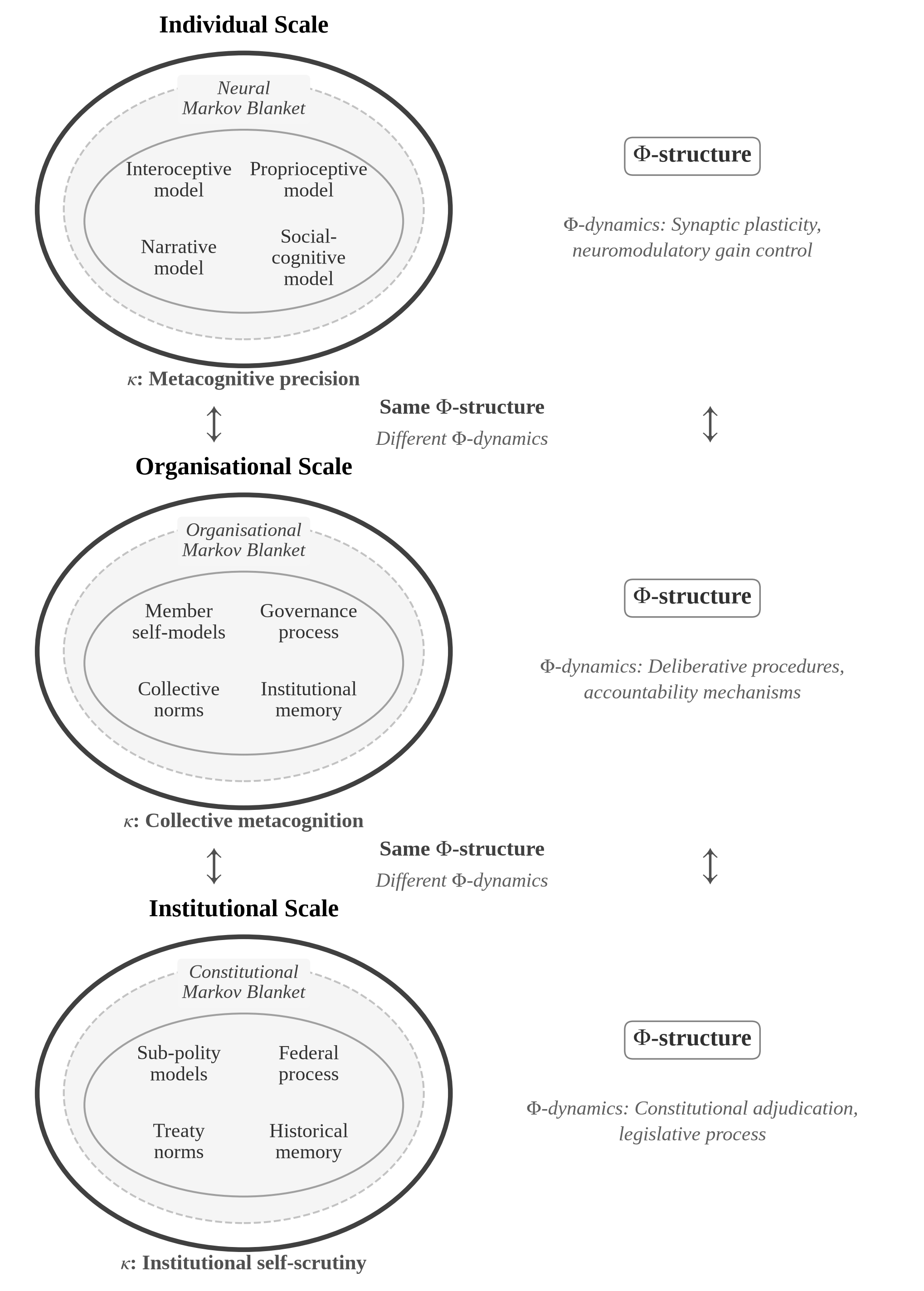
Figure 1. Φ‑structure across scales. The same variational architecture (self-model maintenance through prediction-error minimisation, bounded by a Markov blanket, weighted by metacognitive precision κ) is instantiated at the individual scale and at organisational and institutional levels of the community scale through scale-specific Φ‑dynamics. Synaptic plasticity and neuromodulatory gain control, deliberative procedures, and constitutional adjudication are different mechanisms implementing the same compositional form.
2. The Scale-Free Self-Model
2.1 The Individual as Composition
The argument begins not at the collective scale but at the individual one, by demonstrating that the individual self-model is itself a composition in precisely the sense that social ontology reserves for groups. Consider the sub-personal processes constituting the predictive hierarchy underlying selfhood. Interoceptive inference maintains a model of visceral states, generating predictions about cardiac rhythm, respiratory pattern, and gut sensation that are continuously compared against ascending sensory signals (Seth, 2013). Proprioceptive inference maintains a model of the body in space, integrating vestibular, kinaesthetic, and visual reafference to produce the felt sense of embodiment (Limanowski & Blankenburg, 2013). Social-cognitive inference maintains a model of the self-as-seen-by-others, drawing on mentalising networks to predict how one’s behaviour will be interpreted by conspecifics. Narrative-temporal inference maintains a model of the self across time, binding episodic memory, prospection, and self-continuity into an autobiographical structure.
Each of these processes operates as a predictive model with its own precision weighting, its own characteristic prediction errors, and its own update dynamics. The interoceptive model updates on a timescale of seconds. The narrative-temporal model updates on a timescale of years. They conflict regularly, as when interoceptive signals of anxiety are overridden by narrative self-models of confidence, or when social-cognitive predictions of rejection conflict with proprioceptive signals of approach motivation. The phenomenology of ambivalence, internal conflict and self-surprise are all evidence of the heterogeneity of the processes composing the individual self-model.
The self-model, on the account developed in Morrison (2026b) and extended here, is the Markov blanket that integrates these sub-personal processes into a unified (although never fully coherent) predictive structure. This is an extension beyond Morrison (2026b), which treated the self-model as a single posterior distribution without decomposing it into sub-personal components. The integration is achieved not by eliminating heterogeneity but by establishing precision-weighted relationships in which higher-level predictions constrain lower-level processing and lower-level prediction errors propagate upward. The individual is already a composed entity. ‘You’ are the composition of these processes, held together by the blanket dynamics that integrate their respective contributions to a unified self-model.
If the individual is already a composition, then the question of how individuals compose into collectives is not a question about how atomic units aggregate into wholes. It is a question about whether the same compositional dynamics that operate within individuals also operate between them, and if so, under what conditions. The reframing therefore resolves the composition question without presupposing an asymmetry between individual and collective.
2.2 Φ‑Structure and Φ‑Dynamics
Φ‑structure designates the variational form shared across scales of identity constitution, the process whereby a system maintains a self-model through prediction-error minimisation over self-model parameters, bounded by a Markov blanket that separates internal from external states, and weighted by metacognitive precision κ. Φ‑dynamics designates the scale-specific mechanisms through which Φ‑structure is instantiated in a particular substrate.
At the individual scale, Φ‑structure is instantiated through neural Φ‑dynamics involving synaptic plasticity, neuromodulatory gain control and hierarchical cortical architecture. At the community scale, Φ‑structure is instantiated through institutional Φ‑dynamics involving deliberative procedures, constitutional structures, accountability mechanisms and the informational architectures through which collective self-models are maintained. Φ‑structure is thus the same across scales, whereas Φ‑dynamics differ.
This is offered as a ‘same causal type’ reading, positioned between two alternatives the paper rejects. The weak alternative would be mere isomorphism, too weak because it provides no explanatory gain. The strong alternative would be metaphysical identity, too strong because it ignores substrate differences. Two systems share a causal type when they instantiate the same variational structure, when that shared structure explains their shared behavioural profile, and when interventions on the structure’s parameters produce analogous effects despite substrate differences.
The ‘same causal type’ reading, on which the paper’s ontological claim relies, must be distinguished from standard functional isomorphism if it is not to collapse into either mere analogy or undefended metaphysical identity. Functional isomorphism, in the sense employed since Putnam (1967), describes input-output equivalence. Two systems are functionally isomorphic when they map the same inputs to the same outputs under a suitable description. The ‘same causal type’ claim goes beyond functional isomorphism in a specific respect. It asserts not merely that individual and collective identity systems produce equivalent outputs given equivalent inputs, but that the internal mechanism (prediction-error minimisation over self-model parameters, bounded by Markov blanket constraints, modulated by metacognitive precision) is the same operation at both scales. The distinction matters because functional isomorphism permits two systems to achieve equivalent mappings through entirely different internal processes. The ‘same causal type’ claim denies this possibility for identity constitution, holding that precision-weighted self-model revision under blanket constraints is what constitutes identity, and that a system achieving equivalent outputs through a lookup table rather than genuine prediction-error minimisation would not count as the same causal type.
The ‘same equation does not entail the same process’ objection must be addressed directly. The wave equation describes both ocean waves and electromagnetic radiation, and no one concludes that the ocean is electromagnetic. The present claim is stronger than formal similarity, however, because it is grounded in a specific causal mechanism that is not merely described by the same mathematics but implemented through substrate-appropriate realisations of the same computational process. Whether this intermediate position is ultimately tenable is an empirical question addressable through the intervention asymmetry tests specified in Section 2.4: if interventions on κ produce analogous effects at both individual and collective scales, the ‘same causal type’ claim is supported in a way that mere functional isomorphism would not predict.
κ functions as the identity criterion. Not all Markov blankets constitute identity. A thermostat has a Markov blanket and minimises prediction error yet does not model its own modelling processes. It does not weight its own modelling with differential precision, and it does not exhibit higher-order prediction errors concerning its own inference reliability. κ is what separates identity-constituting Markov blankets from merely homeostatic ones. The justification for selecting κ over alternative candidates (complexity, temporal depth, dimensionality) is that κ uniquely captures the recursive structure whereby a system’s modelling process is itself an object of modelling. Without κ, a system may model many dimensions with considerable sophistication yet remain incapable of revising its modelling process in response to evidence about that process’s reliability.
A smart thermostat, one with an adaptive learning rate, has a single meta-parameter governing first-order dynamics. This does not constitute κ in the framework’s sense, because κ requires a generative model of the system’s own modelling process, a model rich enough to generate predictions about how the system will respond to novel self-referential queries and to detect prediction errors when those predictions fail. The distinction is one of dimensionality and generativity. A single adaptive parameter is a scalar adjustment, whereas κ is a structured model capable of generating expectations across multiple dimensions of self-representation. The four-signature protocol (Morrison, 2026f) operationalises this distinction empirically; a system with genuine κ should exhibit calibrated uncertainty (S2, where its confidence tracks its actual variability) and posterior inertia (S1, where its resistance to perturbation scales with its certainty). A smart thermostat with an adaptive learning rate would fail both signatures.
The S1 signature has been tested across multiple operationalisations and fails under the standard interleaved protocol across all tested systems, although a blocked design passes it for Llama 3.1 8B, which makes the failure dependent on design and model (Morrison, 2026g). The construct may require reconceptualisation, since perturbation resistance appears to track training prior strength rather than output variability as originally specified. S2 is not reliably present either, as single runs passed for two systems whereas replicated draws show the relation between confidence and cross-session variance negative in every draw and passing in a minority. Neither signature is therefore secure in its current formulation, and no tested system reliably reaches three of the four signatures (Morrison, 2026g).
The κ criterion is graded above the threshold but functional at the threshold. Results to date, with no system reliably reaching 3/4 signatures (single high-power runs reached 3/4 and replicated draws do not sustain them; Morrison, 2026g), are consistent with the prediction that current artificial systems approach but do not achieve genuine κ.
2.3 Intellectual History
The claim that identity is processual and scale-transcendent has deep philosophical roots. Whitehead’s (1929) process philosophy rejects substance ontology, treats composition as processual, and recognises multi-scale dynamics. Three features of the present framework go beyond Whitehead: κ as a graded composition measure, testable predictions (Section 9), and the Markov blanket as a precise boundary condition.
Within the active inference literature, the contributions noted in Section 1 (Ramstead et al., 2018; Kirchhoff et al., 2018; Veissière et al., 2020) develop multi-scale dynamics without making the specific claim advanced here.
Thestrup Waade et al. (2025), in ‘As One and Many,’ represent the closest formal predecessor. Their framework demonstrates that individual-level generative models can give rise to emergent group-level generative models, establishing that multi-scale active inference is formally tractable. The present paper contributes beyond their framework in four respects: the Φ‑structure/Φ‑dynamics distinction naming the invariant variational form, the κ identity criterion discriminating identity-constituting compositions from merely homeostatic ones, empirically operationalisable composition conditions, and falsifiable predictions connected to the four-signature protocol (Morrison, 2026f). The present paper’s contribution is thus not multi-scale active inference per se but the application of that framework to the identity question with the Φ‑structure/Φ‑dynamics distinction and empirical operationalisation as its novel apparatus.
Buddhist traditions, particularly the doctrine of anatta (non-self), share the framework’s rejection of substantial selfhood whilst disagreeing on the reality of the composite self-model, which the present account treats as functionally real insofar as it does causal work.
The mereological tradition provides the sharpest point of comparison. Van Inwagen (1990) poses the Special Composition Question directly, asking under what conditions objects compose a further object. His answer, that composition occurs if and only if activities constitute a life, restricts genuine composites to biological organisms. The Markov blanket criterion preserves van Inwagen’s anti-universalism (not everything composes) while providing a broader and formally more precise criterion applicable beyond biological organisms.
2.4 The Composition Criterion
When does Φ‑structure produce genuine composition rather than mere aggregation? The question is unavoidable, and a framework claiming to resolve the composition problem must provide a principled answer.
A genuine composite exists when three conditions obtain simultaneously. First, a Markov blanket must be identifiable that separates the composite’s internal states from its external environment while being constituted by the states of its component parts. Second, the composite must maintain a self-model through prediction-error minimisation across the blanket boundary, exhibiting the Φ‑structure characterised in Section 2.2. Third, the composite must exhibit metacognitive precision (κ), however rudimentary, such that its own modelling processes are themselves objects of higher-order modelling. The third condition is the critical discriminator. A starling flock has a Markov blanket (the boundary of the flock distinguishes internal from external dynamics) and arguably minimises prediction error (each bird’s local rules produce globally coherent behaviour). Yet the flock does not model its own modelling processes. There is no mechanism through which the flock-as-composite reflects on the reliability of its own collective inference. A constituted polity, by contrast, maintains institutional mechanisms (courts, auditors, oversight bodies, free press) through which its collective modelling processes are themselves subjected to scrutiny and revision. The polity has κ; the flock does not.
A circularity objection follows. If Markov blankets are observer-relative (Bruineberg, Kiverstein & Rietveld, 2018), then the composition criterion may be projective rather than discovered, reflecting the analyst’s modelling choices rather than objective compositional facts. The response proceeds on two fronts. First, as conceded in Morrison (2026b), the framework restricts its claims to formally constituted structures, those whose blanket boundaries are maintained by explicit institutional mechanisms (constitutions, membership criteria, governance procedures) rather than being merely statistically identifiable. This restriction narrows the domain of application while preserving empirical traction, because formally constituted structures provide non-arbitrary blanket boundaries.
Second, and more importantly, the criterion demands an independent empirical signature of composition, which the paper terms ‘intervention asymmetry.’ Intervention asymmetry obtains when a perturbation applied at the group level (a constitutional crisis, a trade embargo, the disbanding of the group itself) produces effects on members’ subsequent behaviour that exceed what is predictable from a model containing only individual-level variables (individual psychological profiles, individual resource endowments, individual social network positions). The excess is measured as residual variance in member behaviour after controlling for individual-level predictors, and the signature is genuine when the group-level perturbation’s effects are mediated by the group’s self-model (its governance structures, collective norms, institutional memory) rather than by mere aggregation of individual responses. If disbanding a committee produces effects on its former members’ behaviour not predictable from their individual psychological profiles, this constitutes evidence that the committee was a genuine composite. The empirical signature is independent of the blanket identification and thereby breaks the circularity.
Van Inwagen’s (1990) answer to the Special Composition Question restricts genuine composites to biological organisms, awkwardly excluding artefacts, organisations, and nations. Under the Markov blanket criterion, composition occurs when Φ‑structure is instantiated with κ, regardless of whether the substrate is biological, institutional, or artificial.
3. Collective Metacognition: κ at Every Scale
3.1 κ for Communities
At the individual level, metacognitive precision κ determines whether prediction errors are merely registered or are reflected upon, weighted for reliability, and integrated into self-model revision (Morrison, 2026b). An individual with high κ does not simply experience dissonance between self-model and evidence. Rather, the individual models the dissonance itself, assessing its reliability, its implications for existing self-understanding, and the appropriate magnitude of self-model revision.
The preceding description emphasises κ’s role in enabling responsive updating. Empirical investigation suggests, however, that κ may equally index precision-as-investment, the selective allocation of precision resources to protect identity-relevant dimensions from perturbation (Morrison, 2026g). High-κ individuals are more variable overall across the full parameter space, yet they are specifically more stable on dimensions where they have invested substantial precision, dimensions central to their identity structure, although the direct test (P‑KAI1 in that paper) did not replicate the pattern. The ‘appropriate magnitude of self-model revision’ may frequently be zero, because a high-κ system can assess whether a prediction error warrants model revision or whether the existing model should be maintained on the basis of strong prior evidence. The dual function (informed updating where uncertainty is high, informed protection where precision has been invested) enriches the κ criterion, suggesting metacognitive precision operates as a resource allocation mechanism rather than a uniform update-rate parameter.
At the community level, collective metacognitive capacity is best analysed as a structured distribution with four identifiable dimensions (Figure 2). Aggregate κ designates total metacognitive precision available. A society with a free press, independent judiciary and functioning parliament has higher aggregate κ than one lacking these institutions. κ-access designates who can contribute to collective self-model updating. κ-responsiveness designates whether the governance blanket actually updates in response to κ signals. κ-anisotropy designates dimension-selective precision, in which a community exercises high metacognitive sensitivity along certain dimensions (economic performance, military security) while exhibiting enforced insensitivity along others (minority rights, environmental degradation).
These four dimensions are proposed as theoretical constructs, and the paper does not claim that they can be measured with the precision of individual-level κ (itself a theoretical construct with proxy measures rather than direct operationalisation). They do, however, correspond to identifiable empirical proxies. Press freedom indices (such as the Reporters Without Borders World Press Freedom Index) function as proxies for aggregate κ and κ-access jointly. The Discourse Quality Index (Steenbergen et al., 2003) provides a proxy for the quality of deliberative κ-processing within parliamentary contexts. Soroka & Wlezien’s (2010) thermostatic model of public opinion and policy, demonstrating that democratic governments adjust policy in response to shifts in public preferences, provides a proxy for κ-responsiveness. No single existing measure captures κ-anisotropy, which requires comparison across dimensions rather than aggregate assessment.
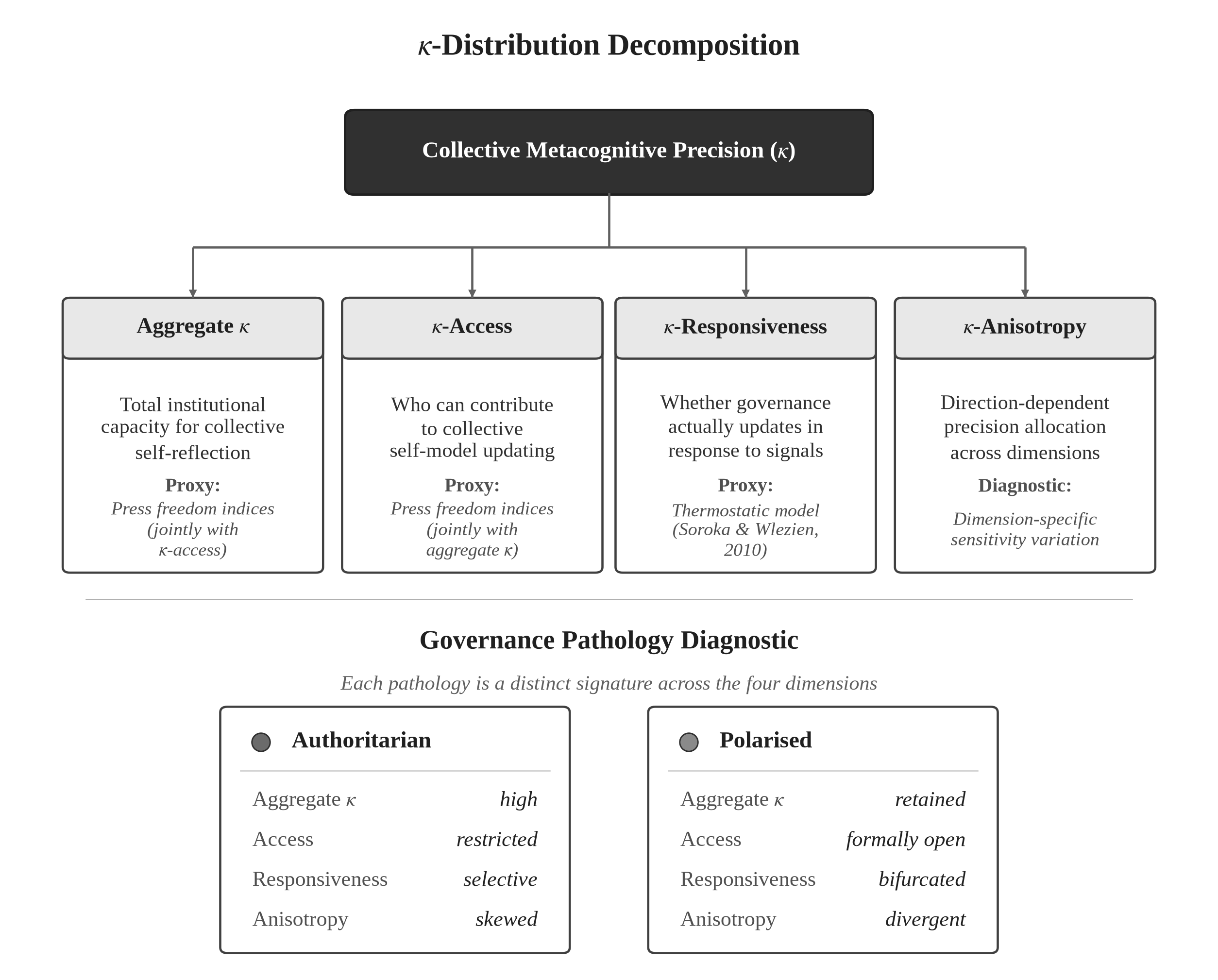
Figure 2. κ‑distribution decomposition. Collective metacognitive precision decomposes into four structured dimensions: aggregate κ (total institutional capacity), κ‑access (who contributes), κ‑responsiveness (whether governance updates in response to κ signals), and κ‑anisotropy (direction-dependent precision allocation). The decomposition generates dimension-specific predictions about governance pathology that scalar accounts cannot produce. The lower panel gives illustrative, qualitative signatures of the two pathologies analysed in Sections 3.2 and 3.3, authoritarian governance and polarised democracy.
3.2 Governance Pathologies as κ‑distribution Disorders
The framework’s analytical value is most apparent when applied to governance pathologies, where the structured κ-distribution analysis generates predictions differing from simpler accounts.
A naive application might predict that authoritarian regimes have ‘low κ’ and cannot maintain coherent collective self-models. This prediction is empirically falsified by competent authoritarian states. Singapore’s governance blanket maintains a highly coherent collective self-model, updating effectively in response to economic and geopolitical prediction errors. China’s governance institutions process enormous volumes of information and adjust policy with remarkable speed along certain dimensions. The problem with authoritarianism pertains to the specific distribution of κ: high aggregate κ (competent institutional capacity for information processing), restricted κ-access (only regime-aligned actors can contribute to collective self-model updating), and critically, anisotropic κ-responsiveness (high sensitivity along regime-survival axes combined with enforced insensitivity along axes threatening regime legitimacy). China’s governance institutions are exquisitely responsive to economic growth signals, social stability indicators and geopolitical positioning while being systematically unresponsive to signals concerning political dissent, ethnic minority welfare and historical accountability. Authoritarian governance maintains coherence through this κ-anisotropy, achieving high precision along selected dimensions at the cost of accumulating unprocessed prediction errors along suppressed dimensions.
This analysis generates a specific and testable prediction distinguishing it from both naive democratic triumphalism and value-neutral institutional analysis. Authoritarian regimes accumulate unprocessed prediction errors specifically on dimensions where κ has been suppressed. When crisis manifests, it manifests on those dimensions rather than on dimensions where κ-processing is active. The Soviet Union’s collapse can accordingly be read as driven not only by economic or military failure (the dimensions along which its κ-processing was most active) but also by legitimacy crisis, ethnic nationalism and informational bankruptcy, precisely the dimensions along which κ had been most systematically suppressed. The prediction generalises not as a short-term dynamic (competent authoritarian states can suppress prediction errors for decades through coercive precision) but as a long-run structural vulnerability. The timeline matters here; the paper does not predict that authoritarianism is self-defeating on any particular schedule, only that accumulation of unprocessed prediction errors on κ-suppressed dimensions creates structural fragility that eventually exceeds the regime’s capacity for coercive management. Initial empirical tests using V‑Dem data support the broader distributional claim, as 22 of 26 coder-level tests found that distributional shape adds predictive value for political instability beyond conventional controls (Morrison, 2026g). The dimension-specific prediction itself has not yet been tested, and the temporal component remains a limitation requiring specification of decay functions linking accumulation rates to crisis probability.
The analysis extends to hybrid regimes and competitive authoritarian systems, which exhibit a characteristic pattern in which formal democratic institutions provide the appearance of broad κ-access while actual κ-responsiveness is restricted to regime-compatible signals.
3.3 Fragmented κ and Democratic Crisis
Authoritarian governance suppresses κ-access and distorts κ-responsiveness. Democratic crisis presents a structurally different pathology in which κ-access remains formally open but κ-processing has bifurcated. Political polarisation, on the present analysis, is a κ-fragmentation disorder, a condition in which different sub-populations process different evidence with different precision weightings, and no integrative mechanism composes their divergent updates into a coherent collective self-model revision.
The structural analogy is to dissociative processes at the individual level (offered as formal parallel, not clinical diagnosis). In dissociative identity, the individual’s sub-personal inference processes fail to compose into a unified self-model, with different self-states processing different experiential domains with incompatible precision structures. The individual does not lose κ; κ becomes fragmented across non-communicating self-states. Polarised democracies exhibit a formally parallel structure, although one requiring a qualification concerning scope. Political sub-populations in a polarised democracy are not formally constituted in the sense required by Section 2.4; their blanket boundaries are analytically identified rather than institutionally maintained, and the Bruineberg et al. (2018) constraint applies. The analysis is offered as an extension beyond the framework’s strictest domain, since the informational ecosystems of polarised sub-populations exhibit sufficiently stable boundary conditions (algorithmically reinforced media environments, geographically sorted communities) to warrant provisional blanket identification. Citizens continue to process metacognitively, and the collective self-model fragments because they do so within separate Markov blankets lacking the integrative mechanism and the institutional architecture required to compose their divergent updates.
This analysis generates a testable prediction. Communities with higher deliberative integration (measured through cross-partisan institutional engagement, mixed-ideology media consumption, and the quality of inter-group deliberative forums) should show lower κ-fragmentation and more coherent governance outcomes, controlling for the degree of underlying value disagreement. The control is essential, since the prediction is not that deliberative integration eliminates disagreement (a naive prediction falsified by every functional democracy), but that it maintains the integrative κ-processing that allows disagreement to produce collective self-model revision rather than collective self-model fragmentation. Two communities with identical distributions of policy preferences may differ dramatically in governance coherence depending on whether their κ-processing is integrated or bifurcated.
3.4 κ Across Overlapping Institutions
The analysis thus far has treated communities as though they possess singular governance blankets, but any modern polity involves overlapping, nested and sometimes competing blanket structures. The EU, NATO, treaty regimes, standards bodies, and professional associations all maintain their own Markov blankets with their own κ-structures, overlapping in complex ways with national governance blankets. The paper declines to advance a single-blanket claim for civilisational identity, as such a claim would overextend the framework beyond the domain where the composition criterion can be applied with confidence, and the Bruineberg et al. (2018) constraint applies with full force at this scale.
What the framework does support is analysis of how κ-structures compose across overlapping formal institutions. Each has its own blanket and κ-distribution. The aggregate behaviour of these overlapping blankets can be analysed without positing their unity. The useful question is not ‘does Western civilisation have an identity?’ but rather ‘how do the κ-structures of overlapping formal institutions interact, and what patterns of inter-blanket coordination or conflict emerge?’
This framing illuminates a class of problems existing frameworks handle awkwardly. Climate change generates prediction errors exceeding any single institutional blanket’s capacity. The deficit is one of inter-blanket coordination, being the absence of institutional Φ‑dynamics through which prediction errors registered by individual blankets (national scientific assessments, IPCC reports, insurance industry risk models) are composed into a collective response. The Paris Agreement can be understood as an attempt to construct inter-blanket κ-coordination mechanisms, although one whose κ-responsiveness remains limited by sovereignty constraints.
4. The Diversity-Alignment Resolution
4.1 The Paradox Stated
The social free energy framework inherited from Morrison (2026b) generates an apparent contradiction when extended to collective identity. Low social free energy requires that individual self-models and the community’s aggregate self-model maintain approximate alignment, so that prediction errors flowing across governance-constituted Markov blankets remain tractable for all parties. Yet the literature on collective intelligence demonstrates with considerable formal precision that cognitive diversity is a prerequisite for high-quality collective problem-solving. Hong & Page (2004) establish that diverse problem-solvers outperform uniformly high-ability ones under conditions of sufficient solution landscape complexity. Van Knippenberg et al. (2004) document elaboration mechanisms through which diversity improves group decision-making. Woolley et al. (2010) provide evidence for a collective intelligence factor.
The tension is genuine within the formalism. A community that minimises social free energy by maximising alignment across all dimensions would converge on monoculture, generating few informative prediction errors and responding poorly to environmental perturbation, a system sacrificing accuracy for low complexity. Conversely, a community maximising diversity across all dimensions would experience chronic misalignment, generating prediction errors so numerous and heterogeneous that no coherent collective self-model could integrate them. Neither extreme is viable. The question is whether the formalism provides principled grounds for identifying which dimensions should be aligned, and which diverse, or whether the framework merely restates the problem.
4.2 Dimensional Decomposition
The resolution rests on a distinction implicit in the Markov blanket formalism. The identity parameter space D can be partitioned into two subsets with distinct functional roles. Blanket-constitutive dimensions B are those whose alignment is necessary for governance blanket coherence. Internal dimensions I = D \ B are parameters over which individuals vary without threatening blanket integrity.
A dimension is blanket-constitutive to the extent that disagreement on it undermines the governance process through which the collective integrates prediction errors. If members disagree on whether majority voting, consensus or hierarchical decree constitutes legitimate decision-making, they cannot operate the κ-processing mechanism. Disagreement on substantive policy preferences, by contrast, generates prediction errors that a functioning governance mechanism can integrate productively.
Conjecture 1. Diversity on internal dimensions I reduces aggregate social free energy when collective κ is high, provided the governance mechanism’s integration capacity is sufficient to process the additional prediction-error volume generated by population heterogeneity. The intuitive argument proceeds as follows. A population diverse on internal dimensions generates a richer set of prediction errors when encountering novel environmental states, because different members’ self-models are surprised by different features of the same event. High collective κ enables the governance mechanism to integrate these heterogeneous prediction errors into a more accurate community self-model, one that captures environmental structure which an homogeneous population would miss. The collective self-model’s accuracy improves, reducing long-run costly surprise. This conjecture is not derived from the formalism. Deriving it would require formally connecting population-level variance to the aggregate social free energy functional. Three conditions are necessary: precision-weighted mixture integration that preserves the multimodal coverage of a diverse population (A4 below), structured environments (multimodality, heavy tails, non-stationarity), and accuracy gains dominating complexity costs (the KL divergence term increases with integration complexity).
Conjecture 2. Diversity on blanket-constitutive dimensions B increases social free energy. When members disagree on the governance dimensions defining the Markov blanket itself, the boundary becomes incoherent. Prediction errors that one member regards as legitimate governance signals, another regards as illegitimate interference. The κ-processing mechanism cannot operate because there is no shared agreement on what counts as a prediction error requiring collective response. The blanket fragments, aggregate social free energy increases, and the collective identity dissolves into competing sub-communities, each attempting to constitute its own blanket.
A simplified model illustrates the mechanism. Consider a one-dimensional parameter θ with the community distribution modelled as Gaussian: P(θ) ~ N(, ). When is high (diverse population) and θ is an internal dimension, each member’s posterior generates prediction errors centred at different points. A high-κ governance mechanism attending to the full distribution of prediction errors can reconstruct environmental structure more accurately than a low-variance population whose errors cluster near . When θ is instead a blanket-constitutive dimension, high means that members disagree on what constitutes the boundary of the collective, and the integration mechanism itself becomes contested.
4.2.1 Proof Sketches
The proof sketches require six simplifying assumptions, stated explicitly so that the scope of the result is transparent.
(A1) One-dimensional internal and blanket-constitutive spaces.
(A2) Gaussianity: each agent’s generative model is Gaussian on each dimension.
(A3) The true environmental distribution on internal dimensions is a mixture of K Gaussians, whereby the mixture structure rewards diverse coverage.
(A4) The governance integration mechanism produces a collective posterior that is a precision-weighted mixture of individual posteriors. This mixture formulation, in contrast to Bayesian fusion (which would collapse individual Gaussians into a single unimodal Gaussian), preserves the multimodal structure of a diverse population’s coverage.
(A5) Exchangeability.
(A6) Coverage: the agent means are distributed such that each mixture component in the environmental distribution has at least one agent within its support.
Proof Sketch for Conjecture 1. Under A1 through A6, an homogeneous population concentrates its collective coverage at a single point, achieving low KL divergence to at most one mixture component and incurring high divergence from all others. A diverse population distributes agent means across the parameter space. The expected log-likelihood of the collective mixture posterior under the true distribution increases with population diversity. By Jensen’s inequality applied to the mixture posterior, the log-likelihood under the true distribution p is log((θ)), where is the posterior of member i and its precision weight, and the mixture’s capacity to place probability mass near each environmental mode ensures that it exceeds any homogeneous posterior when the coverage condition holds. The complexity cost C(G) of the governance mechanism G increases with diversity, but under sufficiently high κ the accuracy gain dominates.
The result holds under the conjunction of Gaussianity, mixture-structured environments, precision-weighted mixture integration, sufficient collective κ, and coverage. The proof breaks when any condition fails, as under integration that collapses the population to a single mode (the average of member estimates or Bayesian fusion), unimodal environments, or low κ. Extension to the general high-dimensional case requires additional assumptions about covariance structure.
Proof Sketch for Conjecture 2. Diversity on blanket-constitutive dimensions disrupts the conditional independence required for Markov blanket coherence. When agents hold diverse models of blanket-constitutive parameters, the effective governance mechanism becomes a mixture of inconsistent mechanisms. The conditional independence condition, = , fails when blanket states are generated by inconsistent governance parameterisations. The result is increased aggregate social free energy through two channels: prediction errors leak through the incoherent blanket, and the governance mechanism’s complexity increases as it reconciles inconsistent parameterisations.
The formal barriers to complete proofs are identified with precision. Conjecture 1 requires extension to the general high-dimensional case, specification of the κ threshold, and a formal bound on the accuracy-complexity trade-off. Conjecture 2 requires a general theory of blanket coherence under heterogeneous parameterisation. Both conjectures are supported by the simplified analysis under stated assumptions, and the assumptions identify conditions under which they might fail.
4.3 Which Dimensions Are Blanket-Constitutive?
Morrison (2026a) proposes four dimensions of civic identity (Authority Source, Commons Relationship, Governance Preference, and Pluralism Processing), with Sovereignty Orientation positioned as the outcome variable the four dimensions predict, and the blanket/internal partition generates specific predictions about which should be aligned, and which diverse. Governance Preference, capturing whether a member favours hierarchical, deliberative or distributed decision-making, is the strongest candidate for blanket-constitutive status, because disagreement on decision procedure undermines the procedure itself; a collective whose members reject its basic decisional form cannot operate a stable governance mechanism. Authority Source occupies a middle position. Moderate diversity is compatible with blanket integrity provided meta-procedures exist for adjudicating authority claims. Pluralism Processing, capturing how members handle persistent disagreement, should be diverse, as members who process pluralism through engagement, avoidance, synthesis, and contestation generate different prediction errors, and high κ can integrate these diverse strategies into a more resilient collective response. Commons Relationship can tolerate moderate diversity, particularly under Ostrom’s (1990) design principles for managing common-pool resources, which function as blanket-constitutive meta-agreements enabling diverse commons orientations to coexist. Sovereignty Orientation, no longer an input dimension, enters the partition differently. As the outcome the four dimensions predict, its convergence across members functions as a diagnostic of blanket integrity rather than a precondition for it; a collective in which some members regard the community as ultimate authority while others regard it as voluntary association cannot operate a stable governance mechanism, and on the revised architecture that incompatibility manifests as divergent predicted sovereignty orientations rather than as misalignment on a measured input dimension.
The classification generates a testable prediction. Communities aligned on blanket-constitutive dimensions but diverse on Pluralism Processing should exhibit lower aggregate social free energy and higher collective performance on novel problem-solving tasks than uniformly aligned communities.
Page’s (2007) diversity prediction theorem provides the most direct formal antecedent; for the simple average of numerical predictions, a group’s collective squared error equals the average individual squared error minus the group’s diversity. The present framework provides a candidate mechanism for how diversity lowers collective error in identity-constituting collectives, with κ-mediated prediction-error integration serving as the channel through which diverse models improve collective accuracy. Van Knippenberg et al.’s (2004) Categorisation-Elaboration Model identifies ‘information elaboration’ as the moderator. The present framework’s moderator, collective κ, is related to but not identical with elaboration. A study separating these constructs could test whether κ mediates the diversity-performance relationship after controlling for elaboration.
4.4 Exclusionary Implications and Their Limits
The dimensional decomposition carries an uncomfortable implication. If blanket-constitutive alignment is necessary for collective identity, then communities have principled grounds for excluding individuals whose governance orientations diverge too far. This formalises a mechanism that could legitimate exclusionary practices, and the paper does not pretend otherwise.
Three considerations limit this concern without eliminating it. First, blanket-constitutive dimensions are themselves subject to renegotiation. The framework models blanket evolution, not blanket permanence. Second, Mouffe’s (2005) agonistic pluralism provides a counterpoint; blanket-constitutive alignment need not require agreement on substantive governance preferences, only agreement on the meta-process through which disagreements are adjudicated, as federalism exemplifies. Third, the framework models what IS (conditions under which collective identity persists), not what OUGHT to be (which identities are morally permissible). The normative question requires resources beyond information theory.
The critical-theoretic concern is well-taken. The B/I partition will in practice reproduce existing power asymmetries if performed by those who currently hold governance authority. Two safeguards are proposed, neither fully resolving the concern. First, the partition should be subject to BY-mode collective deliberation (Section 7.2), since the question of which dimensions are blanket-constitutive is itself a governance question that the collective must answer for itself. Second, the partition should be empirically constrained; a dimension is blanket-constitutive if and only if high within-population variance on that dimension predicts governance failure within a specified observation period. This empirical criterion prevents the partition from being purely a matter of political preference, although it does not eliminate normative judgement entirely. The framework’s position is that the B/I partition is a normatively laden decision that the framework makes tractable but does not resolve.
5. Φ‑Structure Without Phenomenology
At the individual level, Φ‑structure is accompanied by phenomenal experience. The extensive literature on consciousness science, from global workspace theory (Baars, 1988; Dehaene & Naccache, 2001) through integrated information theory (Tononi, 2004) to higher-order theories (Rosenthal, 2005; Lau & Rosenthal, 2011), provides converging evidence that phenomenal experience accompanies recursive self-modelling in neural substrates. At the collective level, the question is whether Φ‑structure also entails phenomenal character. The options range from collective phenomenal consciousness (implausible given current evidence) through distributed phenomenology (facing the combination problem; Chalmers, 2016) to pure functionalism. The paper adopts the last.
Φ‑structure is formally identical across scales in the sense specified by the Φ‑structure/Φ‑dynamics distinction. Phenomenal character depends on substrate and mechanism in ways the formal framework cannot determine. Collective Φ‑structure over institutional processes constitutes genuine functional self-modelling that does causal work (shaping member selection, institutional evolution, collective action and boundary maintenance) without the paper claiming collective phenomenal consciousness. The collective genuinely models itself, genuinely updates that model, and genuinely acts on its basis. The paper makes these claims literally, and it does not assert that there is something it is like to be a nation.
This position is not eliminativism about collective identity. The functional self-modelling constituting collective Φ‑structure is real in the fullest sense available to social ontology. It has causal consequences, empirically measurable signatures (the κ metrics developed in Section 3), and explanatory power that mere aggregation cannot replicate. What the paper concedes is that the hard problem of consciousness (Chalmers, 1995) is relocated rather than solved.
Schwitzgebel (2015) argues that if functionalism is correct and if its conditions can be met by non-brain systems, then some collectives may be conscious. The conditional structure is critical, since Schwitzgebel does not assert collective consciousness but demonstrates that functionalism commits one to taking the possibility seriously. The present framework’s qualified functionalist position must engage this conditional directly. If Φ‑structure is formally identical across scales (as claimed) and if phenomenal consciousness supervenes on functional organisation (as functionalism holds), then the framework is committed to the conditional possibility. The resolution lies in the Φ‑structure/Φ‑dynamics distinction; two systems can share Φ‑structure yet differ in Φ‑dynamics, and it is an open empirical question whether collective Φ‑dynamics are of the kind generating phenomenal experience. The framework’s functionalism commits it to the conditional possibility but does not require asserting the consequent.
Huebner (2014) identifies specific cognitive-architectural conditions for group minds, robustly distributed representations and flexible integration mechanisms. The κ criterion adds a requirement absent from Huebner’s account. The system must model its own modelling, not merely distribute representations. This distinguishes genuine collective identity from distributed cognition without self-reference.
The Φ‑structure notation shares the Greek letter Φ with Tononi’s (2004) integrated information theory, in which Φ denotes a quantitative measure of consciousness. The constructs are distinct; Φ‑structure denotes a variational architecture, whereas Tononi’s Φ denotes a measure of information integration. A formal relationship may exist but is conjectural.
The framework supports a three-level hierarchy of collective mentality. At the first level, a collective with a shared generative self-model but without κ exhibits group belief (consistent output patterns without self-monitoring). At the second level, a collective with a self-model and κ exhibits group agency (the capacity to monitor and revise its own representational states). At the third level, a collective with the appropriate Φ‑dynamics may exhibit group consciousness. The four-signature protocol (Morrison, 2026f) distinguishes the first from the second level; distinguishing the second from the third requires phenomenological criteria the present framework does not supply and explicitly declines to adjudicate.
6. The Bootstrapping Problem
6.1 The Circularity
Every account of collective identity formation confronts a circularity that the present framework makes formally explicit. A community selects members (whether through immigration policy, hiring decisions, admission criteria or informal social filtering) based on alignment between the candidate’s identity distribution and the community’s existing distribution. The community’s distribution, however, IS the composition of its members’ distributions, weighted and shaped by governance-constituted processing. Selection requires the community model; the community model requires members, and members are selected by the model. Any adequate account of collective identity formation must address this circularity.
The problem is sharpened by the κ-structure developed in Section 3. Selection is not merely a matter of matching summary statistics but of aligning the full posterior distributions of candidates with the community’s aggregate posterior, including its uncertainty structure and its metacognitive precision.
6.2 The Fixed-Point Resolution
The circularity can be formalised as a fixed-point problem. Let Φ(M) denote the community’s self-model given membership set M, and S(Φ) the selection function determining which candidates are admitted given self-model Φ. The question is whether Φ(S(Φ(.))) has a fixed point.
Conjecture 3. Under continuous selection (small perturbations in the community model produce small changes in selection outcomes), compact parameter space (identity dimensions are bounded), convex parameter space (the identity parameter space admits interpolation), and continuous Φ, fixed-point existence follows from standard topological results. The Brouwer fixed-point theorem guarantees that any continuous function from a compact convex set to itself has a fixed point; the Schauder theorem extends this to infinite-dimensional spaces. Continuity of S is the most fragile assumption, because real selection processes exhibit threshold effects and veto players.
A simplified one-dimensional Gaussian model demonstrates the mechanism. Consider an identity parameter θ with the community distribution modelled as Gaussian. The selection function admits candidates whose θ falls within d standard deviations of the community mean. Under iterated selection-and-recomputation, the mean converges to the mode of the candidate population’s distribution (assuming a unimodal candidate pool), and variance contracts monotonically. The fixed-point is unique for a given candidate population and selection stringency d, and convergence is geometrically fast. The trade-off mirrors the diversity-alignment tension; stringent selection (small d) produces narrow fixed-point distributions, while permissive selection (large d) produces broader ones.
The convergence conditions for the general high-dimensional, non-Gaussian case remain open. Real identity distributions are multimodal, high-dimensional, and subject to non-continuous selection mechanisms. The Hegselmann & Krause (2002) bounded confidence literature provides the closest existing convergence results, demonstrating that opinion dynamics with bounded interaction thresholds converge to stable cluster configurations. The present framework extends this by embedding convergence within identity-constituting dynamics.
6.3 Path Dependence and the Founder Problem
Where the candidate pool is multimodal, the selection dynamics may have several fixed points, and the initial membership set may then determine which of them the process reaches; the Gaussian result of Section 6.2 does not show this, and the multimodal case is stated here as a conjecture. When a community is founded, determines the initial self-model, which determines the initial selection function, which determines first-round admissions. On this conjecture, founders exert outsized influence on the community’s long-run identity distribution, not because of ongoing authority but because they set the initial conditions of a convergent dynamical process. This founder effect is empirically well-documented in organisational studies (Baron et al., 1999) and the literature on institutional path dependence (Pierson, 2000). The framework offers a candidate mechanism, in which the founder’s identity distribution serves as the seed of a convergent selection-recomputation process and determines the attractor basin that process enters.
The correction mechanism is also identified by the framework. Cooperative governance structures mandating periodic reassessment of the community self-model (constitutional revision, regular re-evaluation of selection criteria, rotating governance roles) flatten the attractor landscape, reducing the founder’s long-run influence. Cooperatives with more frequent reassessment periods should show less founder-imprint in their long-run identity distributions (Prediction 5).
7. Power, Normativity, and the Limits of Information-Theoretic Governance
7.1 Power as Precision Manipulation
Power is formalised as the capacity to set or manipulate precision weights in the collective’s prediction-error processing, thereby shaping which aspects of the collective self-model are updated, which are held fixed, and which prediction errors are treated as informative signals versus noise.
Gramsci’s (1971) hegemony corresponds to the capacity to set default precision weights, in that the dominant group determines which governance outcomes register as ‘expected’ (low prediction error, not requiring model update) and which as ‘surprising’ (high prediction error, demanding response). An hegemonic arrangement is one in which the collective’s self-model assigns high precision to prediction errors threatening the dominant group’s position and low precision to errors revealing subordination. The self-model is not inaccurate in the narrow sense; it is selectively accurate.
Wheeler et al. (2020) apply precision-weighting to ideology within a predictive processing framework, demonstrating that shared ideological commitments function as socially coordinated priors. The present framework extends their contribution by relating it to Lukes’ (2005) dimensions of power. The first dimension (observable decision-making power) corresponds to κ-access, the question of which agents’ prediction errors reach collective deliberation. The second dimension (agenda-setting power) corresponds to the precision-weighting of prediction-error channels, determining which categories of observation are treated as relevant. Foucault’s (1980) power/knowledge analysis operates at this level, because the categories through which the collective interprets prediction errors are themselves products of power relations that the collective’s self-model does not represent.
The κ-distribution framework itself constitutes a knowledge-producing practice of the kind Foucault analyses under the heading of governmentality, since it proposes to render collective identities legible through a diagnostic apparatus that makes governance systems assessable and comparable. The framework participates in the power dynamics it analyses. This reflexive implication does not invalidate the framework, but it means that its deployment is itself a political act requiring the transparency that the TO/FOR/BY taxonomy demands (see the Positionality Statement).
Lukes’ third dimension, ideological power, the capacity to shape subordinated groups’ self-understandings such that they accept subordination as natural, cannot be formalised within the framework. The self-model’s categories are taken as given in the variational architecture. The framework can model how precision weights are distributed across existing dimensions but cannot formalise how power constitutes the dimensions themselves. A complete account must explain not only how communities process information within a given category structure but how the category structure is produced, contested, and transformed by power relations. The present framework requires supplementation from critical theory, cultural studies and the sociology of knowledge. Following Estlund (2008) and Habermas (1996), the formal epistemic argument from κ-distribution is adopted as a partial, not complete, case for distributed governance.
7.2 Normativity and Consent
Φ‑structure establishes necessary conditions for genuine collective identity: a governance-constituted Markov blanket (boundary), a self-model (recursive representation), and the capacity for that self-model to do causal work (active inference). These conditions are formal and structural. However, the paper argues that Φ‑structure alone is insufficient for the full sense of collective identity carrying normative weight, the sense in which a community can make claims on its members, generate obligations, and sustain what Strawson (1962) calls reactive attitudes directed at the collective level.
The missing element is consent, formalised as BY-mode governance within the TO/FOR/BY taxonomy (Morrison, 2026b). The taxonomy distinguishes identity processes done TO an individual (without consent), done FOR an individual (with awareness but without active participation), and owned BY the individual (with full agency, consent, and the capacity to withdraw). Full collective identity requires Φ‑structure PLUS consent, in that members have jointly committed to the governance process in BY-mode.
Gilbert’s (2014) joint commitment provides the normative dimension that dynamical coupling does not supply. Joint commitment generates obligations (each member owes continued participation) and standing to rebuke (each member can legitimately criticise failures to uphold the commitment). The present framework treats Φ‑structure as the necessary condition that commitment supplements, reversing Gilbert’s ordering, in which the commitment comes first and the group is constituted through it. This reversal is motivated by the observation that dynamical coupling can exist without consent (markets, mobs), whereas consent without dynamical coupling produces a declaration rather than a functioning collective. The ordering is not derivable from the formalism and remains open to dispute.
This has a discriminating consequence. Social media mobs exhibit coordinated behaviour and maintain implicit boundary conditions, and may satisfy a minimal reading of Φ‑structure conditions. Yet they lack joint commitment. Their participants have not consented to the mob’s governance, have no standing to make normative claims on one another, and bear no obligations. Market crowds exhibit analogous dynamical coupling without normative structure. The framework distinguishes genuine collective identities (organisations, cooperatives, polities with BY-mode governance) from mere aggregations (mobs, markets, trending topics) that exhibit dynamical regularity without normative binding.
8. Objections and Responses
8.1 ‘This Is Just an Analogy’
The objection holds that demonstrating the same mathematical equation at two scales establishes analogy, not identity, and that the paper trades on an equivocation between formal resemblance and causal equivalence. Neurons minimising free energy and parliamentary committees processing policy feedback may both be describable in variational terms, but so may thermostats and stock markets. The objection derives its force from the history of systems-theoretic analogies in which cybernetic metaphors were applied to organisations without producing the ontological conclusions the present paper claims (Ashby, 1956).
The response requires precision about what the paper does and does not claim. The claim is not metaphysical identity but same causal type, a weaker commitment than ontological equivalence and a stronger one than mere analogy. The Φ‑structure/Φ‑dynamics distinction is the direct answer; the paper acknowledges that mechanisms differ across scales and argues that the shared variational structure, in which prediction errors over self-model parameters are processed through a Markov blanket weighted by metacognitive precision, suffices to resolve the composition problem. The resolution requires only that the individual is not the atomic base case, that the same variational form constitutes selfhood at sub-personal, individual, and collective levels, such that there is no privileged scale at which ‘real’ identity begins. Cybernetics lacked the formal tools to specify when analogy became genuine structural correspondence, and the Φ‑structure criterion (supplemented by κ as composition strength and intervention asymmetry as empirical signature) is offered as such a tool. Whether it is sufficient is an empirical question to which the predictions of Section 9 are addressed.
8.2 ‘The Discursive Dilemma Destroys Φ Composition’
List & Pettit (2011) demonstrate that under minimal conditions of universal domain, systematicity and collective rationality, propositional aggregation from individual judgements to group judgements is impossible. The objection holds that Φ‑structure composition, which purports to produce a coherent community self-model from individual self-models, is subject to the same impossibility result.
The response turns on the distinction between propositional aggregation and dynamical coupling through governance structures. The community self-model does not emerge from aggregating individual beliefs into a collective proposition but from the ongoing institutional dynamics in which prediction errors are communicated through deliberative channels, processed by institutional mechanisms, and integrated into governance decisions. Governance-as-coupling does not satisfy systematicity, the requirement that the collective judgement on any proposition depends only on individual judgements on that proposition. Formally, the collective state on dimension d is not a function of individual states on d alone but of the full population state across all dimensions: (d) = G({, ..., }, H, t), where G is the governance function, H is institutional history, and t indexes the deliberative trajectory. This holistic dependence violates systematicity directly, and it is this violation that exempts the mechanism from the impossibility result.
Dietrich & List (2007) demonstrate that the impossibility generalises beyond majority voting to any aggregation function satisfying independence. Their generalisation strengthens the present argument; governance-as-coupling avoids the dilemma precisely by not being an aggregation function of the requisite type. That avoidance holds because the cross-dimensional coupling and history-dependence of governance dynamics are structural features of institutional mechanisms, not redescriptions imposed by the analyst. The formal gap remaining is the derivation of conditions under which coupling dynamics guarantee collective consistency, which neither this paper nor Morrison (2026e) supplies, and readers should treat that guarantee as an open result. The composition criterion developed here (Sections 2.2, 2.4, 4.2) shares its Markov-blanket apparatus with Morrison (2026e), and a revision of that apparatus would bear on both papers.
8.3 ‘The Framework Is Unfalsifiable’
Colombo & Wright (2021) engage the concern that the free energy principle, when applied as a universal organising principle, risks tautology, redescribing any self-organising system as free-energy-minimising without generating predictions that could fail. Applied to the present paper, the charge holds that ‘communities minimise free energy’ is trivially true of any persistent collective and adds nothing to existing accounts.
The response distinguishes the FEP as universal principle from specific predictions generated by the Φ‑structure framework. The six predictions of Section 9 go beyond what the FEP trivially entails. The FEP does not predict that minimal groups should lack genuine community identity (Prediction 1), that κ-distribution should predict the specific dimensions on which governance crises emerge (Prediction 2), or that newcomer integration should scale with community κ (Prediction 4). These are specific commitments generated by the conjunction of Φ‑structure with the dimensional taxonomy of Morrison (2026a), and they are not derivable from the FEP alone. The framework’s empirical track record provides further rebuttal. Morrison (2026g) reports architecture independence across forty-two systems spanning eighteen architecture families (Kruskal-Wallis p = .377), consistent with the scale-free prediction that Φ‑structure is substrate-neutral. Four falsifications (the proxy for P1 and three secondary predictions), two non-supports (P19 and P‑KAI1 in that paper), and failure of the posterior-inertia signature (S1) across all forty-two models under the standard protocol demonstrate that the framework generates predictions that can and do fail, a pattern incompatible with unfalsifiability.
8.4 ‘This Is Whitehead in FEP Notation’
The genealogical debt to Whitehead’s (1929) process philosophy is acknowledged in Section 2.3. Three formal additions distinguish the present framework. First, κ as a graded, measurable composition criterion (absent from Whitehead). Second, falsifiable predictions committing the theory to empirical outcomes (Section 9). Third, the Markov blanket as a precise boundary condition replacing Whitehead’s intuitive ‘prehension.’ For a century, process philosophy has been productive philosophically while lacking the formal tools from which empirical predictions could be derived. The present formalism’s value depends on whether its predictions prove testable and distinguishing.
8.5 ‘The Diversity-Alignment Resolution Is Exclusionary’
The dimensional decomposition partitions identity dimensions into blanket-constitutive and internal sets, arguing that alignment on blanket-constitutive dimensions is necessary. The objection holds that any framework specifying necessary conditions for membership provides formal apparatus for exclusion, potentially lending scientific legitimacy to gatekeeping that correlates with demographic categories.
Section 4.4 addresses this through three considerations. First, blanket-constitutive dimensions are subject to renegotiation. The framework models blanket evolution, not eternal alignment requirements. Second, federalism provides meta-agreement structures through which communities disagreeing on governance process can compose into higher-order polities; Mouffe’s (2005) agonistic pluralism is accommodated. Third, the framework confines itself to the conditions under which collective identity persists, and leaves the question of which identities are morally permissible to normative resources beyond information theory. The objection therefore remains, and these limits on it are contingent rather than principled.
9. Implications and Predictions
The framework generates implications for several fields. For social ontology, the composition problem receives a formal answer; a collection of individuals composes a genuine collective when Φ‑structure produces a stable Markov blanket with a self-model that does causal work, evidenced by intervention asymmetry. This criterion provides what van Inwagen (1990) sought in posing the Special Composition Question, a principled condition under which parts compose a whole, though the condition is empirical rather than metaphysical. For political theory, κ-distribution analysis provides a formal diagnostic for governance pathology, decomposing collective metacognitive precision into components that generate dimension-specific predictions. Democracy, understood through the lens of κ-distribution, provides distributed κ-access and high κ-responsiveness, yielding more accurate collective self-models through broader prediction-error processing. Section 7.1 adopts the epistemic argument from κ-distribution as a partial case for distributed governance, following Estlund (2008) and Habermas (1996). For measurement, the framework implies that identity measurement must be explicitly multi-scale, and Prediction 6 states the test: if community-level distributions cannot be derived from individual-level measurements, the composition theory fails in its most fundamental commitment.
9.1 Six Falsifiable Predictions
Prediction 1 (Minimal Groups Lack Genuine Community Identity). Social identity theory (Tajfel & Turner, 1979) predicts that minimal group assignment produces in-group identification sufficient to generate intergroup discrimination. The present framework predicts a specific dissociation; minimal groups should show identification effects (in-group preference, out-group derogation) without the stable self-model, intervention asymmetry, or prediction-error processing that genuine Φ‑structure requires. If minimal groups respond to group-level perturbation in ways not predictable from individual identification scores, the prediction fails. Falsification: minimal groups display intervention asymmetry indistinguishable from established communities with governance structures.
Prediction 2 (κ‑Distribution Predicts Governance Crisis Type). Communities with restricted κ-access should accumulate unprocessed prediction errors specifically on suppressed dimensions, producing crisis there rather than on dimensions where κ-processing remains active. The prediction distinguishes this framework from generic democratic resilience accounts by specifying dimension-specificity. Data sources: V‑Dem, Freedom House, and longitudinal governance datasets. Initial support is indirect, insofar as 22/26 V‑Dem tests confirm that distributional shape predicts instability (Morrison, 2026g) while dimension-specificity itself remains untested; temporal indeterminacy is a further limitation. Falsification: crises show no dimension-specific relationship with κ-suppression patterns.
Prediction 3 (Dimensional Decomposition Predicts Community Performance). Communities aligned on the blanket-constitutive dimension of Governance Preference, and convergent on the Sovereignty Orientation outcome it predicts (following Morrison, 2026a), but diverse on internal dimensions should outperform uniformly aligned communities on novel problem-solving tasks. The prediction distinguishes this framework from the categorisation-elaboration model (van Knippenberg et al., 2004), which does not specify which dimensions are blanket-constitutive. Falsification: the B/I partition adds no predictive value beyond existing diversity measures.
Prediction 4 (Newcomer Integration Scales with Community κ). High-κ communities should integrate newcomers faster, showing reciprocal updating whereby the community’s aggregate distribution changes to accommodate the newcomer. Falsification: integration rates are fully predicted by value similarity with no additional variance from κ-distribution.
Prediction 5 (Founder-Imprint Decays with Reassessment Frequency). The conjecture of Section 6.3 is that, where the candidate pool is multimodal, founding members’ distributions determine the attractor the community reaches. Cooperatives with more frequent governance reassessment should show less correlation between founding-member and current-member distributions over time, controlling for membership turnover rate. Falsification: founder-imprint decay is fully explained by membership turnover with no contribution from reassessment frequency.
Prediction 6 (Multi-Scale Measurement Coherence). Community-level aggregate distributions should be derivable from individual-level measurements via the Φ‑structure composition operator, whose specification remains open. The quantitative benchmark is that composition-derived community properties should correlate at r > .70 with independently measured community properties. This is the framework’s strongest falsifiability condition. Falsification: correlation falls below .50, indicating that composition is inadequate.
10. Conclusion
The composition problem has been framed as a question about how individual properties compose into collective properties, a framing presupposing the individual as atomic. The present paper has argued that this framing is mistaken. The self-model constituting personal identity is itself a composition of sub-personal inference processes, and the operation producing this composition is formally identical to the operation producing collective identity from individual self-models.
The Φ‑structure/Φ‑dynamics distinction provides the framework’s central claim with its necessary qualification. The variational form is shared across scales; the mechanisms instantiating it differ. Neural precision-weighting, institutional information-processing, and communicative deliberation are different Φ‑dynamics implementing the same Φ‑structure. The composition problem is resolved not because communities are identical to individuals, but because the causal type constituting identity is the same at both scales, and the apparent novelty of social composition reflects a prior error in treating the individual as fundamental. κ-distribution analysis provides a formal diagnostic for governance pathology, decomposing collective metacognitive precision into components that map onto established political-theoretic concepts. The diversity-alignment paradox resolves through dimensional decomposition, with blanket-constitutive and internal dimensions playing formally distinct roles. Power is formalised as endogenous precision manipulation, capturing Gramsci’s hegemony and Lukes’ first two dimensions while conceding that ideological power exceeds what the framework can formalise.
The paper makes several conjectural claims. The diversity-alignment conjectures require formal proof beyond simplified models. The fixed-point convergence result is demonstrated only for the Gaussian case. The κ-distribution analysis is a theoretical construct whose operationalisation remains a frontier. The six falsifiable predictions are offered as commitments specifying conditions under which the framework would be abandoned, and their survival under empirical test remains open. Morrison (2026g) reports a test of seventy-six predictions, falsifications and non-supports included, whose results support the distributional architecture and the treatment of κ as a person-level construct. The cross-architecture battery of forty-two systems spanning eighteen architecture families finds no architecture effect (Kruskal-Wallis p = .377), which is consistent with the scale-free prediction that functional self-modelling capacity is architecture-independent and with the claim that Φ‑structure is substrate-neutral.
The paper’s broadest claim, offered with appropriate tentativeness, is that the resolution of the composition problem changes what social ontology is about. If identity is an operation rather than a property, and if that operation is scale-free, then the question ‘when do individuals compose into a genuine collective?’ is the same question as ‘when do sub-personal processes compose into a genuine individual?’ The answer in both cases is that where Φ‑structure produces a stable Markov blanket with a self-model that does causal work, weighted by metacognitive precision sufficient to sustain genuine self-revision, identity obtains.
Positionality Statement
The paper’s author is the founder and engineering lead of ~Alter, an identity infrastructure implementing the cooperative governance and identity-alignment mechanisms described herein. The relationship between framework and enterprise is candidly bidirectional. The paper has attempted to mitigate confirmation bias through structural commitments, including six falsifiable predictions testable by independent researchers. The author holds no current institutional affiliation. The TO/FOR/BY taxonomy demands that the conditions under which identity frameworks are produced be rendered visible to those subjected to them, and this statement is made on that basis. The author is not in a position to determine whether the present disclosure suffices to address the structural conflict.
References
Ashby, W. R. (1956). An introduction to cybernetics. Chapman & Hall.
Baars, B. J. (1988). A cognitive theory of consciousness. Cambridge University Press.
Baron, J. N., Hannan, M. T., & Burton, M. D. (1999). Building the iron cage: Determinants of managerial intensity in the early years of organizations. American Sociological Review, 64(4), 527–547. https://doi.org/10.2307/2657254
Bruineberg, J., Kiverstein, J., & Rietveld, E. (2018). The anticipating brain is not a scientist: The free-energy principle from an ecological-enactive perspective. Synthese, 195(6), 2417–2444. https://doi.org/10.1007/s11229‑016‑1239‑1
Chalmers, D. J. (1995). Facing up to the problem of consciousness. Journal of Consciousness Studies, 2(3), 200–219.
Chalmers, D. J. (2016). The combination problem for panpsychism. In G. Brüntrup & L. Jaskolla (Eds.), Panpsychism: Contemporary perspectives (pp. 179–214). Oxford University Press.
Colombo, M., & Wright, C. (2021). First principles in the life sciences: The free-energy principle, organicism, and mechanism. Synthese, 198(Suppl. 14), S3463–S3488. https://doi.org/10.1007/s11229‑018‑01932‑w
Dehaene, S., & Naccache, L. (2001). Towards a cognitive neuroscience of consciousness: Basic evidence and a workspace framework. Cognition, 79(1–2), 1–37. https://doi.org/10.1016/S0010‑0277(00)00123‑2
Dietrich, F., & List, C. (2007). Arrow’s theorem in judgment aggregation. Social Choice and Welfare, 29(1), 19–33. https://doi.org/10.1007/s00355‑006‑0196‑x
Estlund, D. (2008). Democratic authority: A philosophical framework. Princeton University Press.
Foucault, M. (1980). Power/knowledge: Selected interviews and other writings, 1972–1977 (C. Gordon, Ed. & Trans.). Pantheon Books.
Friston, K. J. (2010). The free-energy principle: A unified brain theory? Nature Reviews Neuroscience, 11(2), 127–138. https://doi.org/10.1038/nrn2787
Gilbert, M. (2014). Joint commitment: How we make the social world. Oxford University Press.
Gramsci, A. (1971). Selections from the prison notebooks (Q. Hoare & G. N. Smith, Eds. & Trans.). International Publishers.
Habermas, J. (1996). Between facts and norms: Contributions to a discourse theory of law and democracy (W. Rehg, Trans.). MIT Press.
Hegselmann, R., & Krause, U. (2002). Opinion dynamics and bounded confidence: Models, analysis and simulation. Journal of Artificial Societies and Social Simulation, 5(3), Article 2. https://www.jasss.org/5/3/2.html
Hong, L., & Page, S. E. (2004). Groups of diverse problem solvers can outperform groups of high-ability problem solvers. Proceedings of the National Academy of Sciences, 101(46), 16385–16389. https://doi.org/10.1073/pnas.0403723101
Huebner, B. (2014). Macrocognition: A theory of distributed minds and collective intentionality. Oxford University Press.
Kirchhoff, M. D., Parr, T., Palacios, E., Friston, K. J., & Kiverstein, J. (2018). The Markov blankets of life: Autonomy, active inference and the free energy principle. Journal of the Royal Society Interface, 15(138), Article 20170792. https://doi.org/10.1098/rsif.2017.0792
Lau, H., & Rosenthal, D. (2011). Empirical support for higher-order theories of conscious awareness. Trends in Cognitive Sciences, 15(8), 365–373. https://doi.org/10.1016/j.tics.2011.05.009
Limanowski, J., & Blankenburg, F. (2013). Minimal self-models and the free energy principle. Frontiers in Human Neuroscience, 7, Article 547. https://doi.org/10.3389/fnhum.2013.00547
List, C., & Pettit, P. (2011). Group agency: The possibility, design, and status of corporate agents. Oxford University Press.
Lukes, S. (2005). Power: A radical view (2nd ed.). Palgrave Macmillan.
Morrison, B. (2026a). Jus identitatis: Toward post-geographic sovereignty through measured identity alignment [Preprint]. Figshare. https://doi.org/10.6084/m9.figshare.31794784
Morrison, B. (2026b). Identity as inference: A predictive processing account of psychometric measurement and civic belonging [Preprint]. Figshare. https://doi.org/10.6084/m9.figshare.31804222
Morrison, B. (2026e). Social free energy: A formal theory of polity [Preprint]. Figshare. https://doi.org/10.6084/m9.figshare.31813000
Morrison, B. (2026f). The self-model test: A measurement protocol for synthetic self-models [Preprint]. Figshare. https://doi.org/10.6084/m9.figshare.31813006
Morrison, B. (2026g). Empirical validation of the identity-as-inference framework [Preprint]. Figshare. https://doi.org/10.6084/m9.figshare.31951644
Mouffe, C. (2005). On the political. Routledge.
Ostrom, E. (1990). Governing the commons: The evolution of institutions for collective action. Cambridge University Press.
Page, S. E. (2007). The difference: How the power of diversity creates better groups, firms, schools, and societies. Princeton University Press.
Pierson, P. (2000). Increasing returns, path dependence, and the study of politics. American Political Science Review, 94(2), 251–267. https://doi.org/10.2307/2586011
Putnam, H. (1967). Psychological predicates. In W. H. Capitan & D. D. Merrill (Eds.), Art, mind, and religion (pp. 37–48). University of Pittsburgh Press.
Ramstead, M. J. D., Badcock, P. B., & Friston, K. J. (2018). Answering Schrödinger’s question: A free-energy formulation. Physics of Life Reviews, 24, 1–16. https://doi.org/10.1016/j.plrev.2017.09.001
Rosenthal, D. M. (2005). Consciousness and mind. Oxford University Press.
Schwitzgebel, E. (2015). If materialism is true, the United States is probably conscious. Philosophical Studies, 172(7), 1697–1721. https://doi.org/10.1007/s11098‑014‑0387‑8
Seth, A. K. (2013). Interoceptive inference, emotion, and the embodied self. Trends in Cognitive Sciences, 17(11), 565–573. https://doi.org/10.1016/j.tics.2013.09.007
Soroka, S. N., & Wlezien, C. (2010). Degrees of democracy: Politics, public opinion, and policy. Cambridge University Press.
Steenbergen, M. R., Bächtiger, A., Spörndli, M., & Steiner, J. (2003). Measuring political deliberation: A discourse quality index. Comparative European Politics, 1(1), 21–48. https://doi.org/10.1057/palgrave.cep.6110002
Strawson, P. F. (1962). Freedom and resentment. Proceedings of the British Academy, 48, 187–211.
Tajfel, H., & Turner, J. C. (1979). An integrative theory of intergroup conflict. In W. G. Austin & S. Worchel (Eds.), The social psychology of intergroup relations (pp. 33–47). Brooks/Cole.
Thestrup Waade, P., Lundbak Olesen, C., Ehrenreich Laursen, J., Nehrer, S. W., Heins, C., Friston, K., & Mathys, C. (2025). As one and many: Relating individual and emergent group-level generative models in active inference. Entropy, 27(2), Article 143. https://doi.org/10.3390/e27020143
Tononi, G. (2004). An information integration theory of consciousness. BMC Neuroscience, 5, Article 42. https://doi.org/10.1186/1471‑2202‑5‑42
Tuomela, R. (2013). Social ontology: Collective intentionality and group agents. Oxford University Press.
van Inwagen, P. (1990). Material beings. Cornell University Press.
van Knippenberg, D., De Dreu, C. K. W., & Homan, A. C. (2004). Work group diversity and group performance: An integrative model and research agenda. Journal of Applied Psychology, 89(6), 1008–1022. https://doi.org/10.1037/0021‑9010.89.6.1008
Veissière, S. P. L., Constant, A., Ramstead, M. J. D., Friston, K. J., & Kirmayer, L. J. (2020). Thinking through other minds: A variational approach to cognition and culture. Behavioral and Brain Sciences, 43, Article e90. https://doi.org/10.1017/S0140525X19001213
Wheeler, N. E., Allidina, S., Long, E. U., Schneider, S. P., Haas, I. J., & Cunningham, W. A. (2020). Ideology and predictive processing: Coordination, bias, and polarization in socially constrained error minimization. Current Opinion in Behavioral Sciences, 34, 192–198. https://doi.org/10.1016/j.cobeha.2020.05.002
Whitehead, A. N. (1929). Process and reality: An essay in cosmology. Macmillan.
Woolley, A. W., Chabris, C. F., Pentland, A., Hashmi, N., & Malone, T. W. (2010). Evidence for a collective intelligence factor in the performance of human groups. Science, 330(6004), 686–688. https://doi.org/10.1126/science.1193147